Six Centuries of Cloth
Evolution of Dance Attire
Every dance is partly choreographed by what its dancers were wearing. From Renaissance panniers to rhinestoned ballgowns, the cut of a sleeve has rewritten footwork as often as any teacher has — and the costume distinctions on a modern competition floor are still telling four-hundred-year-old stories.
Dance historians sometimes argue that costume is the most underrated source in the field. Choreographic notation survives unevenly. Music survives in fragments. But a preserved gown, a heeled shoe, an embroidered glove — these are physical evidence of what a body could and could not do in a given decade. Read in that order, the history of dance attire is also the history of dance itself.
What follows is a tour of six centuries of Western dance dress, with attention to the specific moments where a fabric or a fastener made a new step possible. We close with the modern competition floor — where a tailsuit, a smooth suit, and a Latin shirt still mark the boundaries between three distinct dance languages.

1400s – 1600s
Renaissance Courts
Heavy gowns, fitted doublets, and the slow vocabulary of the basse danse.
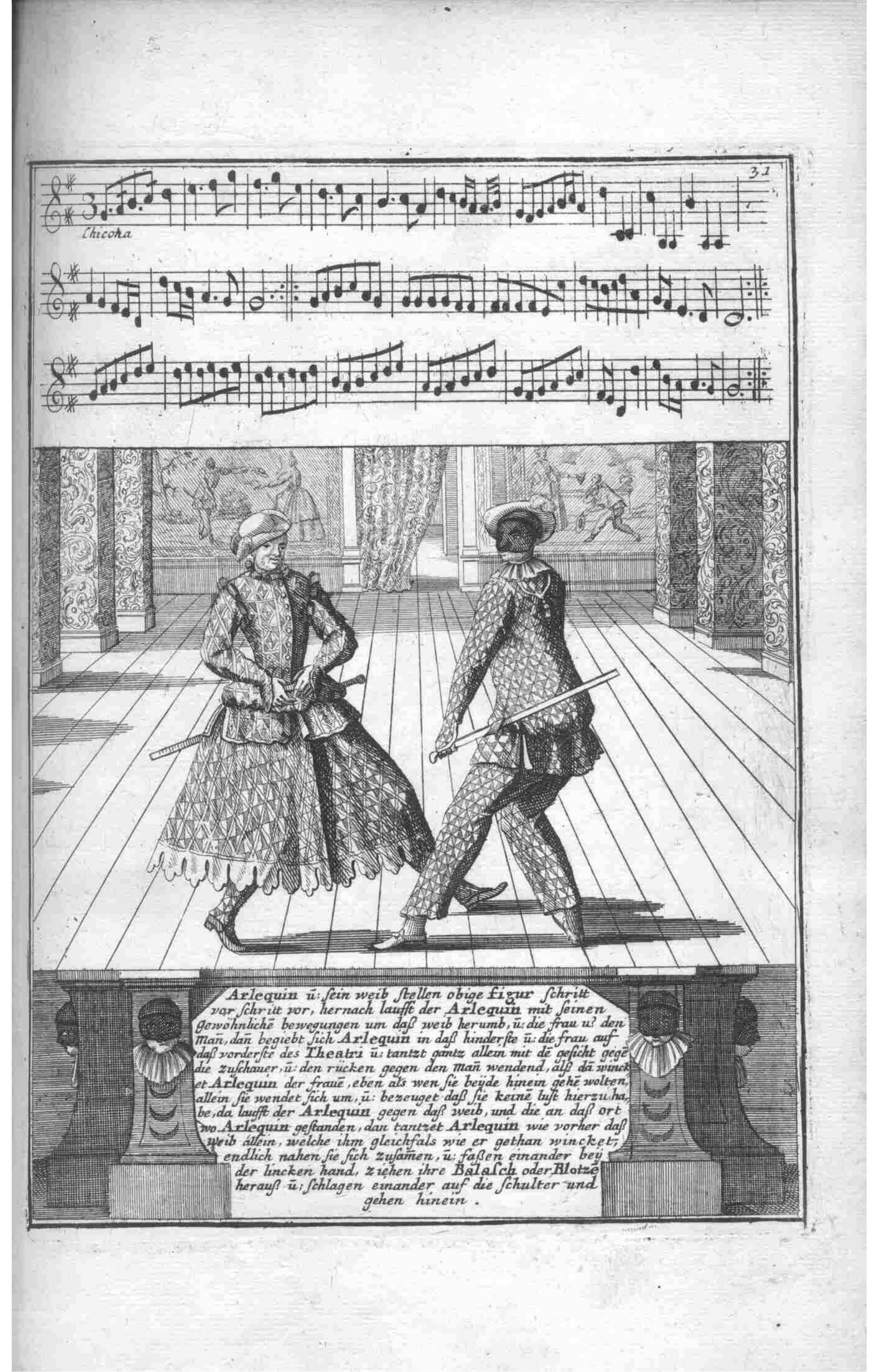
When a noblewoman of the late fifteenth century stepped into a basse danse, she was wearing a small architecture: a kirtle, a stomacher, layered overskirts, a trained gown of brocade or damask, sleeves so heavy they had to be pinned to the bodice. The dance moved at the speed the dress allowed.
Renaissance court dance was a public performance of rank, and clothing carried most of the message. Sumptuary laws across Italy, France, and England restricted velvet, gold thread, and certain dye colors to specific social tiers, so a dancer's silhouette announced status before a single step was taken. The dances that survived this period — the basse danse, pavane, almain, galliard, courante — are slow, processional, and floor-bound precisely because no one could lift a foot quickly inside thirty pounds of clothing.
Men wore the doublet (a tightly fitted padded jacket), trunk hose or paned upper hose, and pointed leather pumps with thin soles. The doublet's stiff peascod belly and shoulder rolls made deep bows the most expressive upper-body gesture available. Women's gowns rested on a farthingale or Spanish hoop, which spread the skirt into a bell or drum and made the legs invisible — a constraint that drove choreography upward into hand carriage, head turns, and the ceremonial exchange of glances.
The galliard is the era's exception: a virtuoso jumping dance with the famous five-step cinque-pas. It was danced with the doublet unbuttoned at court parties, the sword and cloak set aside. Even Elizabeth I was reported to dance six or seven galliards before breakfast, and the period's dance manuals (Arbeau's Orchésographie, 1589; Caroso's Il Ballarino, 1581) describe the leaps as deliberately athletic — a release valve from the rest of the wardrobe.
Signature Garments
- Farthingale / Spanish hoop — Bell-shaped underskirt; legs hidden, choreography moves to hands and head.
- Doublet with peascod belly — Padded torso line; emphasizes the bow as primary courtesy.
- Trunk hose & paned hose — Decorative slashed upper-leg garments; restrict deep knee bend.
- Pumps (thin leather) — Direct floor contact; ancestor of the modern dance shoe.
What it changed on the floor
Floor-bound, processional, upper-body expressive. Speed and elevation are reserved for unbuttoned moments.
1600s – 1700s
Baroque Era
Panniers, towering wigs, and the first truly heeled shoe for men.
Louis XIV's court at Versailles built an entire dance vocabulary around the silhouette of the costume. The minuet, the bourrée, the gavotte — every step in Pierre Rameau's Le Maître à danser (1725) assumes a body that must turn out from the hip because the hip is the only joint the costume permits.
The Sun King, who studied dance daily for over twenty years, established the Académie Royale de Danse in 1661 and codified turnout (en dehors) as the foundation of refined movement. The reason was as much costume as aesthetic: heeled shoes, narrow trunks, and long-skirted justaucorps coats made parallel feet look clumsy. Turnout pushed the leg sideways, making it visible past the coat skirt and creating a longer, more elegant line for the spectator above.
Men's heels in this era reached two to three inches and were often red — a Versailles privilege originally restricted to those granted the king's favor (talons rouges). The men's heel and the women's were nearly identical in height; the modern association of heels with femininity is a nineteenth-century reassignment, not a constant.
Women wore panniers — side-hoops that flattened the skirt front-to-back and extended it laterally, sometimes to a width of two meters at French court. Doorways had to be modified. A pannier-wearing dancer could not pass another woman face-on, which explains the elaborate side-stepping passes (chassés) that thread through Baroque social choreography. The robe à la française with its trailing Watteau back pleats added another two feet of train, requiring the dancer to manage fabric continuously with the left hand while the right held a fan.
Beneath everything, women wore tightly laced stays (the era's term for corsets) that immobilized the rib cage and forced breathing into the shoulders and collarbone. This is why Baroque port de bras — the carriage of the arms — became so refined: it was the only part of the upper body that could move freely.
Signature Garments
- Panniers / side-hoops — Lateral skirt extension; demands chassés and lateral passes.
- Stays (corsetry) — Rigid torso; isolates expression to head, neck, and arms.
- Heeled shoes (men & women) — Forces turnout; foundational to ballet's en dehors.
- Justaucorps — Knee-length men's coat; long skirted body that flares on a turn.
- Powdered wig (perruque) — Constrains head movement; forces a controlled, level carriage.
What it changed on the floor
Turnout becomes the law of the land. Every line — leg, arm, fan — is engineered to be legible past the costume.
1800s
Regency & Victorian
Lighter fabrics enabled the waltz revolution; gloves became required equipment.
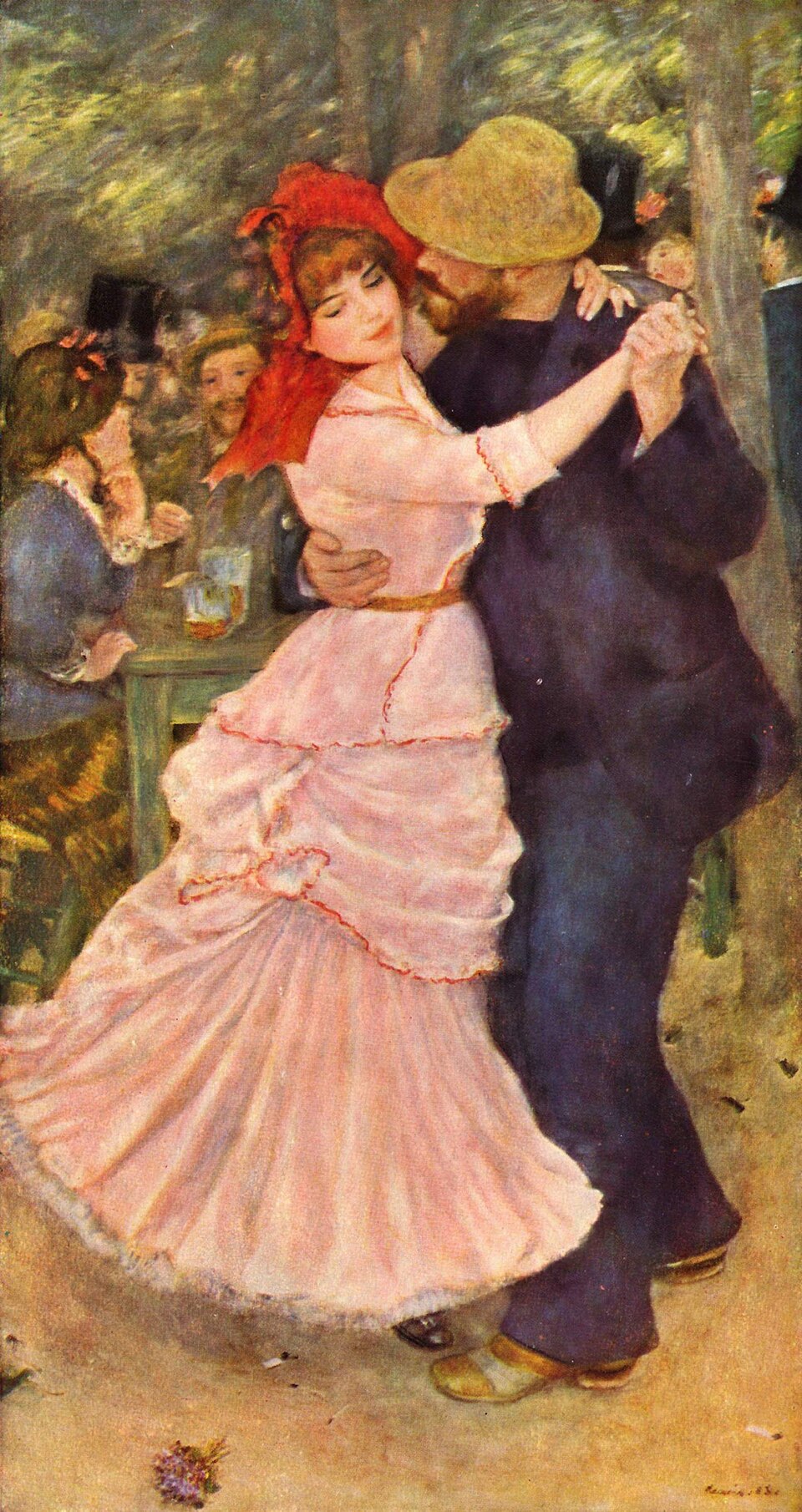
When the waltz arrived in the English ballroom around 1812, it was scandalous for two reasons. First, it placed a man's hand on a woman's waist. Second — and almost as important — it required clothing that allowed both partners to turn, continuously, for an entire piece of music.
The Regency dress (c. 1795 – 1820) was a direct response to the French Revolution's rejection of aristocratic excess. The waist rose to just under the bust, the fabric became sheer muslin or fine cotton, and the panniers vanished. Suddenly a woman could rotate without crashing into anyone, and the closed-position couple dance — the waltz, and later the polka — became mechanically possible. Jane Austen's heroines do not dance the waltz; her contemporaries' daughters did.
Mid-century crinolines (1850s) reintroduced volume but kept it light: a cage of steel hoops or horsehair-stiffened petticoats, much lighter than Baroque panniers, that allowed the wearer to glide. The bustle (1870s – 1880s) shifted volume to the back, freeing the front of the skirt for the long forward step that the new gliding waltz, the schottische, and the polka required. Fabric historians often note that the waltz's footwork lengthened across the century in proportion to how much skirt the choreography had to clear.
Gloves were required equipment in any respectable ballroom. The reason was practical, not decorative: bare hands on a partner's gown left sweat marks on silk. Etiquette manuals — The Ball-Room Guide (1860s), The Dancing Master (Wilson, 1816) — are explicit that a gentleman never asked for a dance with ungloved hands, and a lady kept hers on through every figure. White kid for evening, lighter shades for day, always above the wrist for women, always wrist-length for men.
Men's evening dress rigidified into a near-uniform: black tailcoat, white waistcoat, white bow tie, black trousers with a satin stripe, patent leather pumps. This is the direct ancestor of the modern International Standard tailsuit. Almost every detail — the cutaway tail line, the pointed waistcoat, the wing collar — survives in competition wear with only minor alteration.
Signature Garments
- Empire-waist muslin gown — The clothing change that made the waltz physically possible.
- Crinoline / cage hoop — Light-volume skirt; supports gliding closed-position dance.
- Bustle — Volume to the back; clears the front leg for the long waltz step.
- White kid gloves — Required for both partners; protects fabric and sets social distance.
- Black tailcoat & white waistcoat — Direct ancestor of the modern Standard tailsuit.
What it changed on the floor
Closed-position couple dance becomes possible. Continuous rotation, the long traveling step, and the modern ballroom hold are all born here.
1900 – 1945
Early Twentieth Century
Tango cuts hemlines, bias gowns find the body, and the foxtrot demands a softer shoe.
Between 1910 and 1930 the ballroom changed faster than at any point since the introduction of the waltz. The argentine tango arrived in Paris in 1912, the foxtrot in 1914, and the Charleston in 1923. Each new dance demanded a new garment, and the garments — once invented — outlived the dances that prompted them.
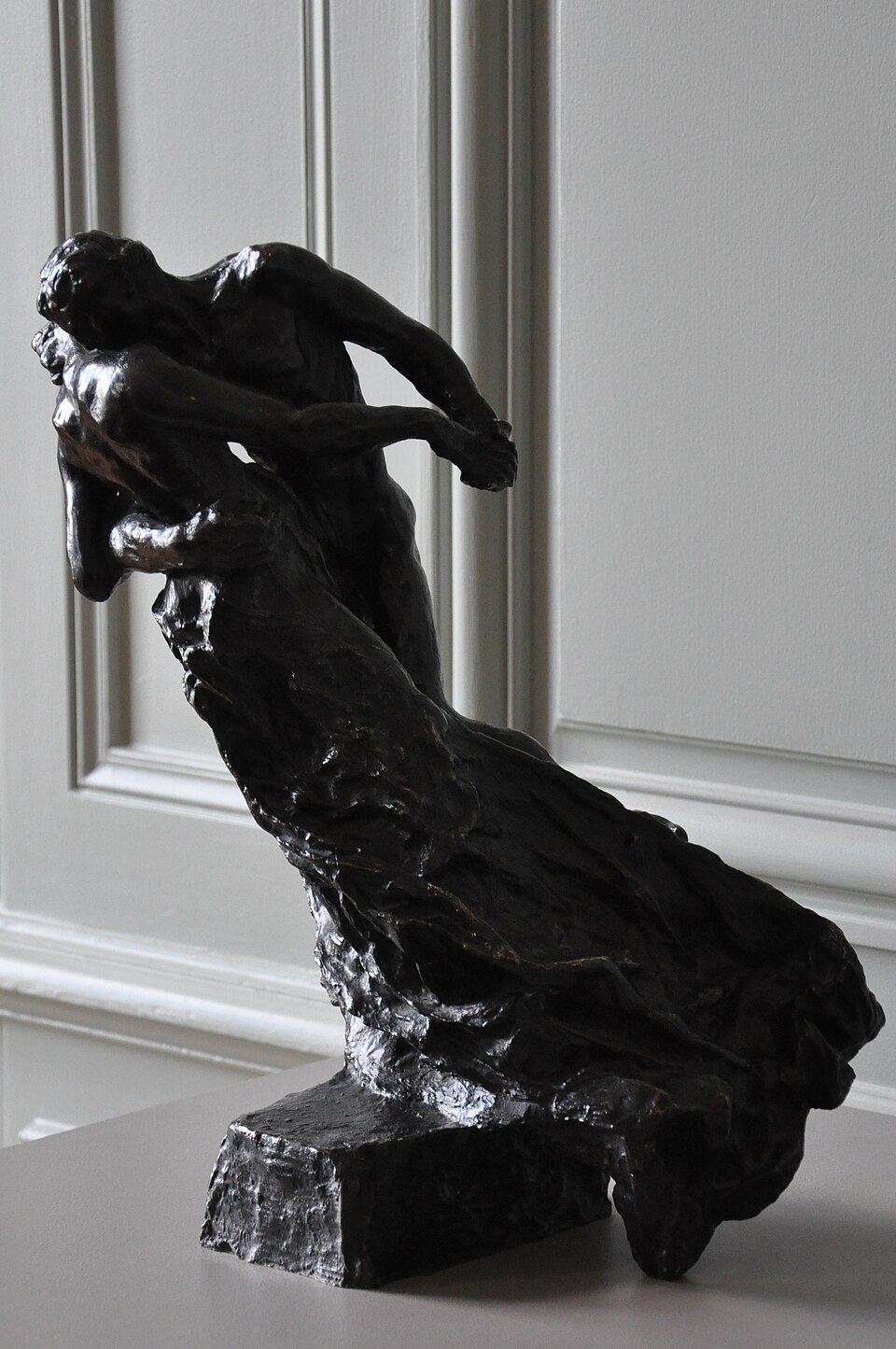
The tango was the first popular dance whose footwork was visible. Couples in the 1910s shortened skirts to mid-calf and then, by 1925, to the knee — partly fashion, partly necessity. The tango's deep walks, ochos, and ganchos require a partner who can see her own feet, and the audience who can see them too. Madeleine Vionnet's bias-cut gowns (1922 onward) were engineered for exactly this: cut diagonally across the grain of the fabric so the gown fell vertically along the body and moved in long fluid sheets when the dancer pivoted. The bias cut is still the foundation of competition ballgowns a century later.
The flapper dress of the 1920s — drop-waist, fringed, knee-length — was a Charleston costume before it was anything else. The fringe was choreography in fabric: every kick, swivel, and Charleston shimmy showed up amplified, four to six inches of motion for every inch the body actually moved. Beaded fringe added weight that helped the fringe trail correctly on the off-beat. The dress made the steps visible to a crowded speakeasy from across the room.
Men's evening dress in this period diverged for the first time. The full white-tie tailcoat remained the formal default and the dance-floor uniform, but the dinner jacket (tuxedo) — invented in the 1880s, popularized in the 1920s — offered a less formal alternative for nightclubs and supper dances. The tailcoat stayed locked to ballroom dance; the tuxedo migrated outward into general formal wear. This is why International Standard competitors today wear tailcoats and not dinner jackets: they are wearing the older, more dance-specific garment.
Shoe construction also shifted. The foxtrot's smooth, slipping footwork required a softer sole than the patent leather pump could provide, and the first dedicated dance shoes — split-sole, suede-bottomed, leather-uppered — appeared in catalogs by the late 1920s. Capezio (founded 1887) and Selva began advertising 'ballroom oxfords' as a distinct product line. Modern dance shoes are a direct evolution of these.
Signature Garments
- Bias-cut gown (Vionnet) — Diagonal weave drape; foundation of every modern ballgown.
- Drop-waist flapper dress — Fringe amplifies Charleston footwork for the audience.
- Tango shoe (T-strap) — Holds the foot during ochos and pivots; survives in modern Latin.
- Tailcoat (formalized) — Locked into ballroom; tuxedo migrates to non-dance formal wear.
- Suede-soled dance oxford — First dedicated dance shoe sole; ancestor of all modern ballroom soles.
What it changed on the floor
Hemlines rise so footwork can be seen. Fabric learns to drape with the body instead of hanging from it.
1950s – present
Competition Era
Rhinestones, stretch fabric, and the formal split between Standard, Smooth, and Latin.
When the Blackpool Dance Festival reopened after World War II and the world championships migrated onto television in the 1950s and 1960s, ballroom costume optimized for one new variable: visibility under stage lighting. Everything since — Swarovski, lycra, AB stones, feather boas — descends from that single requirement.
The introduction of stretch fabrics (lycra, spandex, elastane) in the 1960s let costumes follow the body without restricting it. Latin dresses became short, fitted, and engineered to expose the line of the leg through every action. The Latin man's costume — open or sheer shirt, fitted trousers, often a shaped vest — emphasized the same: every rib cage isolation, every Cuban hip motion, had to read from the back of an arena.
Crystal application became its own craft. A competitive ballgown today carries between 5,000 and 30,000 stones, applied by hand or by hot-fix iron, weighted to flare on a sway and catch light from any angle. The Aurora Borealis (AB) finish, developed by Swarovski with Christian Dior in 1956, is still the most common finish on competition costumes — its iridescent coating is specifically engineered to read on television cameras. The gown's float (the sheer fabric panel suspended between the wrists and the shoulders or back) creates the long flowing line that defines International Standard's silhouette and exists only because it photographs beautifully in slow motion.
The split between International Standard and American Smooth was codified in the United States during the same period. Standard kept the closed hold throughout each dance and the float-equipped gown; Smooth permitted the partners to break apart, which required gowns without floats or wings — the woman's arms have to be free to leave and rejoin the frame. Watch a Smooth dress and you will not see the gauzy panel under the arm; watch a Standard gown and you almost always will.
Men's tailsuits, in contrast, have remained nearly unchanged since 1900. The cutaway front, the pointed waistcoat, the wing collar, the satin-stripe trousers, the patent oxford — every detail comes from the Edwardian dance floor. The only competition-era additions are weighted hems (lead in the tail to hold the line), elasticized waistcoats (the wing-collared shirt is locked to the trouser waistband by elastic loops to prevent ride-up), and slightly longer tails for taller competitors. American Smooth is the exception: the man wears a smooth suit — a tuxedo or formal jacket without tails, because the partner separates and rejoins, and the long tail would tangle. International Standard man wears tails; American Smooth man wears no tails. This is the single most reliable visual cue distinguishing the two styles.
Practice wear separated from competition wear in the same era. A modern dancer in class wears black trousers or a wrap skirt, a fitted top, and either practice shoes (1.5" heel for women, 1" Cuban heel for men) or split-sole sneakers for warm-up. The competition costume is reserved for competition; nobody dances eight hours of class in a thirty-pound gown.
Signature Garments
- International Standard tailsuit — Tailcoat + pointed waistcoat + wing collar + satin-stripe trousers + patent oxford.
- Standard ballgown with float — Sheer panel from wrist to back; defines the Standard silhouette.
- American Smooth suit — Tuxedo-style jacket without tails; tails would tangle when partners separate.
- American Smooth gown (no wings) — No float panel; arms free to leave and rejoin the frame.
- Latin man's open-shirt costume — Sheer or open-front shirt + fitted trouser + optional vest; designed for rib-cage and hip visibility.
- Latin woman's competition dress — Short, fitted, fringed or feathered; engineered to amplify hip and leg action.
- Practice wear — Separate wardrobe; black trousers / wrap skirt + fitted top + dedicated practice shoe.
What it changed on the floor
Costume becomes a stagecraft instrument. Every fabric choice answers the question: what does this look like under arena lighting at 60 frames per second?
Reading the Modern Floor
How to Tell Them Apart
The differences between Standard, Smooth, and Latin costumes are not decorative — they are functional, and once you know what to look for you can identify a genre across an arena from the silhouette alone.
International Standard
Leader
Black tailsuit (tailcoat, pointed white waistcoat, wing collar, satin-stripe trousers, patent oxford).
Follower
Floor-length ballgown with float panels (wings) from wrist to back/shoulder. Heavy crystal work.
American Smooth
Leader
Smooth suit — tuxedo-style jacket without tails. No tailcoat (it would tangle when partners separate).
Follower
Floor-length gown without floats / wings — arms must be free to leave and rejoin the frame.
International Latin
Leader
Fitted trouser, open-front or sheer shirt, optional fitted vest. Latin shoe with Cuban heel.
Follower
Short, fitted competition dress, often with fringe, feathers, or strategic mesh. Latin sandal with flared heel.
American Rhythm
Leader
Similar to Latin — fitted shirt, trouser, Cuban-heel shoe. Slightly less revealing than International Latin in many federations.
Follower
Short or knee-length competition dress; cut tends to be slightly more conservative than International Latin.
Practice / Class
Leader
Black trousers + fitted shirt; practice oxford with 1" Cuban heel.
Follower
Black trousers or wrap skirt + fitted top; practice shoe with 1.5"–2" heel, or split-sole sneaker for warm-up.
Note: leader / follower is the role-neutral framing. Same-gender and reversed-role partnerships compete in many federations under the same costume rules.