Lines of Dance
One line helps everyone share the floor. The other helps dancers create beauty on it.
A Dual Meaning
The Floor Pattern
The Line of Dance (LOD) is the counterclockwise traffic pattern that keeps dancers organized on a crowded floor. When everyone follows the line, couples can travel freely without collisions, competitions run smoothly, and the dance floor becomes a shared space where everyone moves together in harmony.
The Visual Art
Dance lines are the visual shapes and extensions dancers create with their bodies—the sweeping arcs of an arm, the diagonal opposition between partners, the negative space through which movement flows. Lines transform technique into art, making dance visible and beautiful.
Line of Dance 101
Master the traffic pattern
Counterclockwise Flow
The Line of Dance moves counterclockwise around the ballroom floor. Imagine standing at the center looking outward: dancers progress to the left, creating a continuous traffic pattern. This convention is universal—whether you're in a competition in New York, London, or Tokyo, the LOD always flows the same direction.
Why counterclockwise? Tradition established this as the standard over centuries of ballroom dancing. Once established, it became the safe assumption: every experienced dancer knows which way to go without asking.
Dance Floor Zones
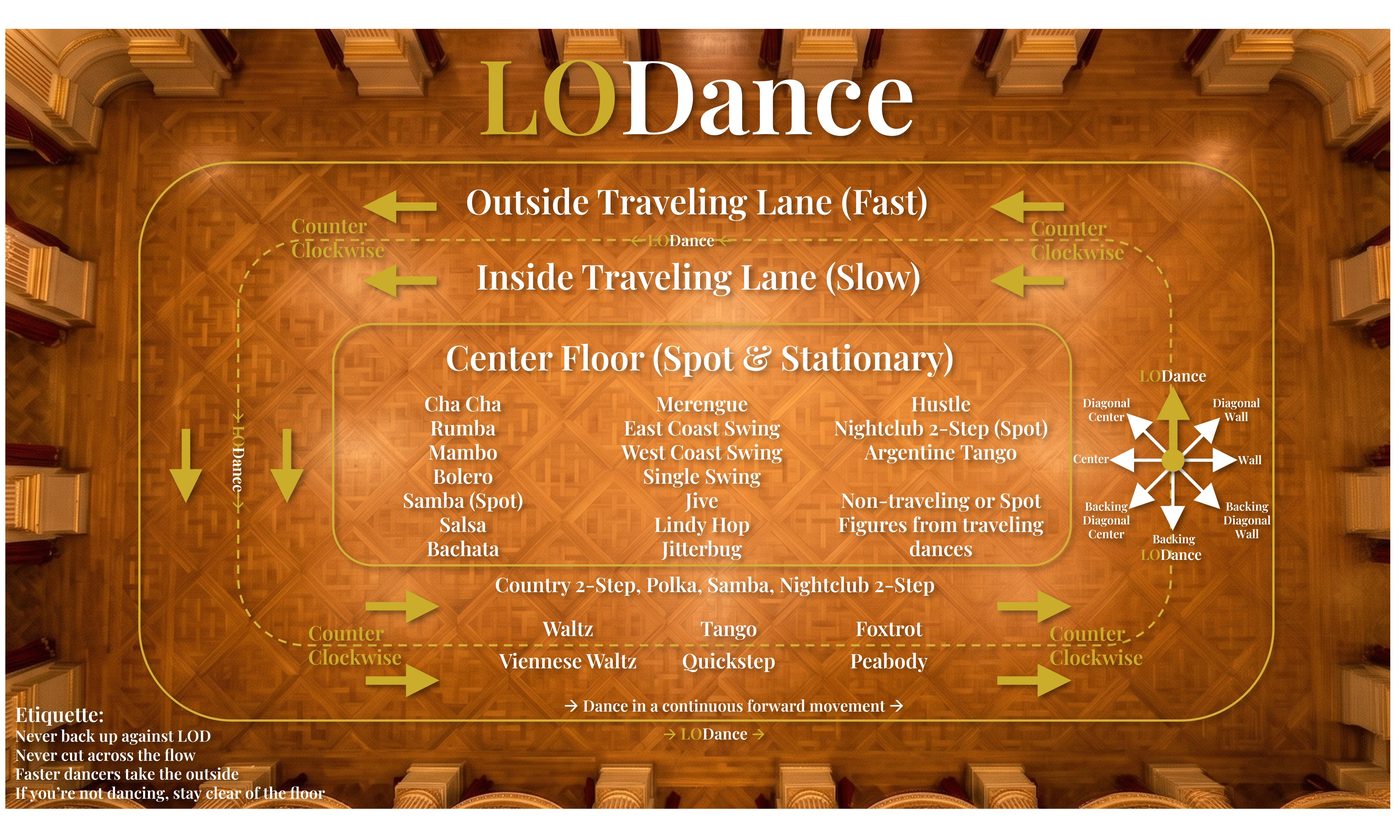
Outside Lane (Traveling Lane)
The outermost edge of the floor where couples progress counterclockwise. This is the highway of the dance floor—couples moving forward through traveling dances (Waltz, Tango, Viennese Waltz, Foxtrot, Quickstep, Peabody, Polka, Country Two-Step, Samba) use this lane to cover ground and pass other couples.
Middle Lane
An intermediate zone between the outside lane and center. Some couples move here for stationary turns or as a transition zone. Traffic is lighter than the outside lane.
Center (Spot Dances)
The heart of the floor where couples dance spot dances (Cha Cha, Rumba, Swing, Bolero, Mambo, Jive, Hustle, West Coast Swing, Argentine Tango). These dances emphasize technique, rotation, and partnering over traveling distance. Couples stay in roughly the same location while executing complex footwork.
Corners
Strategic places to navigate. Corners can be tight, especially in competitions. Skilled floorcraft means knowing how to enter and exit corners without collision, and how to adjust your LOD progression when turning.
Floorcraft Basics
The etiquette of shared space
Common Mistakes to Avoid
Going Against Traffic
Progressing clockwise or moving forward while facing the center. This puts you directly in the path of dancers following LOD, causing collisions and disruption.
Stopping in the Lane
Executing a long, stationary pattern in the traveling lane forces couples behind you to slow down or swerve. Stay aware of traffic flow; if you need time for a complex figure, shift toward the center or corner.
Backing Blindly
The follower is responsible for maintaining awareness of traffic while backing. Communicate with your partner, and never back into someone.
Crowding the Corners
Corners are transition zones. Don't linger here. Adjust your speed and spacing so that traffic moves smoothly through these tight spots.
Spot Dances vs Traveling Dances
Traveling Dances
Waltz, Tango, Viennese Waltz, Foxtrot, Quickstep, Peabody, Polka, Country Two-Step, Samba (and sometimes Nightclub Two-Step) — progress around the floor following LOD. These dances feature forward and side movement that covers ground. Dancers change partners by moving to the next couple in line.
Spot Dances
Cha Cha, Rumba, Swing, Bolero, Mambo, Jive, Hustle, West Coast Swing, Argentine Tango — rotate in place or travel minimally. These dances prioritize technique, frame, rotation, and partnering. Couples occupy roughly the same floor space throughout.
Entry and Exit Etiquette
- •Entering the floor: Enter at a corner or the side. Never cut across the center or into the traveling lane while couples are moving.
- •Finding your place: Latch onto the end of the line of couples. Don't try to insert yourself in the middle.
- •Exiting: Exit smoothly at a natural break (between dances) at a corner or side.
- •Pace awareness: Match the speed of traffic. If you're much faster than others, you'll catch up and create a pile-up. Adjust your technique to fit the flow.
Dance Lines as Visual Art
Creating beauty through body lines
While the Line of Dance organizes traffic, dance lines are how movement becomes art. Every extension, every curve of the arm, every moment of opposition between partners creates visual shapes that the audience reads as beauty.
Types of Lines
Stretch Lines
Extensions through the entire body from the foot through the crown of the head. Think of lengthening through the spine, creating an unbroken line of energy. Common in Standard dances where elongation is prized.
Curve Lines
Flowing, rounded shapes created by arm placement and body sway. Waltz and Foxtrot use sweeping curves to create elegance and flow. Latin dances create sharp, controlled curves for energy.
Diagonal Lines
Movement along the diagonal of the body or the floor. Opposition (one side of the partnership moving forward while the other side moves back) creates dynamic diagonal lines.
Negative Space
The empty space created through the couple's frame. How partners use the space between them tells a story of connection, tension, and artistry.
Opposition
When one side of the body moves forward while the other stays back. This creates dynamic contrast and visual interest.
Connection Lines
The visual shape created between partners through frame. Strong frame creates a clear line that reads as partnership; loose frame loses definition.
How Lines Differ by Style
Different dance styles emphasize lines differently:
- •Standard (Waltz, Tango, Viennese Waltz, Foxtrot, Quickstep): Long, sweeping lines. Rise and fall create flow. Extensions emphasize elegance and reach.
- •Latin (Cha Cha, Samba, Rumba, Paso Doble, Jive): Compact, sharp lines with emphasis on hip motion and isolation. Lines are staccato rather than continuous.
- •Tango: Dramatic, angular lines. Staccato movement alternates with smooth walks. Lines convey emotional intensity.
- •Swing: Bouncy, playful lines with quick changes. Frame is loose and flexible, creating dynamic visual shapes.
Lines by Dance Style
Waltz
Standard
Rise and fall creates sweeping, elongated lines. Graceful arm extensions emphasize elegance and floating quality.
Foxtrot
Standard
Smooth, continuous lines with feather and reverse wave figures creating long horizontal lines of travel.
Quickstep
Standard
Bouncy, sharp lines created by staccato footwork. Lines are more angular than Waltz, reflecting quicker rhythm.
Tango
Standard
Dramatic staccato alternating with smooth walks. Promenade creates strong directional lines. Intensity and angularity throughout.
Rumba
Latin
Hip-driven undulation creates flowing curves. Cuban motion generates continuous, sensual lines. Close frame emphasizes connection.
Cha Cha
Latin
Sharp, staccato hip action creates compact lines. Quick weight changes prevent long extensions. Playful and rhythmic.
Samba
Latin
Bouncy, continuous hip motion creates fast-moving lines. Limited arm extension; focus on lower body isolation.
Jive
Latin
Quick, springy lines with bouncy movement. Swinging action creates loose, flexible shapes. Playful and energetic.
Key Takeaways
- •The Line of Dance is a shared traffic pattern—counterclockwise—that keeps everyone safe and organized on the floor.
- •Dance lines are the visual extensions, curves, and shapes dancers create—the art that makes dance beautiful to watch.
- •Floorcraft means respecting shared space: knowing your zones, reading traffic, and adjusting your pace and movement to flow with others.
- •Every dance style emphasizes different lines—Standard values elongation, Latin values isolation, Tango values intensity. Understanding this helps you develop technique appropriate to each dance.
- •Great dancers master both: they follow the floor's traffic pattern while creating beautiful visual lines that captivate audiences.