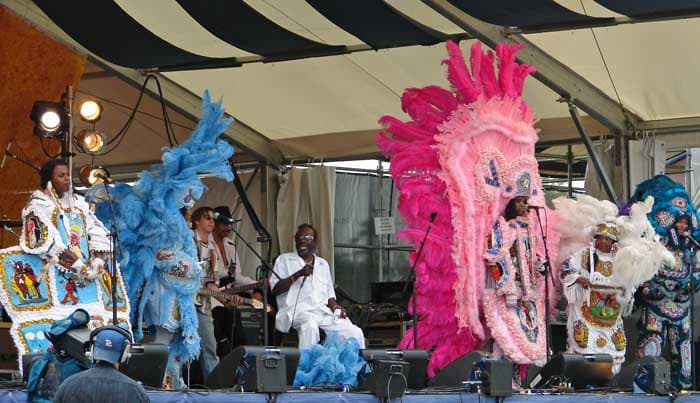
Bo Dollis
Legend of Dance
Why They Matter
Dollis matters to dance because he makes visible a cultural form in which movement cannot be isolated from sound, dress, route, encounter and social organization. Under his leadership the Wild Magnolias helped redirect inter-group competition toward artistry and display, while recordings and…
Known For
Watch
Handa Wanda
Bo Dollis - Topic
An exact rightsholder-distributed audio page documents the signature chant/recording central to Dollis’s public musical legacy.
Indian Red — Bo Dollis
Useful for hearing another core repertoire item in Dollis’s recorded catalog, but movement application requires cultural context and manual listening.
Biography
Theodore Emile "Bo" Dollis was born in New Orleans in 1944 and grew up in Central City, where he entered the participatory world of Black Masking as a teenager. He first masked in 1957 with the Golden Arrows after learning repertoire around the White Eagles, discovering a cultural form in which singing, percussion, movement, neighborhood identity and the making of a new beaded suit were inseparable. In 1964 Dollis became Big Chief of the Wild Magnolias, named for Magnolia Street. The title joined artistic leadership to community responsibility: a Big Chief led chants and encounters, organized the group and embodied its visual identity through a hand-sewn suit. Dollis became known for the force of his singing and for increasingly elaborate bead-and-feather work worn on Mardi Gras and St. Joseph's Day.
The Wild Magnolias' 1970 recording of "Handa Wanda," made with Big Chief Monk Boudreaux and musicians around keyboardist Willie Tee, helped carry an actual masking group's repertoire into commercial circulation. That same year Dollis and Boudreaux appeared at the inaugural New Orleans Jazz & Heritage Festival. The collaboration joined street-rooted call-and-response and percussion to amplified New Orleans funk and rhythm-and-blues, expanding the audience without replacing the underlying community practice.
Albums including *The Wild Magnolias* (1974) and *They Call Us Wild* (1975) followed, with collaborators including Willie Tee, Snooks Eaglin and other New Orleans musicians. The group performed nationally and internationally, reaching Carnegie Hall, the Smithsonian Folklife Festival and stages in Europe. Dollis's rasping lead voice and the ensemble's layered percussion gave the recorded work a sonic force suited to dancing, while the live presentation retained the spatial authority of a chief and a responsive gang.
After Hurricane Katrina devastated the neighborhood, Dollis opened Handa Wanda's as a place for tribal members to gather, sew, chant and practice. In 2011 the National Endowment for the Arts named him a National Heritage Fellow, the federal government's highest honor in folk and traditional arts. Declining health limited Dollis's later performance, and his son Gerard "Bo" Dollis Jr. increasingly carried the Wild Magnolias' leadership and music forward. Dollis died in New Orleans on January 20, 2015, six days after his seventy-first birthday.
Career Highlights
Dollis masked for the first time, with the Golden Arrows, after learning repertoire around the White Eagles. National Endowment for the Arts National Endowment for the Arts
He became Big Chief of the Wild Magnolias. National Endowment for the Arts National Endowment for the Arts
The Wild Magnolias recorded “Handa Wanda,” bringing an actual masking Indian group’s call-and-response performance into commercial recording. My Spilt Milk My Spilt Milk
Dollis and Big Chief Monk Boudreaux appeared at the inaugural New Orleans Jazz & Heritage Festival. National Endowment for the Arts National Endowment for the Arts
The Wild Magnolias released their self-titled album, merging Mardi Gras Indian music with New Orleans funk and rhythm-and-blues. National Endowment for the Arts National Endowment for the Arts
The group released They Call Us Wild, another album cited by the NEA as seminal to Dollis’s recorded legacy. National Endowment for the Arts National Endowment for the Arts
The Wild Magnolias continued international touring and recording, carrying the tradition to European stages as well as major U.S. institutions. National Endowment for the Arts National Endowment for the Arts
Dollis opened Handa Wanda’s in the Katrina-damaged uptown/mid-city area as a gathering, sewing and practice space. National Endowment for the Arts National Endowment for the Arts
He received an NEA National Heritage Fellowship for artistic mastery and lifetime contribution to traditional arts. National Endowment for the Arts National Endowment for the Arts
Dollis died in New Orleans at age 71. family obituary family obituary
Gallery
Legacy & Impact
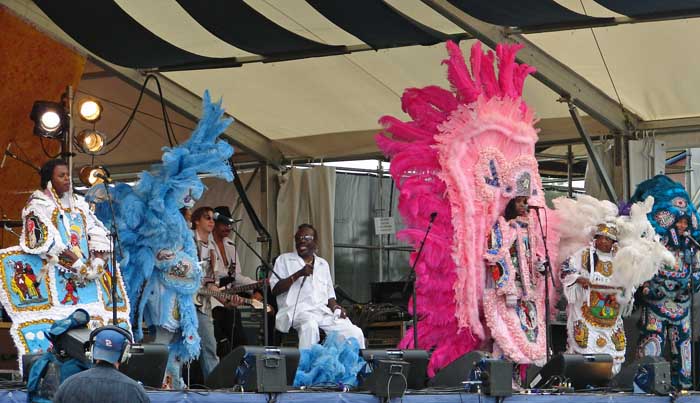
Bo Dollis matters to dancers and culture bearers because he makes visible a form in which movement cannot be isolated from sound, dress, route, encounter and social organization. Under his leadership the Wild Magnolias helped direct inter-group competition toward artistry and display, while recordings and touring allowed wider audiences to hear and move to the tradition's polyrhythmic call-and-response. His legacy belongs first to New Orleans's Black Masking community and continues through family, tribe, practice spaces and the annual labor of making and masking.
Explore More Legends
Discover the dancers, teachers, choreographers, and cultural icons who shaped how the world moves.
Keep the thread going
Dance history, technique, and the occasional rabbit hole — in your inbox. Thoughtful, infrequent, unsubscribe anytime.
Free. No spam. One click to leave.