Brian Mac Farlane
Legend of Dance
Why They Matter
Mac Farlane matters to dance because Carnival mas is kinetic art: a design succeeds through bodies walking, dancing, turning, balancing, and collectively transforming the street. His work renews the “theatre of the streets” tradition by joining historical research, social argument, handcrafted…
Known For
Biography
Brian Mac Farlane is a leading Trinidad and Tobago mas designer and bandleader whose costumes and themed bands transform Carnival into large-scale street theatre. Born in Trinidad and Tobago in 1957, Mac Farlane grew up in the Port of Spain area and entered mas production as a teenager through work with designer Raoul Garib, learning the craft by working rather than through formal training. Designer Christopher Santos was another early influence on his development.
Mac Farlane's breakthrough came in 1994 when Anthony Paul portrayed *The Conquest—The Slaying of Medusa*, a monumental costume design that won King of Carnival and Best Designer honors. This achievement established him in the King-and-Queen arena, where a costume must function as both sculptural form and a moving extension of its masquerader. In 2000, he designed Rosalind Gabriel's junior-queen costume *Exodus: The Power and the Glory*, a structure whose visual configuration changed as the performer moved—an unusually direct fusion of costume design and choreography.
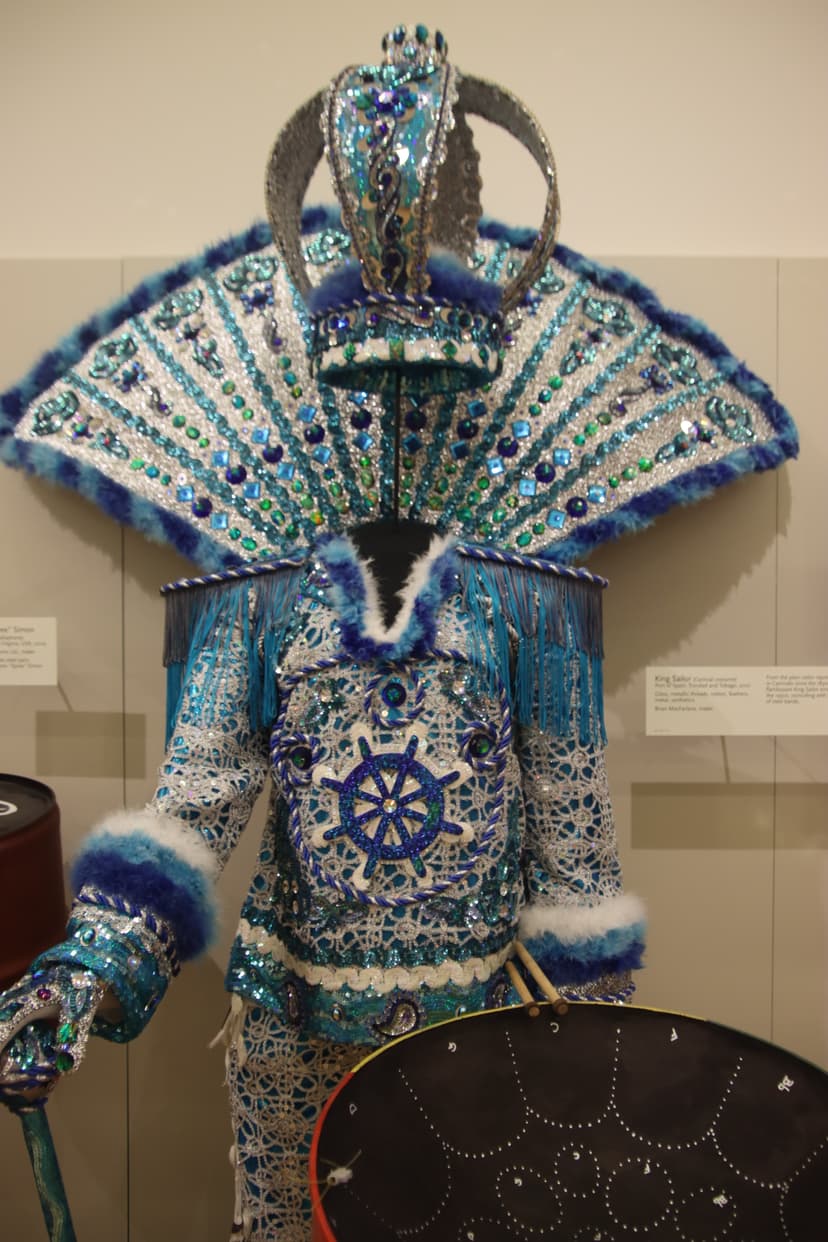
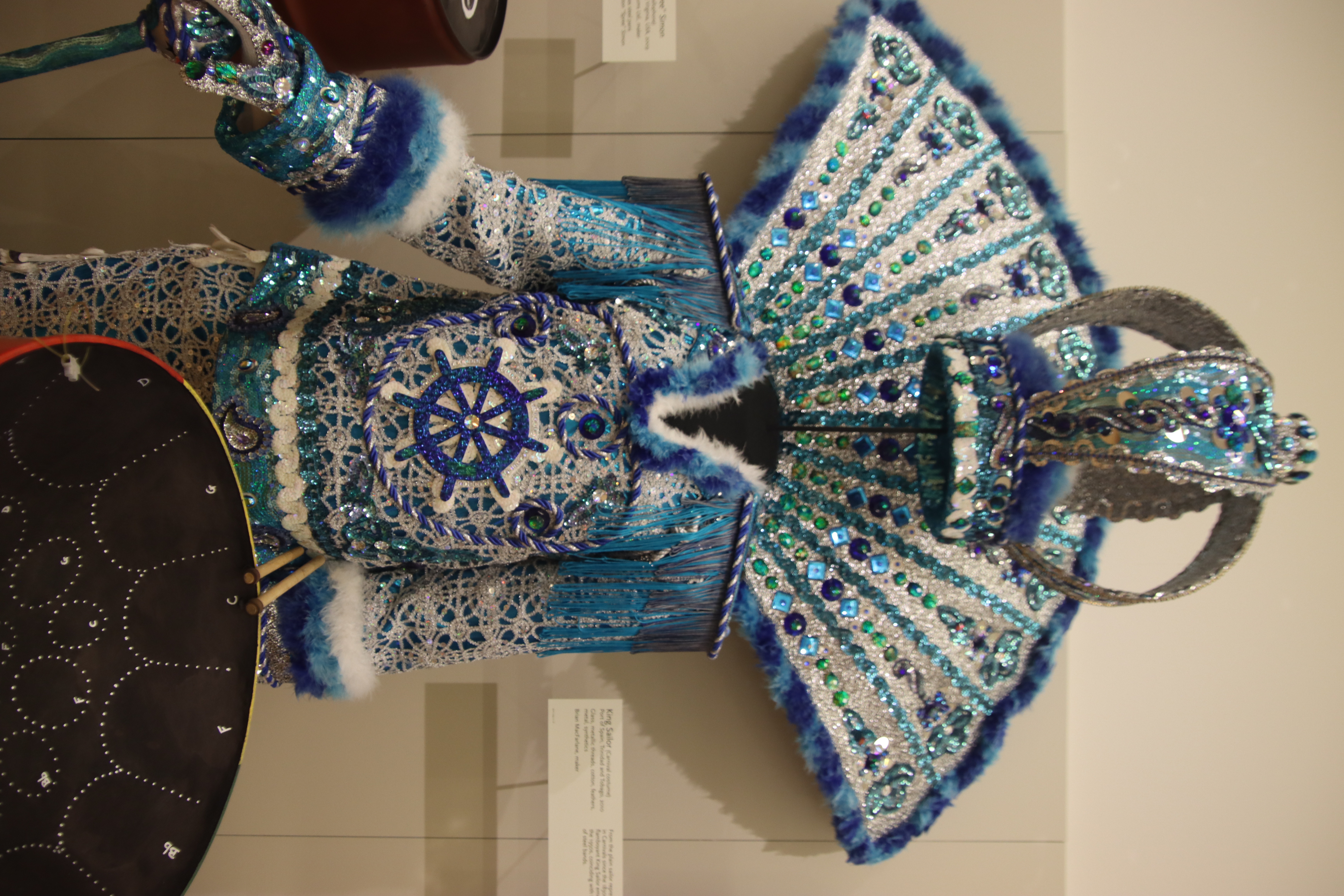
In 2005, Mac Farlane launched his first full band, *The Washing by Fire, by Water*, winning the medium-band title. Subsequent presentations—*India: The Story of Boyie* and the environmentally themed *Earth: Cries of Despair, Wings of Hope*—placed narrative, social commentary, hand fabrication, and theatre at the center of Carnival mas. His bands are built for collective performance: sections of masqueraders carry color, material, character, and rhythm through the streets, while Kings and Queens animate towering structures. A 2010 *King Sailor* costume now documented at the Musical Instrument Museum demonstrates how glass, metal, textiles, feathers, and synthetics create volume that fully reads around a moving body.
Trinidad and Tobago awarded Mac Farlane the Chaconia Medal Gold in 2010, recognizing his contributions to national culture. His work has extended beyond annual band production to state ceremonies, international cultural presentation, and theatre. After stepping away from annual band production, he returned for a special 2017 presentation centered on Trinidad and Tobago's built heritage, demonstrating how he uses mas to stage national memory.
Career Highlights
Entered mas-making as a teenager through work with bandleader and designer Raoul Garib. official biography
Won King of Carnival and Best Designer with Anthony Paul's portrayal The Conquest—The Slaying of Medusa. TriniGourmet profile
Designed Rosalind Gabriel's junior-queen portrayal Exodus: The Power and the Glory, widely reported as sweeping its entered competitions. TriniGourmet profile
Launched his first full band, The Washing by Fire, by Water, and won the medium Band of the Year category. TriniGourmet profile
Presented India: The Story of Boyie, an East Indian-themed large band that won major Carnival judging points. TriniGourmet profile
Presented Earth: Cries of Despair, Wings of Hope, using mas to address environmental damage. TriniGourmet profile
Created the King Sailor costume documented by the Musical Instrument Museum. (Wikimedia Commons/MIM record_-_MIM_PHX_(2022-04-06_03.01.28_by_Terry_Ballard).jpg)) Wikimedia Commons/MIM record
Received Trinidad and Tobago's Chaconia Medal Gold. official biography
Contributed cultural-presentation work connected with London's Cultural Olympiad and appeared in an international profile of Trinidadian creativity. First Forum interview
Returned from a band hiatus with a presentation honoring Trinidad and Tobago's built heritage. Trinidad and Tobago Guardian
Legacy & Impact
Mac Farlane matters to dancers because Carnival mas is kinetic art: a design succeeds through bodies walking, dancing, turning, balancing, and collectively transforming the street. His work renews the tradition of street theatre by joining historical research, social argument, handcrafted material, music, and mass choreography. He demonstrates that bandleaders and makers who shape what bodies wear and how a band moves are essential dance authors, even when their primary credential is design rather than dancer training.
Explore More Legends
Discover the dancers, teachers, choreographers, and cultural icons who shaped how the world moves.
Keep the thread going
Dance history, technique, and the occasional rabbit hole — in your inbox. Thoughtful, infrequent, unsubscribe anytime.
Free. No spam. One click to leave.