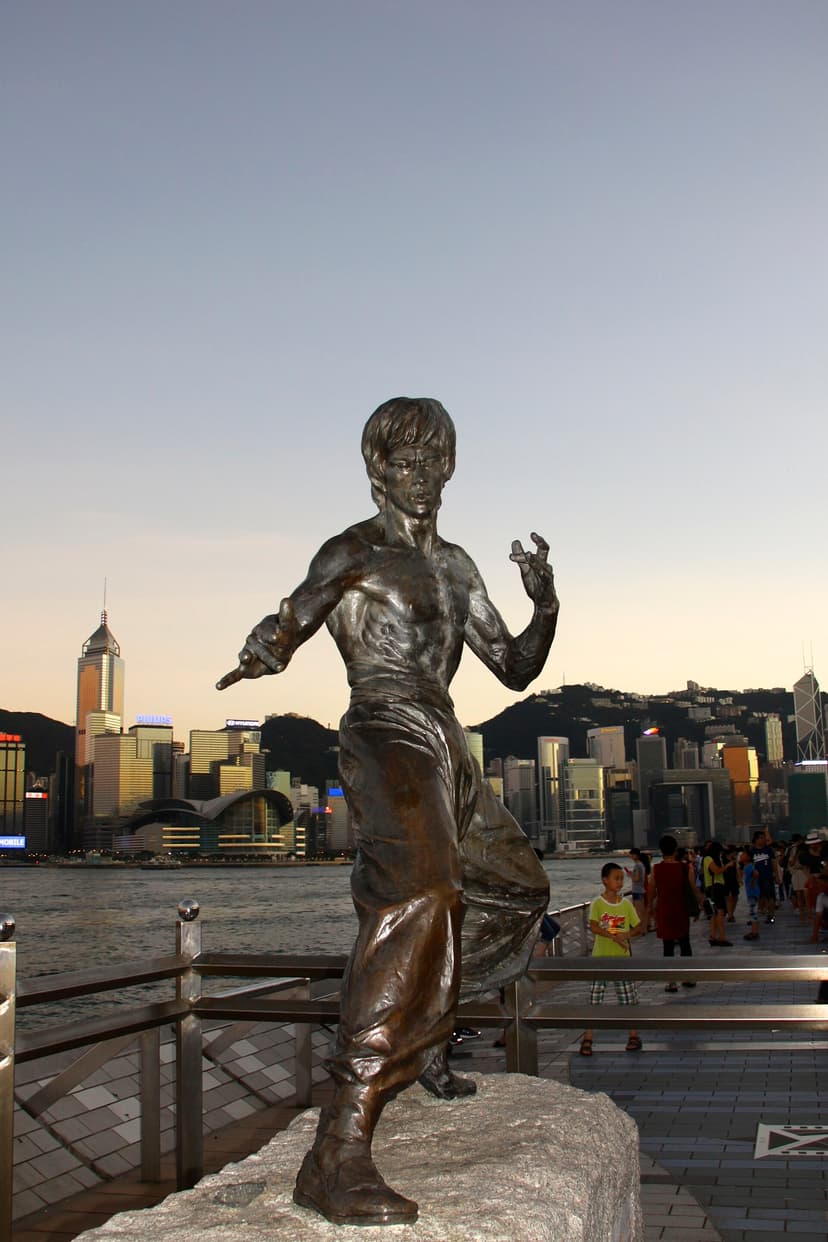
Bruce Lee
Legend of Dance
Why They Matter
Lee matters to movement history because he joined practical inquiry to performance intelligence. He challenged rigid stylistic boundaries, treated rhythm and distance as variables, and understood that movement for a camera must be legible as well as fast. His films widened the international…
Known For
Biography
Bruce Jun Fan Lee was born on 27 November 1940 at Jackson Street Hospital in San Francisco while his father, the Cantonese opera performer Lee Hoi-chuen, was touring the United States. The family returned to Hong Kong during Lee's infancy, and because of his father's entertainment connections, Lee appeared on screen as a child and became an experienced performer well before his adult martial-arts films made him internationally famous.
As a teenager in Hong Kong, Lee studied Wing Chun within Ip Man's circle and also encountered other practices, including Western boxing. This mixed background shaped his habit of comparing techniques across distance, timing and resistance, retaining what he found useful. Lee returned to the United States in 1959 and settled in Seattle, where he studied and began teaching the approach he called Jun Fan Gung Fu. He later opened or helped establish schools in Seattle, Oakland and Los Angeles, building a teaching community that included important collaborators and students.
A demonstration at the 1964 Long Beach International Karate Championships helped bring Lee to the attention of television producers. He was cast as Kato in *The Green Hornet* (1966–67), a supporting role whose compact, fast screen movement made an impact beyond the program's short run. His practice continued to change during these years, and he used "Jeet Kune Do" for an approach organized around interception, adaptability and personal expression rather than loyalty to a fixed catalogue of forms.
Frustrated by limited Hollywood opportunities, Lee returned to Hong Kong and became the lead in *The Big Boss* (1971) and *Fist of Fury* (1972). In *The Way of the Dragon* (1972), he expanded his authorship by writing, directing, starring and designing the action. His final completed starring film, the Hong Kong–Hollywood co-production *Enter the Dragon*, was released after his death on 20 July 1973 in Hong Kong, aged 32. The short span of his adult film career contrasts with the scale of his afterlife in martial arts, cinema, popular culture and Asian American representation.
Career Highlights
Born on 27 November at Jackson Street Hospital in San Francisco while his family was in the United States. Official Bruce Lee site
Returned with his family to Hong Kong, where he grew up and began appearing in films. Hong Kong museums portal
Returned to the United States and established himself in Seattle. Bruce Lee Foundation
Demonstrated at the Long Beach International Karate Championships, an appearance that helped lead to screen opportunities. Bruce Lee Foundation
Began appearing as Kato in the television series The Green Hornet. Official Bruce Lee site
Developed and taught the evolving approach he named Jeet Kune Do, emphasizing interception and adaptation rather than a closed style. Bruce Lee Foundation
Starred in The Big Boss, beginning the Hong Kong feature-film run that established him as a leading martial-arts screen performer. Hong Kong Heritage Museum
Starred in Fist of Fury. Hong Kong Heritage Museum
Wrote, directed and starred in The Way of the Dragon, including its climactic fight with Chuck Norris. Bruce Lee Foundation
Completed his starring work on Enter the Dragon, a Hong Kong–Hollywood co-production released posthumously. Bruce Lee Foundation
Died in Hong Kong on 20 July at age 32. Bruce Lee Foundation
Gallery
Legacy & Impact
Lee matters to movement history because he joined practical inquiry to performance intelligence. He challenged rigid stylistic boundaries and understood that movement for a camera must be legible as well as fast. His films widened the international audience for Chinese martial arts, while his insistence on self-expression gave later performers a vocabulary for discussing form without treating tradition as immovable. His economical technique—compressed preparation, mobile guard, weight available for quick changes—and his use of rhythm and interception as performance tools establish him as a bridge among martial practice, acting, choreography and cinematic rhythm.
Explore More Legends
Discover the dancers, teachers, choreographers, and cultural icons who shaped how the world moves.
Keep the thread going
Dance history, technique, and the occasional rabbit hole — in your inbox. Thoughtful, infrequent, unsubscribe anytime.
Free. No spam. One click to leave.