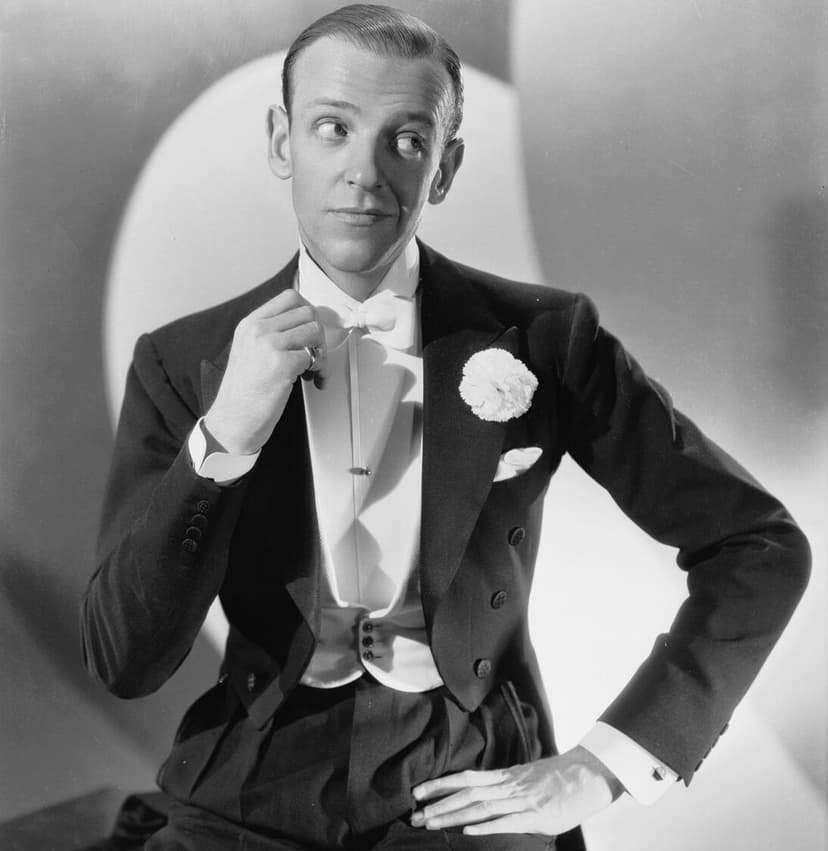
Performer · Film / Screen Icon · Partnership Icon
Fred Astaire
Hollywood Dance Icon
“The higher up you go, the more mistakes you are allowed. Right at the top, if you make enough of them, it's considered to be your style.”
Why They Matter
He transformed how dance was presented on screen and became one of the most recognizable dance icons of the 20th century.
Known For
Styles Fred Astaire shaped
Each one links to the style’s own page — its origins, music, tempo and video.
Watch
Fred Astaire & Ginger Rogers — Swing Time (1936)
Astaire and Rogers in one of their most celebrated routines, a seamless blend of ballroom elegance and cinematic choreography that defined their partnership.
Fred Astaire — Puttin' On the Ritz (Blue Skies, 1946)
Astaire's legendary solo, multiplied through split-screen into a chorus of dancing Astaires — a showcase of his musicality, precision, and showmanship.
Biography
Fred Astaire was born Frederick Austerlitz in Omaha, Nebraska in 1899. He began performing in vaudeville alongside his sister Adele as a child, and the pair became Broadway sensations in the 1920s. When Adele retired to marry in 1932, Fred transitioned to Hollywood, where he would redefine what dance could be on screen.
Astaire's partnership with Ginger Rogers at RKO produced ten films between 1933 and 1949, creating a new standard for cinematic dance. He insisted that dance numbers be filmed in full-body shots with minimal editing, allowing audiences to appreciate the choreography in its entirety. His perfectionism was legendary: he would rehearse routines hundreds of times until they appeared completely effortless.
Beyond his work with Rogers, Astaire continued innovating throughout the 1940s and 1950s, partnering with dancers like Rita Hayworth, Cyd Charisse, and Audrey Hepburn. He incorporated props, special effects, and novel camera techniques into his numbers, including the famous ceiling dance in Royal Wedding (1951).
Astaire's influence extends far beyond his era. His insistence on integrating dance into storytelling, his impeccable musicality, and his blend of tap, ballroom, and jazz created a template that film choreographers still reference today. He received an Honorary Academy Award in 1950 for his contributions to film.
Career Highlights
Broadway debut with sister Adele in Over the Top
First film with Ginger Rogers, Flying Down to Rio
Top Hat becomes a massive box office hit
Easter Parade with Judy Garland
Honorary Academy Award for contributions to film
Ceiling dance in Royal Wedding showcases technical innovation
Fred Astaire on screen
Films and television featuring Fred Astaire, with the sequences we have indexed.
 Top Hat (1935)8 sequences indexedOpening-credit feet and cane chorus · chor. Fred Astaire (uncredited); Hermes PanNo Strings (I'm Fancy Free) · 00:08:18 · chor. Fred Astaire (uncredited); Hermes PanTop Hat, White Tie and Tails · 00:40:52 · chor. Fred Astaire (uncredited); Hermes Pan
 The Gay Divorcee (1934)4 sequences indexedThe Continental · chor. Dave GouldA Needle in a Haystack · 00:17:47 · chor. Hermes Pan (dance director)Don't Let It Bother You
 Swing Time (1936)3 sequences indexedPick Yourself Up lesson and reveal · 00:22:48 · chor. Hermes Pan (dance director)Pick Yourself Up lesson · chor. Hermes Pan (dance direction; Fred Astaire collaborated)Bojangles of Harlem · 01:12:43 · chor. Hermes Pan (dance director)
 The Band Wagon (1953)2 sequences indexedShine on Your Shoes · chor. Michael KiddBy Myself · 00:06:17 · chor. Michael Kidd
Poster artwork from TMDB.
 This site uses TMDB and the TMDB APIs but is not endorsed, certified, or otherwise approved by TMDB.
Legacy & Impact
Fred Astaire established dance as a serious art form in Hollywood cinema. His insistence on full-body shots, minimal cuts, and narrative integration of dance numbers created standards that persist in film choreography. He demonstrated that elegance, musicality, and technical precision could captivate mass audiences, and his influence reaches from classic Hollywood through modern music videos and beyond.


Explore More Legends
Discover the dancers, teachers, choreographers, and cultural icons who shaped how the world moves.
Keep the thread going
Dance history, technique, and the occasional rabbit hole — in your inbox. Thoughtful, infrequent, unsubscribe anytime.
Free. No spam. One click to leave.