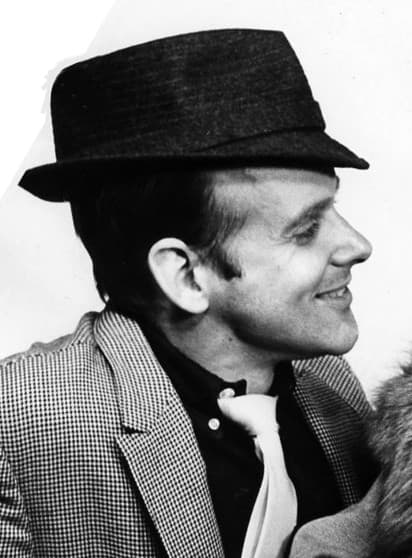
Choreographer · Innovator · Film / Screen Icon · Stage Icon
Bob Fosse
Master of Stylized Movement
“Live like you'll die tomorrow, work like you don't need the money, and dance like nobody's watching.”
Why They Matter
His style is instantly recognizable and permanently influenced Broadway, film, and music video choreography.
Known For
Watch
Bob Fosse — Rich Man's Frug (Sweet Charity, 1969)
Fosse's signature style — turned-in knees, rolled shoulders, angular isolations — distilled into one of his most iconic film sequences.
Biography
Bob Fosse was born in Chicago in 1927 and began performing in burlesque shows as a teenager. His early exposure to vaudeville, strip clubs, and nightclub acts gave him a vocabulary of movement that was seductive, dark, and theatrical, far removed from the sunny athleticism of Hollywood dance.
Fosse developed one of the most instantly recognizable choreographic styles in history: turned-in knees, rolled shoulders, isolated hip movements, jazz hands, bowler hats, and white gloves became his signatures. His style emerged partly from necessity, as he used hats and gloves to disguise his own thinning hair and thick hands, transforming limitations into iconic aesthetic choices.
His Broadway works include Sweet Charity (1966), Pippin (1972), Chicago (1975), and Dancin' (1978). In film, he directed and choreographed Cabaret (1972), which won eight Academy Awards, and the autobiographical All That Jazz (1979). In 1973, he became the only person to win an Oscar, Emmy, and Tony in the same year.
Fosse's influence on popular culture is immeasurable. His style directly inspired Michael Jackson's movements, Madonna's choreography, and virtually every music video that uses isolated, angular, or seductive movement. The 1996 revival of Chicago and the 2002 film adaptation introduced his aesthetic to new generations.
Career Highlights
First Broadway choreography credit, The Pajama Game
Sweet Charity brings his style to Broadway stardom
Cabaret wins 8 Academy Awards including Best Director
Wins Oscar, Emmy, and Tony in the same year
Chicago premieres on Broadway
All That Jazz, autobiographical film masterwork
Works
One stage work credited to Bob Fosse.
- Dancin' (1978)Musical theatre · Choreographer
Credits sourced from Wikidata (CC0), one citation per field. Works without a recorded premiere date are listed last. Titles link to the work in Limelight.
Bob Fosse on screen
Films and television featuring Bob Fosse, with the sequences we have indexed.
 Cabaret (1972)6 sequences indexedWillkommen · 00:02:20 · chor. Bob FosseMein Herr · 00:11:27 · chor. Bob FosseMoney · 00:57:12 · chor. Bob Fosse
 All That Jazz (1979)5 sequences indexedBye Bye Life finale · chor. Bob FosseTake Off With Us / Air-otica rehearsal · chor. Bob FosseEverything Old Is New Again · chor. Bob Fosse
 Fosse/Verdon (2019)5 sequences indexedBig Spender filming and on-set correction · chor. Andy Blankenbuehler (series reconstruction); Bob Fosse (original choreography)Mein Herr Kit Kat Klub recreation · chor. Andy Blankenbuehler (series reconstruction); Bob Fosse (original choreography)Whatever Lola Wants rehearsal · chor. Andy Blankenbuehler (series choreography); Bob Fosse and Gwen Verdon (dramatized creative process)
Poster artwork from TMDB.
 This site uses TMDB and the TMDB APIs but is not endorsed, certified, or otherwise approved by TMDB.
Legacy & Impact
Bob Fosse created a complete choreographic language that influenced Broadway, film, television, and music video for decades after his death. His dark, sensual, witty style proved that dance could be psychologically complex and culturally subversive. His work continues to be performed, revived, and referenced throughout popular culture, making him arguably the most influential theatrical choreographer of the 20th century.


Explore More Legends
Discover the dancers, teachers, choreographers, and cultural icons who shaped how the world moves.
Keep the thread going
Dance history, technique, and the occasional rabbit hole — in your inbox. Thoughtful, infrequent, unsubscribe anytime.
Free. No spam. One click to leave.