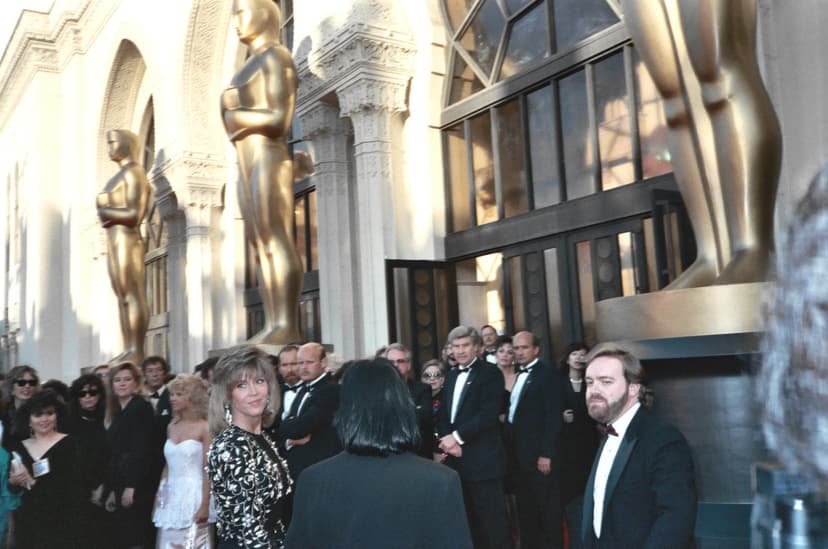
Jane Fonda
Legend of Dance
Why They Matter
Fonda made screen-mediated movement instruction culturally ordinary. Her videos helped turn the television into a repeatable class space, widened access for people exercising at home, and gave rhythmic follow-along choreography a commercial infrastructure. Her celebrity accelerated that change, but…
Known For
Biography
Jane Seymour Fonda was born in New York City on 21 December 1937 and became one of the most visible figures to bring choreographed aerobic movement into American homes. Her acting career—marked by Academy Awards for Best Actress for *Klute* (1972) and *Coming Home* (1979)—gave her an unusual platform when she entered the fitness industry. That celebrity reach proved decisive: when she released *Jane Fonda's Workout* on 24 April 1982, she did so with millions of viewers already familiar with her face and voice.
The workout grew from classes at the Workout studio in Beverly Hills, where she trained with instructor Leni Cazden. Fonda's *Workout Book* had appeared the year before, but the video format proved transformative. The program combined spoken instruction, rhythmic music, floor conditioning, and standing aerobic sequences—all designed for repetition in a home setting. The original tape became a landmark in the emerging home-video market and an emblem of 1980s women's aerobic exercise.
What followed was a sustained franchise. According to her official biography and the California Museum, Fonda produced 23 home-exercise videos, 13 audio programs, and five books, with approximately 16 million combined sales. The format itself—direct address, demonstrators in unison, clear counts, graded repetition—would become a durable template for fitness media. The early routines combined jazz-inflected arm lines and presentation with calisthenics, stretching, and floor work, optimized for home viewers to follow without individual correction.
Later in her career, Fonda adapted her instruction for older adults, returning to age-appropriate fitness around 2010 and continuing to frame movement as a tool for strength and independence. In 2022, she publicly discussed maintaining the same kinds of activity at reduced speed, emphasizing mobility across the life course rather than appearance alone. Her fitness legacy therefore spans both the high-energy aesthetics of 1980s aerobics and a later message about sustainable movement with aging.
Fonda remained active in film, television, writing, and activism throughout her life. For dance history, her specific significance lies not in inventing aerobics—a practice with its own longer lineage—but in mediating it through celebrity and mass media. She helped make follow-along screen choreography a commercial form and ordinary domestic practice.
Career Highlights
Fonda’s early feature-film career began with Tall Story, launching the public platform that later amplified her fitness work. Source Source
She won the Academy Award for Best Actress for Klute. Source Source
She won a second Best Actress Oscar for Coming Home. Source Source
Jane Fonda’s Workout Book established the publishing foundation for her exercise franchise. Source Source
Jane Fonda’s Workout was released on 24 April, carrying her studio routine into the home-video market. Source Source
She produced a large series eventually totaling 23 home exercise videos, plus audio programs and books. Source Source
The California Museum inducted Fonda into the California Hall of Fame and highlighted her impact on the fitness industry. Source Source
She released programs aimed at older adults, extending her exercise work toward age-adapted strength and mobility. Source Source
The American Film Institute honored her with its Life Achievement Award. Source Source
Fonda publicly revisited the workout’s forty-year legacy and described adapting her own training with age. Source Source
Legacy & Impact
Fonda transformed fitness instruction into a repeatable media experience. Her videos helped make the television into a class space, widened access for people exercising at home, and established a format—direct address, demonstrated movement, musical phrasing, graded repetition—that remains foundational to fitness broadcasting. Though she did not invent aerobics, she accelerated its cultural reach through the home-video market and created infrastructure that made choreographed movement instruction a durable commercial and cultural form.
Explore More Legends
Discover the dancers, teachers, choreographers, and cultural icons who shaped how the world moves.
Keep the thread going
Dance history, technique, and the occasional rabbit hole — in your inbox. Thoughtful, infrequent, unsubscribe anytime.
Free. No spam. One click to leave.