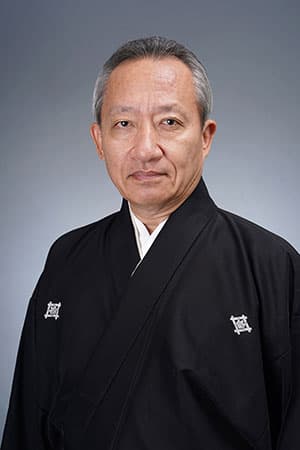
Kanjuro Kiritake Iii
Legend of Dance
Why They Matter
Kanjūrō matters to dance and movement history because Bunraku makes expressive motion a visibly collective achievement. His career demonstrates how a dramatic body can be distributed across three operators, coordinated with a narrator and shamisen player, yet perceived as one character. His breadth…
Known For
Watch
BUNRAKU 1st SESSION (English version)
National Theatre, Tokyo / Japan Arts Council
Official English-language National Theatre material introduces Bunraku through a session supervised by Kanjuro and gives international readers a reliable visual orientation.
BUNRAKU 1st SESSION | Kiritake Kanjuro interview
National Theatre, Tokyo / Japan Arts Council
Centers Kanjuro's own explanation in the National Theatre program he supervised and supports the biography and movement-analysis sections.
Biography
Kanjūrō Kiritake III is a leading contemporary Bunraku puppeteer and 2021 holder of the Important Intangible Cultural Property designation for "Ningyō Jōruri Bunraku Puppetry." Born Toyomi Miyanaga on March 1, 1953, in Osaka City, he is the son of Kanjūrō Kiritake II, a distinguished puppeteer who later became a Living National Treasure. Rather than inheriting a position, the younger Miyanaga entered the Bunraku Association through apprenticeship. In July 1967, at fourteen, he joined the puppet department and studied under Yoshida Minosuke III, taking the professional name Yoshida Minotarō.
He became a Bunraku Association performer in April 1968, making his documented debut as a water carrier in the *Akoya kotozeme* scene of *Dan-no-ura Kabuto Gunki* at Osaka's Mainichi Hall. Like all Bunraku puppeteers, he advanced through coordinated positions—foot operator, left-hand operator—before assuming the main role of *omozukai*, which controls the puppet's head and right hand. This progression taught him to respond physically to fellow operators' intentions before leading the ensemble himself.
His artistic education crossed two lineages. Yoshida Minosuke was celebrated for female roles (*onnagata*), while Kanjūrō II was associated with forceful male roles (*tachiyaku*). Kanjūrō III learned female work from his master and male work from his father, developing unusual range rather than specializing in a single character type. Through the 1970s and 1990s he accumulated honors including the Minister of Education's Art Encouragement New Artist Prize in 1995 and a Matsuo Performing Arts Award in 1999.
In April 2003 he succeeded to his father's stage name as Kanjūrō Kiritake III, performing Takechi Mitsuhide in the Amagasaki scene of *Ehon Taikōki* at the National Bunraku Theatre in Osaka. A name-succession performance followed at the National Theatre in Tokyo in May. The succession was a public responsibility to carry a recognized artistic name, not a change in his birth identity.
National honors accelerated. In 2008 he received the Minister's Art Encouragement Prize, a National Theatre Bunraku Grand Prize and the Medal with Purple Ribbon. The Japan Art Academy Prize followed in 2010. Alongside performance of repertory roles, Kanjūrō has led workshops, taught younger practitioners, participated in overseas tours and produced new works, treating transmission as central to the puppeteer's role.
In 2021 the Japanese government recognized him as an individual holder of the Important Intangible Cultural Property for Ningyō Jōruri Bunraku Puppetry, citing his command of traditional techniques and his capacity to portray a wide range of male and female characters. He continued performing major roles—including Hayano Kanpei in *Kanadehon Chūshingura* at the National Bunraku Theatre in November 2024—and became a member of the Japan Art Academy in March 2025.
Career Highlights
Entered the Bunraku Association's puppet department at fourteen, apprenticed to Yoshida Minosuke III and adopted the name Yoshida Minotarō. Bunraku Association Bunraku Association
Became a Bunraku Association performer and made his documented debut in Dan-no-ura Kabuto Gunki at Osaka's Mainichi Hall. Bunraku Association Bunraku Association
Received the Art Encouragement New Artist Prize from the Minister of Education. Bunraku Association Bunraku Association
Received the 20th Matsuo Performing Arts Award for excellence. Bunraku Association Bunraku Association
Succeeded to the name Kanjūrō Kiritake III, with formal performances as Takechi Mitsuhide in Osaka and Tokyo. Bunraku Association Bunraku Association
Received the Minister's Art Encouragement Prize, a National Theatre Bunraku Grand Prize and the Medal with Purple Ribbon. Bunraku Association Bunraku Association
Received the 66th Japan Art Academy Prize. Bunraku Association Bunraku Association
Published Naniwa no Hana: Bunraku e no Izanai—Ningyōzukai Kiritake Kanjūrō, an introduction to Bunraku and his craft. Bunraku Association Bunraku Association
Received the 57th Mainichi Art Award in the theatre/traditional-dance/entertainment category. Bunraku Association Bunraku Association
Received a Traditional Culture Pola Prize for excellence. Pola Foundation Pola Foundation
Was recognized as an individual holder of the Important Intangible Cultural Property “Ningyō Jōruri Bunraku Puppetry.” Agency for Cultural Affairs Agency for Cultural Affairs
Became a member of the Japan Art Academy. Bunraku Association Bunraku Association
Legacy & Impact
Kanjūrō Kiritake III matters to movement practice because Bunraku makes expressive motion a visibly collective achievement. His career demonstrates how a dramatic body can be distributed across three operators, coordinated with a narrator and shamisen player, yet perceived as one character. His breadth across male and female roles, his command of repertory, and his sustained teaching and outreach connect a long apprenticeship system to contemporary audiences. His work shows how rigorous choreography of breath, weight, timing and multi-operator coordination can produce nuanced dramatic expression without amplification or spectacle.
Explore More Legends
Discover the dancers, teachers, choreographers, and cultural icons who shaped how the world moves.
Keep the thread going
Dance history, technique, and the occasional rabbit hole — in your inbox. Thoughtful, infrequent, unsubscribe anytime.
Free. No spam. One click to leave.