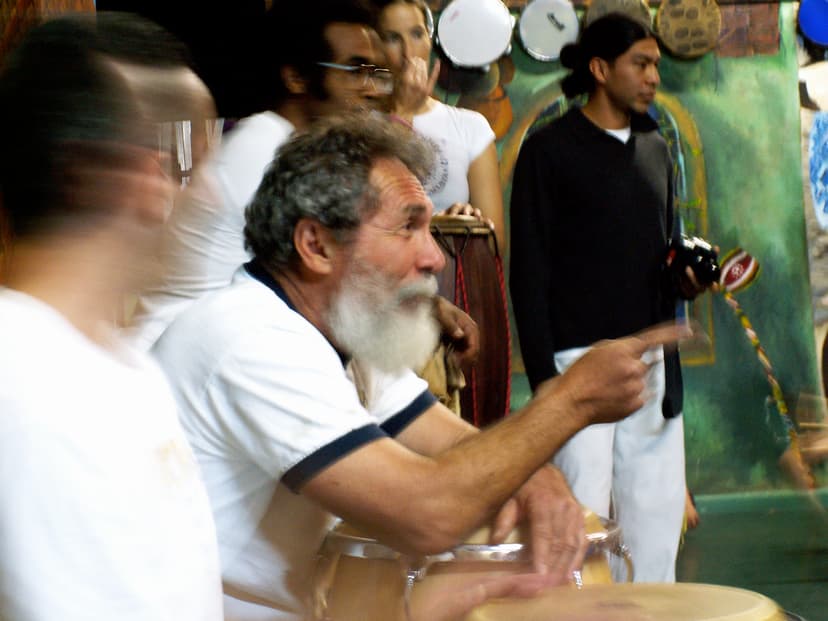
Mestre Acordeon
Legend of Dance
Why They Matter
Mestre Acordeon matters to dance history because his career demonstrates that capoeira’s movement cannot be separated from musical command, call-and-response, lineage, game structure and community teaching. His work in Brazil and the United States joined stage presentation, classroom transmission…
Known For
Watch
Capoeira Chat with Mestre Acordeon
Capoeira Arts Foundation
First-party organizational context for his practice and teaching
Mestre Acordeon 80 Years
Capoeira Arts Foundation and Ecos de Santo Amaro
Officially produced retrospective marking his eightieth year
Un Grito de Liberdade
Smithsonian Folkways Recordings / YouTube Music
Connects the movement page to an institutionally cataloged recording from his Folkways album
Biography
Ubirajara Guimarães Almeida, known as Mestre Acordeon, was born in 1943 in Salvador, Bahia, Brazil. He trained at Mestre Bimba's capoeira school, graduating as a certified mestre. In the early 1960s, Almeida began teaching in Brazil and founded Grupo Folclórico da Bahia, which developed the stage work *Vem Camará: Histórias de Capoeira* in 1966. These performances were groundbreaking because they presented capoeira within a theatrical frame while preserving its game, song, percussion and social exchange as central elements. By most accounts, Almeida won three Brazilian national capoeira championships during the 1970s.
Around 1978, Mestre Acordeon moved to the United States and established a sustained teaching presence on the West Coast. His work became known through multiple channels: in 1984, he appeared on the cover of *Inside Kung-Fu* magazine, marking a significant moment in capoeira's visibility in America. The following year, Folkways Records released *Music of Brazil: Music of Capoeira*, documenting his singing, berimbau playing and ensemble leadership. This recording remains available through Smithsonian Folkways and stands as an institutional record of his musical artistry.
Almeida's teaching extended into universities and public cultural institutions. He served as a performing artist and visiting professor at the University of Wisconsin–Madison during the 1994–95 academic year. In 2008, Berkeley proclaimed October 18 "Mestre Acordeon Day" in recognition of his contributions to the community. At seventy years old in 2013, he undertook the Berkeley-to-Bahia B2B Joga Capoeira bicycle journey, a roughly 14,000-mile route designed to support and document capoeira community work. His organizational work has continued through the Capoeira Arts Foundation, which has documented his legacy and ongoing teaching and community programming.
Career Highlights
Born in Salvador, Bahia, Brazil.
Graduated from Mestre Bimba’s capoeira school, according to The Sun’s author biography.
Founded Grupo Folclórico da Bahia and developed the stage work Vem Camará: Histórias de Capoeira, according to the consulted biographical record.
Won three Brazilian national capoeira championships; the institutional oral history does not identify every event or date.
Began sustained teaching on the United States’ West Coast, according to the consulted secondary biography.
Appeared on the October cover of Inside Kung-Fu, a milestone highlighted by the Capoeira Arts Foundation.
Folkways Records released Music of Brazil: Music of Capoeira (FW04332 / FE 4332).
Served as a Tinker Visiting Professor/performing artist at the University of Wisconsin–Madison for the 1994–95 academic year.
October 18 was proclaimed “Mestre Acordeon Day” in Berkeley, according to the cited biographical record.
Began the B2B Joga Capoeira bicycle journey from Berkeley toward Salvador at age seventy.
The Capoeira Arts Foundation published an official film celebrating his eightieth year.
Gallery
Legacy & Impact
Mestre Acordeon shaped how international audiences understand capoeira by insisting that movement, music, lineage and game structure are inseparable. His work in Brazil and on the United States West Coast—through stage production, classroom teaching, recordings, writing and community organization—presented capoeira as an Afro-Brazilian cultural practice with martial, musical, theatrical and social dimensions. Rather than isolating movement as choreography or technique, he modeled an integrated approach that remains central to how contemporary capoeira mestres and students engage with the form's full context.
Explore More Legends
Discover the dancers, teachers, choreographers, and cultural icons who shaped how the world moves.
Keep the thread going
Dance history, technique, and the occasional rabbit hole — in your inbox. Thoughtful, infrequent, unsubscribe anytime.
Free. No spam. One click to leave.