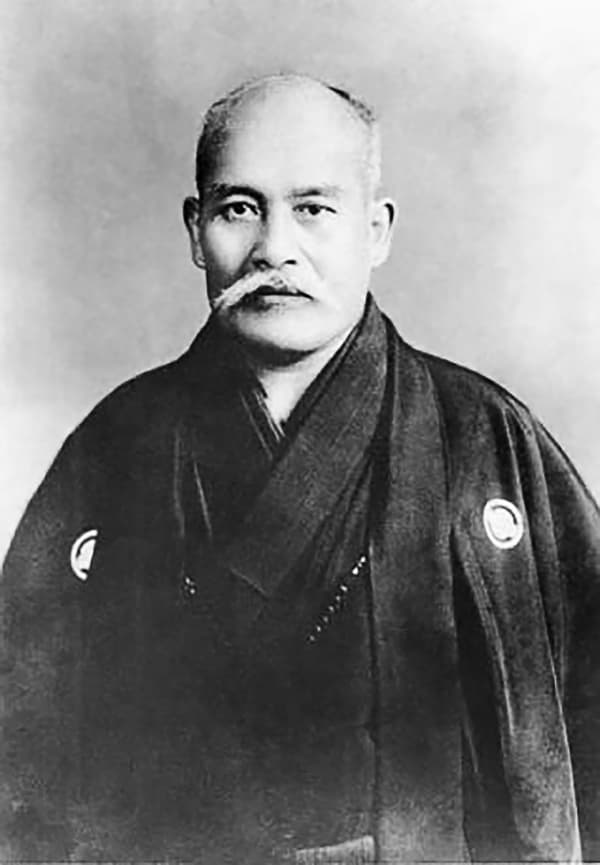
Morihei Ueshiba
Legend of Dance
Why They Matter
Ueshiba matters to movement history because aikido made combat-derived partner study into a repeatable practice of attention, distance, timing, redirection, balance loss and safe recovery. Its vocabulary has traveled through martial arts, actor and dancer training, somatic education and…
Known For
Biography
Morihei Ueshiba (植芝盛平) was born on 14 December 1883 in Nishitani Village, Nishimuro District, Wakayama Prefecture, in what is now Motomachi, Tanabe. His early life combined farming, local civic activity and physical training; he served in the Japanese military during the Russo-Japanese War. From the late 1890s, he undertook sustained study of traditional martial arts, building a physical foundation that would shape his later work.
In 1912, Ueshiba led a group of settlers to Shirataki in Hokkaido. There he met Sokaku Takeda and began intensive study of Daito-ryu jujutsu. In 1922, Takeda granted him a teaching certification—a connection central to aikido's documented technical lineage. That same year, Ueshiba articulated "Aiki" as a martial essence. His development was not a single revelation but a gradual synthesis of martial training, lived experience and deepening practice.
In 1919, Ueshiba encountered Onisaburo Deguchi, a leader of the Omoto religious movement, and settled at its center in Ayabe. He opened the Ueshiba-juku dojo in 1920, combining martial instruction with farming and spiritual practice. In 1924, he joined Deguchi's expedition to Mongolia—an episode well documented in travel and return, though later accounts contain visionary claims that belong to testimony rather than verified history.
Ueshiba relocated to Tokyo in 1927, making the city the center of his teaching. The purpose-built Kobukan Dojo opened in 1931 in present-day Wakamatsu-cho, Shinjuku, and his circle expanded among prominent civilian and military students. In 1942, he adopted "aikido" as the art's official name and transferred headquarters direction to his son Kisshomaru Ueshiba. The Kobukai Foundation received legal recognition in 1940, and the Aikikai Foundation was officially recognized in 1948.
In the early 1940s, Ueshiba established his base at Iwama. He established the Aiki Shrine in 1943 and opened an adjacent dojo in 1945, where he farmed, trained and developed his teaching through this period. He received Japan's Medal with Purple Ribbon in 1960 and the Order of the Rising Sun, Gold Rays with Rosette, in 1964. Ueshiba died on 26 April 1969, aged 86. Memorial services were held in Tokyo, Iwama and Tanabe, with his remains buried at Kozan-ji Temple in Tanabe. Kisshomaru Ueshiba succeeded him as Doshu. The international spread of aikido that followed was shaped not only by its founder but also by his family, his students and multiple organizations whose interpretations continue to diverge.
Career Highlights
Born on 14 December in present-day Tanabe, Wakayama Prefecture. Source Source
Led a settler group from Wakayama to Shirataki in Hokkaido. Source Source
Began documented Daito-ryu study with Sokaku Takeda in Hokkaido. Source Source
Opened the Ueshiba-juku training dojo at Ayabe. Source Source
Received a Daito-ryu teaching certification from Takeda; the Aikikai chronology also dates Ueshiba's explicit articulation of “Aiki” as a martial essence to this year. Sources 2 Sources
Moved with his family to Tokyo and made the city the center of his teaching. Source Source
Established the Kobukan Dojo in present-day Wakamatsu-cho, Shinjuku. Source Source
Adopted “aikido” as the art's name and transferred headquarters direction to Kisshomaru Ueshiba. Source Source
Established the Aiki Shrine at Iwama; the adjacent Ibaraki dojo followed in 1945. Source Source
Aikikai Foundation received official recognition from the Ministry of Health and Welfare. Source Source
Received Japan's Medal with Purple Ribbon; in 1964 he received the Order of the Rising Sun, Gold Rays with Rosette. Source Source
Died on 26 April; Kisshomaru Ueshiba succeeded as Doshu. Source Source
Gallery
Legacy & Impact
Ueshiba transformed documented Daito-ryu study, religious practice and decades of teaching into aikido—a system of relational timing, redirection, balance disruption and controlled falling that became globally influential. Aikido's vocabulary of paired movement, spatial listening and dynamic recovery has travelled through martial arts, actor and dancer training, and somatic education. Its value lies in what it reveals about weight, intention, contact and the continuous reorganization of balance between partners. The practice remains plural: the Aikikai, other lineages and individual teachers transmit different expressions of what aikido became across Ueshiba's lifetime and continues to be.
Explore More Legends
Discover the dancers, teachers, choreographers, and cultural icons who shaped how the world moves.
Keep the thread going
Dance history, technique, and the occasional rabbit hole — in your inbox. Thoughtful, infrequent, unsubscribe anytime.
Free. No spam. One click to leave.