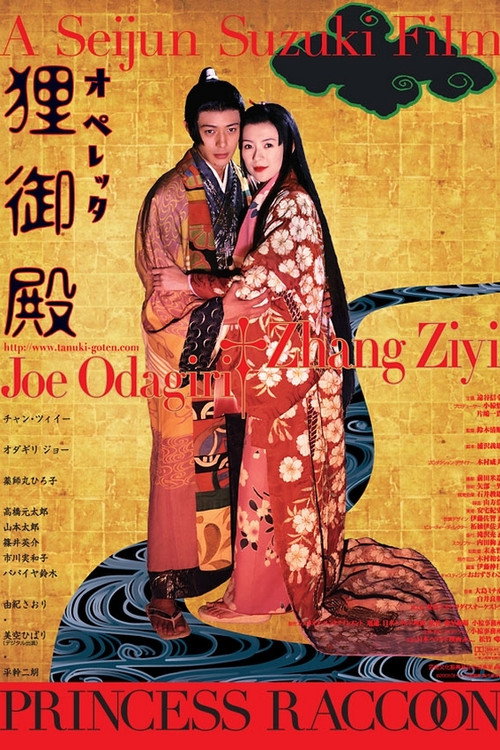
Dance in Film · 2005
Princess Raccoon (2005)
Seijun Suzuki turns a tanuki folktale into a dance-bearing screen operetta, placing Zhang Ziyi and Joe Odagiri inside Kabuki-derived spectacle that repeatedly collides with tap, breaking, hip-hop, and rap.
Princess Raccoon is a 2005 dance feature film centred on ballroom and social dance. For dancers, it's a chance to see the style performed on screen — the phrasing, partnering, and musicality that the same dances carry onto a real floor.
Jump to the 5 indexed dance sequences ↓
Where to watch: No current U.S. streaming, rental, or purchase source was verified on 2026-08-10; Netflix marked the title unavailable in the current country and Plex listed no viewing locations. Archival 35mm screenings are documented by UCLA and Film at Lincoln Center.
The dance sequences in Princess Raccoon
5 sequences — what is danced, by whom, and where to find it.
Breakdancing number
Breaking (B-Boying / B-Girling)Breakdancing appears among the operetta's tap, rap, and synchronized production numbers.
A breaking passage punctures the period-fantasy setting with street-dance vocabulary, one of the clearest examples of the film's intentionally collision-based choreography.
Not currently available to stream; timestamp is for reference. The opened review explicitly identifies breakdancing in the film, and breaking is an exact supplied taxonomy key. The source does not identify the dancers or scene position, so performer and timestamp remain blank; current U.S. access was not verified on 2026-08-14.
Bushy-tailed moppets' raccoon dance
Raccoon-character danceA trio of impish children dance like raccoons, complete with bushy tails.
A compact character-dance vignette turns the tanuki mythology into playful physical storytelling instead of exposition.
Not currently available to stream; timestamp is for reference. No supplied dance_key exactly represents the review's raccoon-character movement, so the style is an explicit taxonomy gap. No edition-specific timestamp or named performer was asserted; current U.S. access was not verified on 2026-08-14.
Kimono peasants' voguing chorus
VoguePeasants in kimonos vogue while singing a simple la-la-la chorus.
The deliberately anachronistic posing folds ballroom-derived Vogue into a Japanese fairy-tale operetta, making the film's cross-cultural collage visible in one ensemble beat.
Not currently available to stream; timestamp is for reference. No edition-specific timestamp or named performer was asserted. The source describes the exact ensemble image. Plex showed no current viewing locations and Netflix marked the title unavailable in the current country when checked 2026-08-14.
Swollen-belly drum dance
Comic ensemble character danceMen beat their swollen bellies like drums in a bouncing synchronized routine.
The number converts bodies into comic percussion: an immediately readable piece of cartoon-like ensemble choreography that fits the film's operetta logic.
Not currently available to stream; timestamp is for reference. The review calls this exact movement cartoon-like choreography; no supplied dance_key matches it, so no approximate style key was substituted. No edition-specific timestamp, named performer, or choreographer was asserted.
Tap-dance interlude before the romantic ballad
Tap danceA brief tap-dance passage gives way to a romantic ballad and then the comic drum-body number.
The short tap interlude functions as a crisp musical-theatre transition, abruptly changing the film's movement vocabulary just before a romantic song.
Not currently available to stream; timestamp is for reference. The opened review identifies the scene order but not a tap substyle. The taxonomy contains only specific tap variants, so style_dance_id is blank and style_not_in_taxonomy=true. No edition-specific timestamp or performer was inferred.
Poster artwork from TMDB.
 This site uses TMDB and the TMDB APIs but is not endorsed, certified, or otherwise approved by TMDB.