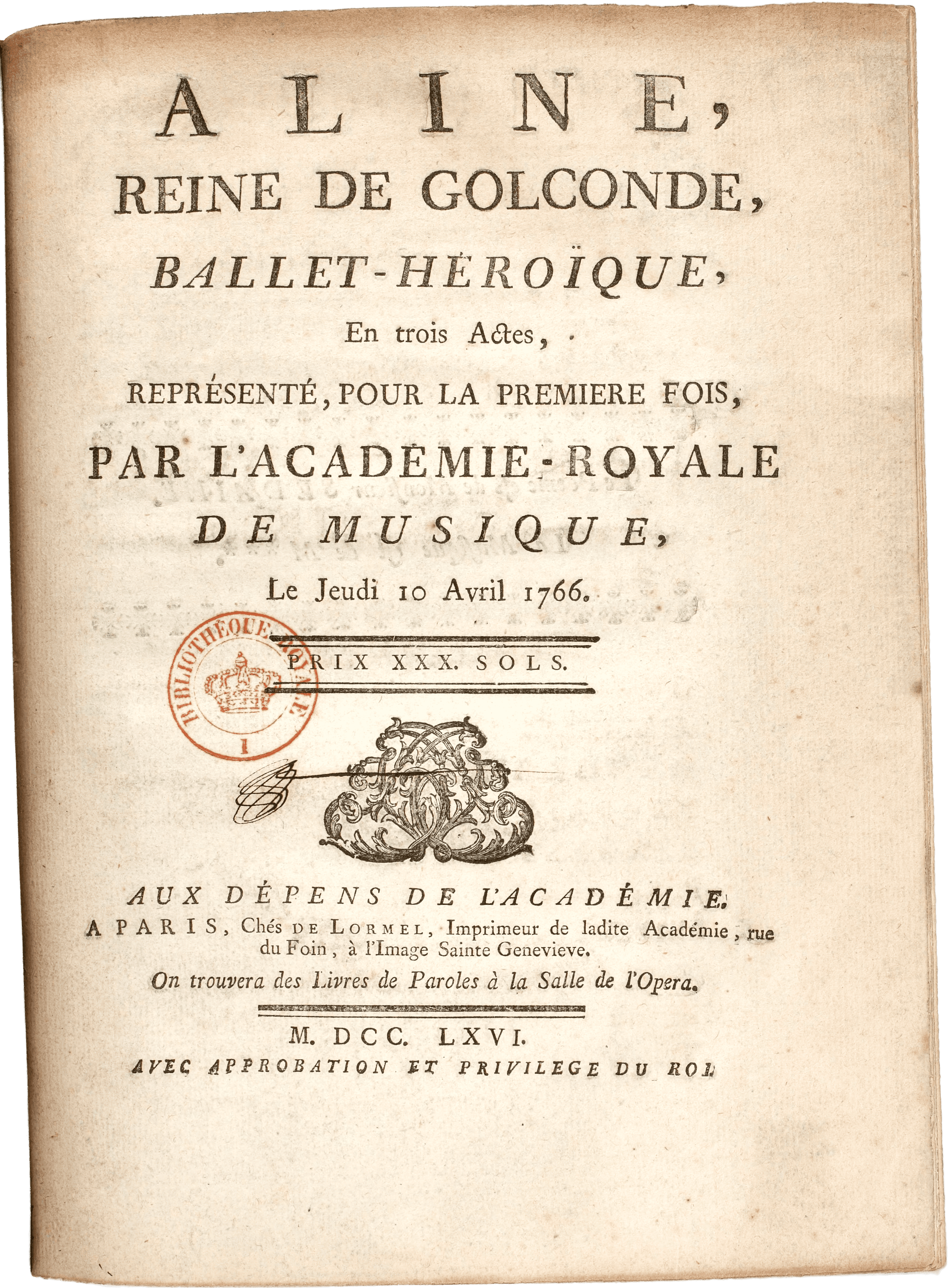
— This file comes from Gallica Digital Library and is available under the digital ID bpt6k1511197m · Public domain
Aline, reine de Golconde is a three-act ballet-héroïque — an opera incorporating substantial dance — composed by Pierre-Alexandre Monsigny to a libretto by Michel-Jean Sedaine, itself drawn from a tale by Stanislas-Jean de Boufflers. It premiered at the Salle des Machines in Paris on 15 April 1766 and was, notably, the only grand opera Monsigny ever attempted; his other works were lighter opéras-comiques. Our record credits Jean-Barthélemy Lany as choreographer, but the source article does not name any choreographer at all, so that credit cannot be corroborated here.
What is danced
The article gives almost no detail on what was actually danced. The single concrete statement is that in the revised 1779 staging 'the public felt that the dances were too long,' which confirms the work carried substantial danced divertissements typical of the ballet-héroïque form but says nothing about their steps, vocabulary, or which act or scene carried them. The same passage notes that the recitatives in the revision were 'now all accompanied rather than secco as before,' a musical change (in line with Gluckian reform taste) that would have altered the pacing around any danced interludes, but again without describing the choreography itself.
Context
Ballet-héroïque was the dominant French genre for combining tragedy-adjacent plots, exotic settings, and formal court-derived dance divertissements in the mid-18th-century Paris opera house, following the model established by Rameau. Monsigny, known for opéra-comique, attempting a grand ballet-héroïque in 1766 was itself notable, and the Journal historique's damning review of Sédaine's libretto and Monsigny's music suggests the work sat awkwardly against the genre's conventions. The 1779 revision, explicitly updated 'in the light of changes to public taste and the styles made popular by Christoph Willibald Gluck,' shows the piece being pulled toward the newer reform-opera aesthetic that was reshaping how dance and recitative interacted on the Paris stage in this period.
Staging history
The opera was popular enough to be substantially revised and restaged in Paris in 1779, and it traveled widely: Brussels (1774), Liège (1783), a German translation in Berlin (1782), an Italian translation in London (1784), and a Russian translation in Moscow (1793); a parody, Nanine, Sœur de lait de la reine de Golconde, appeared in 1768. Despite this circulation it did not survive as Opéra-Comique repertory once Monsigny's later Le déserteur (1769) became a much bigger success. The theme was reused by later composers entirely independent of Lany or Monsigny's original: Johann Abraham Peter Schulz set new music to a translated libretto in 1787, an unrelated 1803 Aline with music by Henri-Montan Berton appeared at the Opéra-Comique, and Donizetti later wrote Alina, regina di Golconda on an Italian translation of the same story.
How to watch it
Because the surviving commentary concerns reception and revision rather than staging, a viewer or reader has to infer the dance's role from context: as a ballet-héroïque, danced divertissements would conventionally appear at points of festivity or exotic local colour (an Indian court setting is specified in the plot), but the article gives no scene-by-scene breakdown to confirm where. The one direct audience reaction recorded — that the dances in the 1779 version ran too long — is worth noting as evidence that dance was a prominent, not incidental, element of the evening.
Credits
- composer: Pierre-Alexandre Monsigny