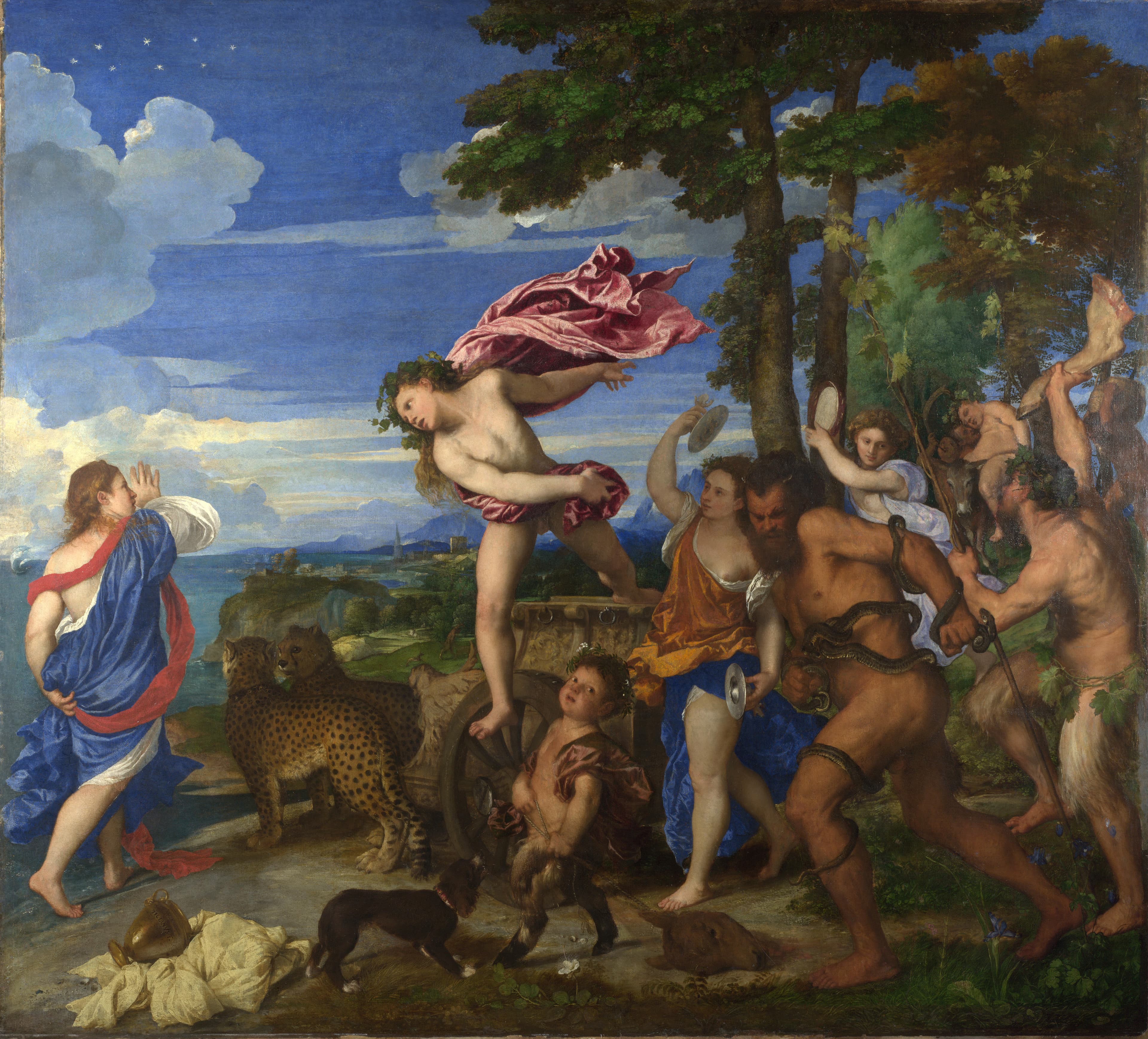
Titian — National Gallery, London - online catalogue. · Public domain
Bacchus and Ariadne (Bacchus et Ariane), Op. 43, is a two-act ballet score composed by Albert Roussel in 1930, one of his last major works and written close in time to his Symphony No. 3. The Paris Opera staged it on 22 May 1931 under conductor Philippe Gaubert, with choreography by Serge Lifar and sets by Giorgio de Chirico, telling the story of Ariadne's abduction by Dionysus.
What is danced
The article does not describe the choreographic vocabulary Lifar created for the premiere — no steps, holds, groupings, or technical demands are given. What can be stated on its authority is limited to production facts: it was staged in two acts at the Paris Opera, with designs by Giorgio de Chirico, and its subject is the abduction of Ariadne by Dionysus (Bacchus). Anyone reconstructing the danced content of the original production would need to go beyond this source, since it treats the piece primarily as a musical composition rather than a described stage work.
Context
The premiere sits at a moment when Serge Lifar was consolidating his influence over the Paris Opera Ballet, and when French composers were supplying the Opera with large orchestral scores for narrative, mythologically themed ballets. The article situates the score as a late, mature Roussel work, composed alongside his Symphony No. 3, which places it within the composer's own late-classical turn rather than within any dance-technical lineage described in the text.
Staging history
The article records only the single 1931 Paris Opera premiere as a staged ballet. It notes that Roussel himself extracted two orchestral suites from the score, the first conducted by Charles Münch on 2 April 1933 and the second by Pierre Monteux a year later — suggesting the concert suites, not the ballet, became the more durable and frequently performed form of the work. No later revivals or restagings of the danced version are mentioned.
How to watch it
The article gives no basis for describing what to watch for choreographically, since it records no synopsis of scenes or numbers. What it does support is that the work is now most often encountered as concert music via the two extracted suites rather than as a staged ballet, so a viewer should not expect the original Lifar choreography to be readily available for comparison.
Credits
- composer: Albert Roussel