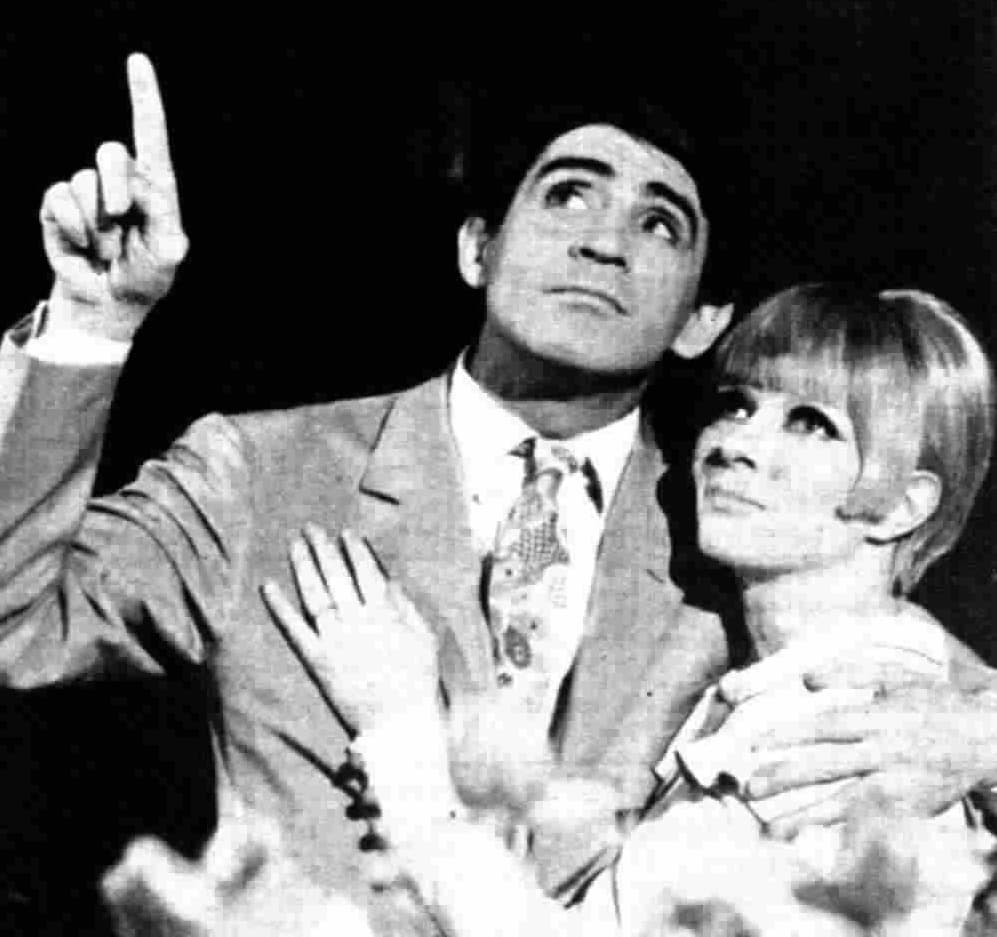
Unknown authorUnknown author — Radicorriere TV · Public domain
Buonanotte Bettina is a stage comedy by the Italian playwriting duo Pietro Garinei and Sandro Giovannini, built around a mistaken-authorship farce: a scandalous manuscript found abandoned in a taxi turns a discreet young wife into an accidental literary sensation and drives her husband into a jealous spiral. The article itself calls it 'a play' set in Turin on 14 November 1956, and describes an English adaptation (When in Rome, Adelphi Theatre, London, 1959) and a Spanish version (Teatro de la Comedia, Madrid, 1958).
What is danced
The source article gives no information about choreography, musical numbers, orchestration, or physical staging of any kind. It summarises the plot in prose and lists production variants (English, Spanish, a 1967 television film by Eros Macchi) without ever naming a dance, a musical sequence, a performer's movement, or a choreographer. Nothing in the text supports assigning specific dance vocabulary to this work, and no act/scene or number breakdown is given to hang a claim on even speculatively.
Context
Garinei and Giovannini were the central authors of Italian postwar commedia musicale and teatro di rivista (revue theatre), the bibliography cited in the article situates the pair squarely in that tradition ('Il teatro di Garinei e Giovannini', 'Quarant'anni di teatro musicale all'italiana'). That tradition typically paired spoken comedy with songs and staged numbers in the Broadway/West End mould that Italy was adapting in the 1950s. This particular article, however, frames Buonanotte Bettina as a play rather than a musical comedy, so its place within that sung-and-danced repertoire cannot be confirmed from this source alone.
Staging history
The article documents three staged versions: the original set in Turin (14 November 1956), an English-language adaptation titled When in Rome given at the Adelphi Theatre in London in 1959, and a Spanish version presented at the Teatro de la Comedia in Madrid on 31 December 1958. A television film adaptation followed in 1967, directed by Eros Macchi. No choreographer, composer, or original cast is named anywhere in the article.
How to watch it
Nothing in the article describes performance convention, so no guidance on movement vocabulary or staging technique can be given from this source; a viewer would need to consult a script, programme, or the 1967 television film directly. What can be watched for is the farce mechanics the synopsis lays out: parallel narration by the older generation, the mounting confusion over authorship, and the 'reassuring ending' the article mentions.