Studio — Pinterest · Public domain
Carioca (1933)
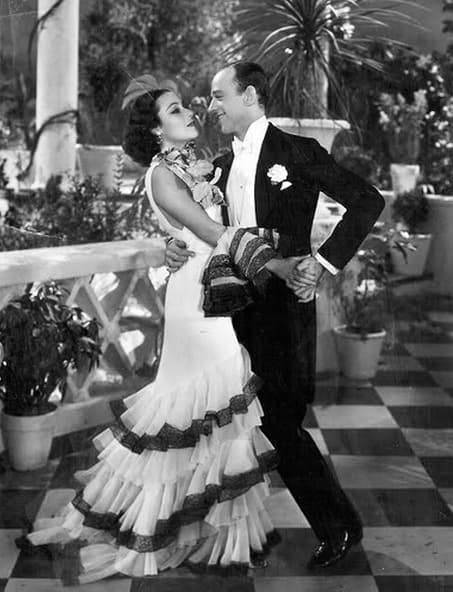
"The Carioca" is a 1933 song-and-dance number written for the RKO film Flying Down to Rio, with music by Vincent Youmans and lyrics by Edward Eliscu and Gus Kahn. The number was sung on screen by Alice Gentle, Movita Castaneda and Etta Moten and danced by Fred Astaire and Ginger Rogers, in a routine choreographed by the film's dance director Dave Gould with Hermes Pan assisting, itself adapted from an earlier stage dance of the same name by the revue producers Fanchon and Marco.
What it contains
- Maxixe · The Carioca dance as popularized after the film, built on the Astaire-Rogers screen routine — Described as a hybrid dance combining the Brazilian couple dance maxixe with samba, foxtrot and rhumba elements Source: "It was a mixture of samba, maxixe, foxtrot and rhumba."
What is danced
The number as filmed is an extended production sequence: the song is sung by other performers before Astaire and Rogers dance it, billed only fourth and fifth in the cast. The article's single specific movement detail is the routine's signature device — the couple dances with their foreheads touching, a novelty partnering hold that became the routine's calling card and is the one piece of concrete choreographic description the source gives.
After the film's success, promoters tried to launch "the Carioca" as a new social ballroom dance built on the Astaire-Rogers routine; the article describes this popularized version explicitly as "a mixture of samba, maxixe, foxtrot and rhumba" — that is, a hybrid of a Brazilian couple dance (maxixe), a Latin dance vocabulary (samba, rhumba) and the standard ballroom foxtrot. It is not stated whether this is an exact description of the film choreography itself or of the diluted social-dance version marketed afterward, so the two should not be treated as identical.
Beyond the forehead-touching hold and this named mixture of dance idioms, the article gives no further technical detail — no step names, no formation description, no indication of solo versus ensemble passages beyond the credited singers and the two lead dancers.
Context
The number belongs to the early sound-era Hollywood musical, where dance numbers were staged by studio dance directors (here Dave Gould, with Hermes Pan as his assistant) rather than by choreographers working in a theatrical-ballet tradition, and were frequently derived from existing stage revue material — in this case a dance already devised by the vaudeville/revue producing team Fanchon and Marco. Flying Down to Rio's Carioca sequence is historically significant chiefly as the first time Fred Astaire and Ginger Rogers danced together on screen, before either was billed as a lead; RKO's subsequent marketing of them as "The King and Queen of 'The Carioca'" set up their starring partnership in The Gay Divorcee the following year.
Staging history
The article does not describe any theatrical restaging of the dance itself; its afterlife is tracked through recordings of the song and one screen revival. A comic French cover of the song and dance appears in the 1994 film La Cité de la peur, set at the Cannes Film Festival, which the article says became a generational reference point in France; in May 2019 the scene was marked in Cannes with a flashmob and a re-performance by the original actors.
How to watch it
Watch for the structure of the number — the song is established vocally by other performers before Astaire and Rogers take over the floor — and for the forehead-touching hold, the routine's distinguishing partnering device. The steps draw on a blend of Latin American and ballroom idioms (samba, maxixe, rhumba) folded into a foxtrot base, so listen for shifts in rhythmic character across the sequence rather than a single consistent metre.