Scan by NYPL — https://digitalcollections.nypl.org/items/5bc93570-b9f9-0132-4445-58d385a7bbd0 · Public domain
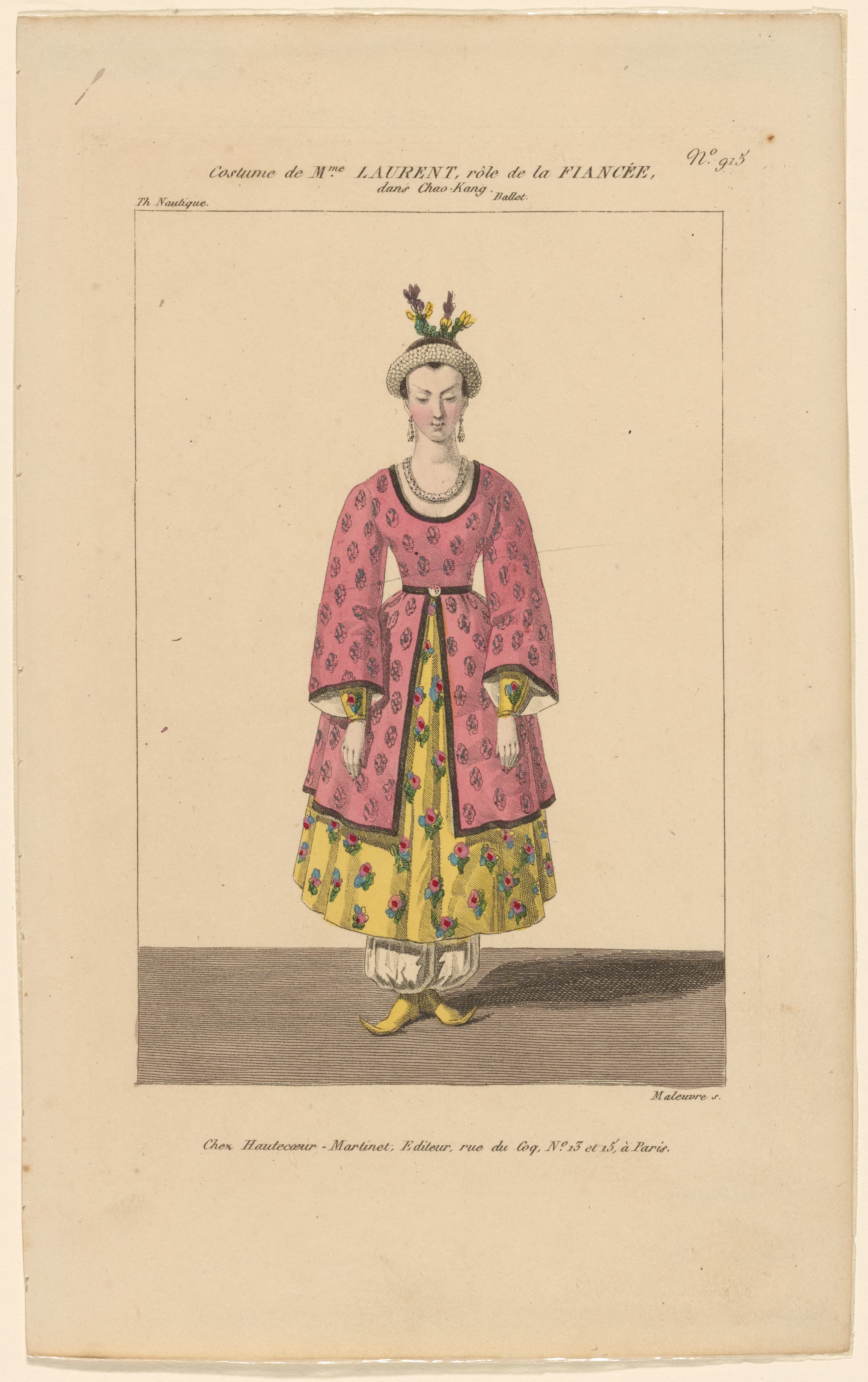
Chao-Kang is a French ballet-pantomime in three acts plus epilogue, presented in Paris in 1834 and authored and choreographed by Louis Henry, who also danced the title role. It dramatizes a Chinese dynastic-usurpation story — a rightful heir raised in hiding as a shepherd who returns at thirty to overthrow the lord who deceitfully seized his father's throne — staged with sets and costumes drawing on the Xia dynasty.
What is danced
The article gives no description of specific choreographic vocabulary, steps, holds or technical demands. It tells us the piece was 'in the pantomime genre' across three acts with an epilogue by Henry, and that Henry researched Chinese customs and daily life for the production, but it does not describe what was danced in any act, scene or number. As a ballet-pantomime of this period, the plot's turns — exile, disguise, discovery, conspiracy, the usurper's public humiliation in an iron cage — were almost certainly conveyed largely through dramatic mime rather than set dance numbers, but this is an inference from the genre label, not something the article demonstrates about movement itself.
Context
The work dates from the height of the Paris Romantic ballet period, two years after La Sylphide, when ballet-pantomime — narrative-driven works leaning heavily on mimed action, exotic settings and moral or political allegory — was an established house style. Louis Henry was already a veteran figure of this tradition, and the article's note that he 'undertaken a detailed study of the customs and ways of life among China's people' points to the orientalist interest in staging non-European settings that runs through much Romantic-era spectacle.
How to watch it
Expect a narrative carried by mimed action and pageantry rather than a sequence of set dances: the storytelling — exile, disguise, discovery, conspiracy, public shaming of the usurper — is the organizing device. Watch the design register, since costume and setting were built to evoke the Xia dynasty and 'Ancient China' as period researchers of the time understood it, rather than any specific danced technique the article names.