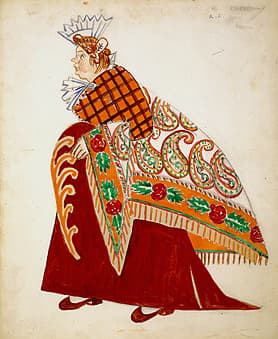
М.Ф. Ларионов — http://www.snob.ru/chronicle/entry/8363 · Public domain
Chout (1921)
Chout is a ballet score by Sergei Prokofiev, composed in 1915 and substantially revised in 1920–21 at Diaghilev's insistence, first staged by the Ballets Russes in Paris in 1921. Its full title, Tale of the Jester Who Outwits Seven Other Jesters, names a folk-tale plot recorded by Alexander Afanasyev: a jester tricks seven fellow buffoons into killing their wives with a false promise of a resurrecting whip, then evades their revenge by disguising himself as a woman to swindle a merchant.
What is danced
The article does not describe the actual movement vocabulary used on stage — no steps, holds, or technique are recorded. What survives in the source is the musical and dramaturgical structure: six scenes (The Buffoon's Kitchen, The Seven Clowns, The Buffoon's Courtyard, The Buffoon's Sitting Room, The Buffoon's Bedroom, In the Merchant's Garden) linked by five entr'actes that Prokofiev was asked to compose so the music would play continuously. This tells us the piece was built scene-by-scene around a comic, farcical narrative with a cross-dressing disguise sequence and mock-death/burial business (the suite's movement titles include 'The Young Woman Becomes a Goat' and 'Fifth Entr'acte and the Goat's Burial'), but none of this is confirmed as choreographic content in the article — it is drawn from the score/suite titles rather than a description of dancing.
Context
Chout belongs to Diaghilev's Ballets Russes at the point where the company was moving from Fokine-era exoticism toward the more angular, modernist and folk-inflected commissions of the 1910s–20s (the same period that produced Stravinsky's and Massine's collaborations with the company); indeed Stravinsky had originally suggested the Afanasyev tale to Diaghilev, and Diaghilev and Massine helped shape the scenario before Fyodor Slavinsky choreographed it. It followed Prokofiev's rejected Ala and Lolli score (recast as the Scythian Suite), making Chout his first ballet actually to reach the stage for Diaghilev.
Staging history
The premiere was given by the Ballets Russes on 17 May 1921 at the Théâtre Municipal de la Gaîté in Paris, conducted by the composer, and was fairly well received; the London premiere on 9 June 1921 was, by contrast, 'bitterly attacked by audiences and critics alike.' The ballet was staged only once more, in the Soviet Union in January 1928 under the Ukrainian title Blazen at the Kiev Theatre of Opera and Ballet, where the score had to be reconstructed from the symphonic suite (minus entr'actes), causing prolonged pauses; further Soviet staging attempts failed because Prokofiev refused to permit changes. The concert suite, extracted by Prokofiev in 1922–23 and premiered in Brussels on 15 January 1924, has been performed and recorded far more often than the ballet itself; the first recording of the complete ballet score was not made until the mid-1980s, by Gennady Rozhdestvensky.
How to watch it
Because the article gives no account of the choreography's actual vocabulary, a viewer or reader has to rely on the six-scene, farce-driven structure — kitchen, clowns, courtyard, sitting room, bedroom, merchant's garden — punctuated by entr'actes, and on the plot's comic reversals (false resurrection, cross-dressed disguise, swindled merchant) as the dramaturgical skeleton the choreography was built to serve. Anyone approaching this work for staging purposes should treat the choreographic record as essentially lost and reconstructable only from the music and scenario, not from a documented step vocabulary.
Credits
- composer: Sergei Prokofiev