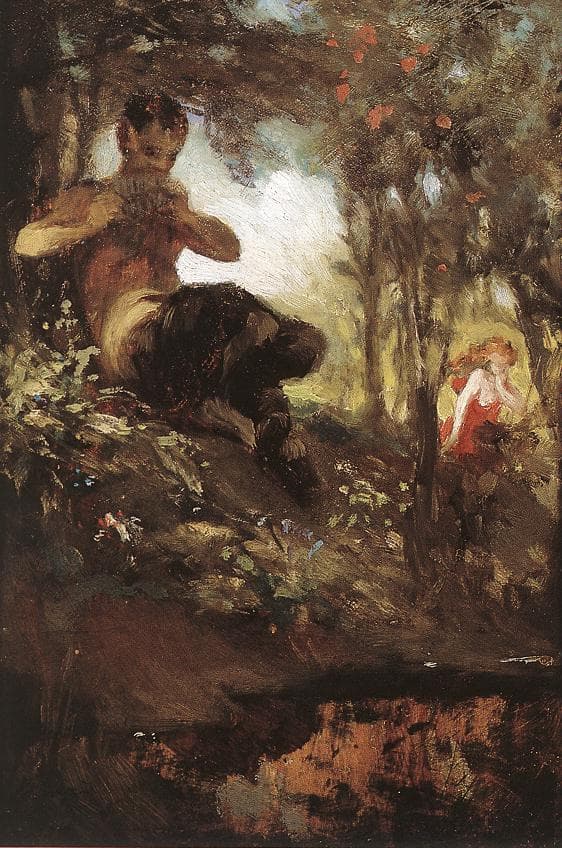
Pál Szinyei Merse — Fine Arts in Hungary: · Public domain
Cydalise et le Chèvre-pied (1915)
Cydalise et le Chèvre-pied is a two-act ballet with a score by Gabriel Pierné, set to a libretto by Gaston Arman de Caillavet and Robert de Flers adapted from Remy de Gourmont's Lettre d'un satyre. It was composed between 1914 and February 1915 but its Paris Opéra premiere, danced to Léo Staats's original choreography, did not take place until 15 January 1923, delayed by the First World War.
What is danced
The article is a music-history article, not a production record: it describes the score in detail (impressionist harmony, a wordless chorus at the opening moonrise, an enlarged woodwind section, an unusual use of harpsichord in Act II) but it does not describe steps, holds, or choreographic vocabulary for any scene, and it gives no synopsis or numbers list to anchor sections against. The one piece of choreographic vocabulary named is descriptive rather than technical: 'L'École des Ægipans' is also known as 'The Entry of the Little Fauns' or 'The March of the Fauns', which tells us the number depicts fauns entering/marching but not how that was danced. Without a synopsis, cast list, or eyewitness/critical account of the staging, nothing here supports a movement-vocabulary claim strong enough to code against the taxonomy.
Context
The ballet was written in the mid-1910s, in the immediate wake of Ravel's Daphnis et Chloé (1912), and the article draws that comparison directly for the opening moonrise scene and its wordless chorus. Pierné's score is described as sitting inside Impressionism while pulling in Romantic, Neoclassical and Neo-Baroque elements (the Act II harpsichord, the Classical/Baroque-referencing woodwind writing), which situates the work amid the same early-20th-century French turn back toward 18th-century models that shaped ballets of the period more broadly. The wartime delay between composition (1914-15) and Paris Opéra premiere (1923) means the work reached the stage in a very different theatrical moment from the one it was written for.
Staging history
The article records only the delayed 1923 Paris Opéra premiere under Léo Staats's original choreography; it gives no later revivals, restagings, or companies beyond that. Three years after the premiere Pierné drew two orchestral suites from the ballet (Suite No. 1 from the first two tableaux, Suite No. 2 from the whole third tableau), and these suites, along with the excerpted 'L'École des Ægipans' / 'March of the Fauns', have had an independent concert life documented via two commercial recordings (1976, Paris Opera under Jean-Baptiste Mari; 2001, Luxembourg Philharmonic under David Shallon). The work was also on the original planned programme for Disney's Fantasia (1940) before being dropped late in production and replaced by excerpts from Beethoven's Pastoral Symphony.
How to watch it
The article supports attention to the music rather than to specific choreography: listen for the wordless chorus and modal, Ravel-adjacent harmony at the opening moonrise, the magnified flute/piccolo-heavy woodwind writing, and the harpsichord passages in Act II that signal a conscious Baroque/Classical reference within an otherwise Impressionist score. 'L'École des Ægipans' (the fauns' entrance/march) is the number most likely to be excerpted or programmed separately, so it is a useful marker if only a suite or highlights are being performed.
Credits
- composer: Gabriel Pierné