Unknown · No known copyright restrictions
Dance of the Hours (1876)
Dance of the Hours is the ballet interlude that closes Act III of Amilcare Ponchielli's opera La Gioconda, first heard in 1876 and revised in 1880. Within the opera it is a diegetic entertainment staged inside the plot: the Inquisitor Alvise's ballroom scene, where a sequence representing dawn, day, night and morning is danced before his guests while, unseen by them, a death chamber adjoins the room. Extracted from the opera and given independent concert and ballet-stage life, it became one of the most frequently performed short ballets of its era before a second life as the comic hippo-and-ostrich sequence in Disney's Fantasia (1940), the version by which most people now know the tune.
What is danced
The article's evidence for what is actually danced is thin and mostly musical rather than choreographic: it tells us the piece unfolds as a sequence of episodes representing dawn, daytime, night and morning, each in its own key and tempo, closing with 'a vigorous can-can in the manner of Romualdo Marenco's Ballo Excelsior (1881)... introduced by an abrupt change of tempo to allegro vivacissimo.' Beyond naming this can-can-style coda and noting 'costume changes and lighting effects reinforce the progression,' the source does not describe steps, holds, or technique — only that the whole is built from 'solo and ensemble dances' depicting the hours of the day, with the design read as an allegory of 'the eternal struggle between the forces of light and darkness.'
Context
The article situates the ballet's finale explicitly against Romualdo Marenco's Ballo Excelsior (1881), the archetypal Italian grand ballo of the period — a genre of large-scale, spectacle-driven opera-house ballet built on rousing, rhythmically driven finales. Ponchielli's coda is described as written 'in the manner of' that piece, which places Dance of the Hours within the same Italian tradition of virtuosic, crowd-pleasing ballabile finales rather than within the French Romantic ballet-blanc lineage.
Staging history
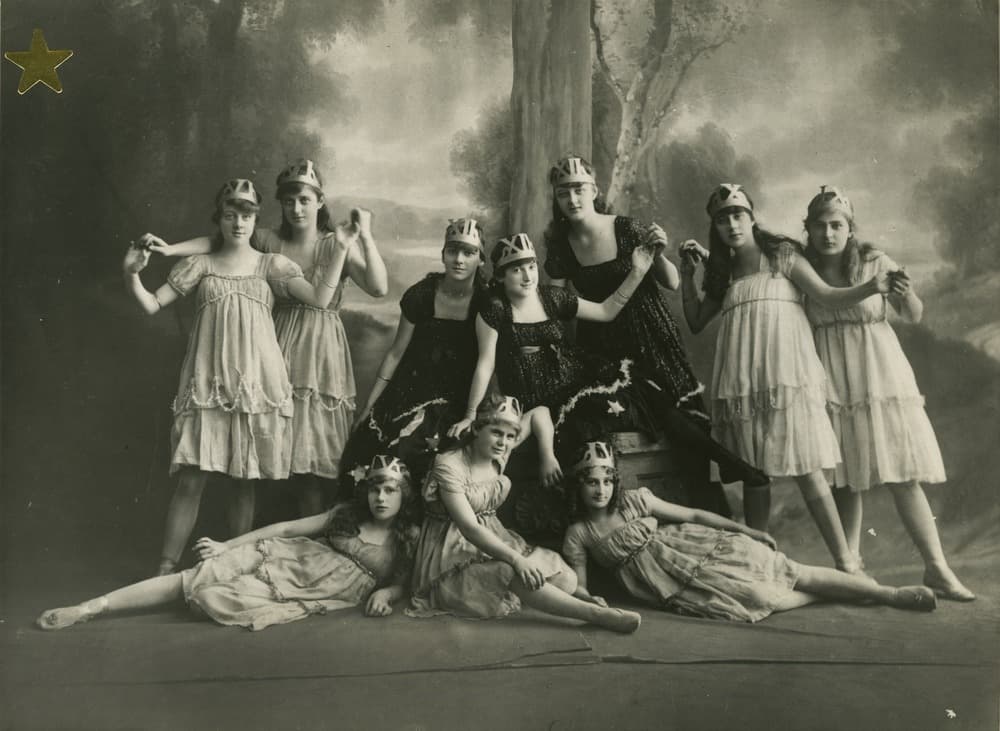
The article notes that the piece was 'later performed on its own' and 'was at one time one of the best known and most frequently performed ballets,' independent of stagings of the full opera. Its most consequential afterlife was as the comic set-piece in Disney's Fantasia (1940), 'depicted as a comic ballet featuring ostriches, hippopotamuses, elephants and alligators,' which the article credits with making the music 'even more widely known.' A cited external link records a 2008 girls'-ballet staging choreographed by Victoria Lyras, but the article gives no detail on it beyond the credit.
How to watch it
Listen for the four clearly separated episodes — dawn, day, night, morning — each signalled by a change of key and tempo, then for the sudden allegro vivacissimo can-can coda that closes it; in a fully staged version, costume and lighting changes are used to mark each transition rather than a change of set. Because the number was designed as an internal entertainment within Alvise's ballroom scene, a staging that includes the opera's frame will show it being watched by onstage guests rather than performed to the house directly.
Structure
- Act III · IntroductionAn orchestral introduction in G major, originally accompanied by a sung recitative that is omitted in concert/symphonic performance.
- Act III · Dance of the Hours of DawnAn episode in E major representing dawn, which merges directly into the introduction of the following daytime episode.
- Act III · Dance of the Hours of DayA daytime episode built on a four-note rhythmic figure, culminating in a fortissimo choral outburst ('Prodigio! Incanto!') marking the birth of day.
- Act III · Dance of the Hours of NightA brief episode in C-sharp minor built on staccato figuration, representing night.
- Act III · MorningA cello-led melody in E minor introduces morning, extended by a further melody in A minor before a diminuendo.
- Act III · Final CodaA vigorous closing coda in A major, described as in the manner of Marenco's Ballo Excelsior, launched by an abrupt shift to allegro vivacissimo.
Structure read from an encyclopaedia article, not from a libretto or score we hold. Confirm against a programme before treating the numbering as authoritative.
Credits
- composer: Amilcare Ponchielli