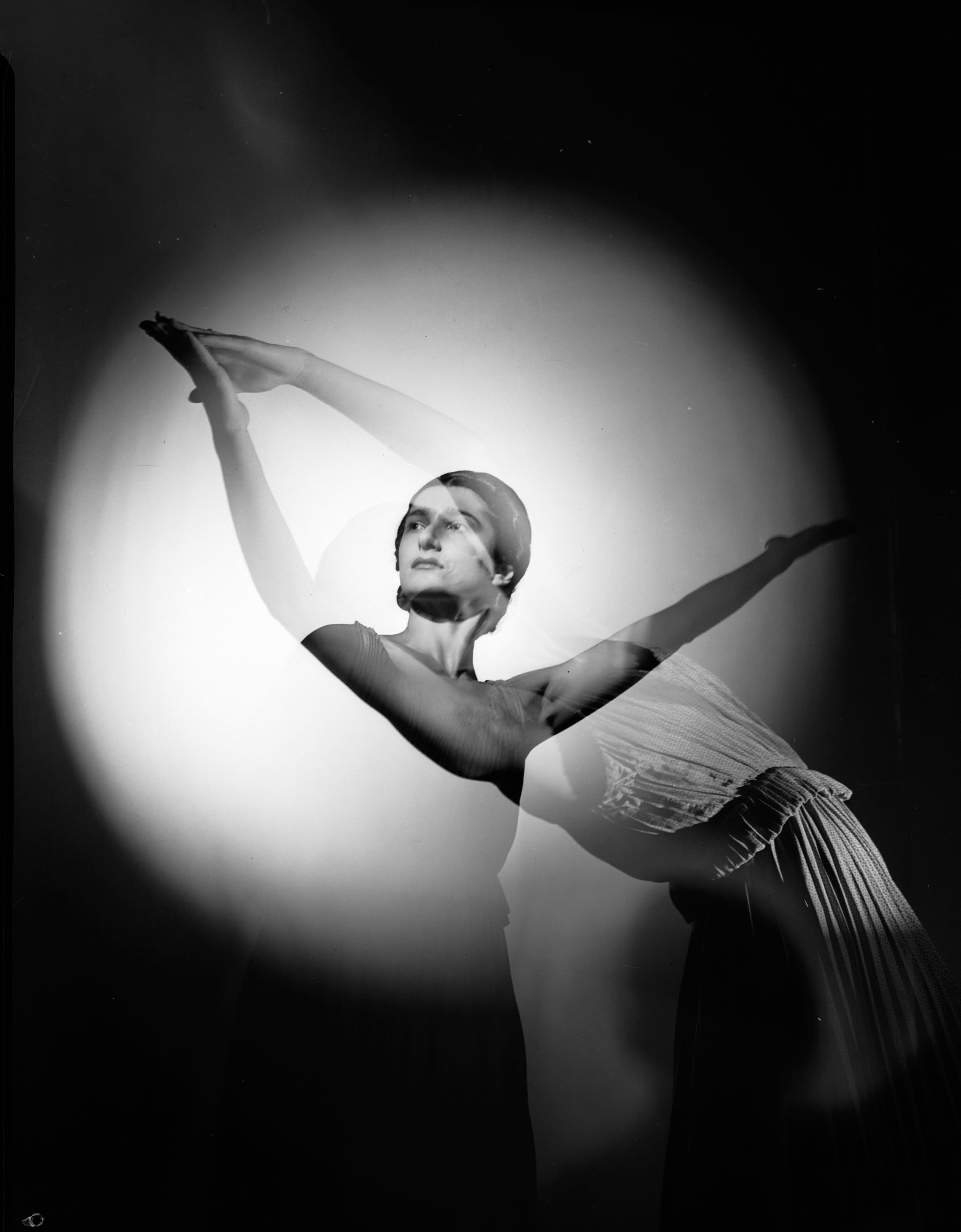
Max Dupain · Public domain
Destiny
The catalogue record for "Destiny" gives only a composer (Tchaikovsky) and a category (ballet), with no choreographer or premiere date on file. The source article available for this entry describes a Tchaikovsky ballet titled Les Présages — choreographed by Léonide Massine to his Symphony No. 5, designed by André Masson, and premiered on 13 April 1933 at the Opéra de Monte Carlo by the Ballets Russes de Monte-Carlo. "Les Présages" is the French title under which this ballet is usually catalogued internationally; it is also known in English-language programming as "Destiny" or "Presages," which is almost certainly why the two match here on composer alone. That identification is not made explicit in the article itself and should be treated as a research lead rather than a settled fact.
If the identification holds, this is a landmark work: the article states it was Massine's first attempt at a plotless ballet built on a symphonic score rather than a libretto, a move that helped establish the twentieth-century "symphonic ballet" as a form in its own right, distinct from the story-ballet and divertissement traditions that had dominated the Ballets Russes repertory before it.
What is danced
The article gives production facts — choreographer, composer, designer, company, premiere date — but does not describe a single step, hold, or passage of movement. There is no synopsis, no listing of numbers or roles, and no account of technique, so nothing about the actual vocabulary danced can be sourced to it directly.
What can be said from the article is structural rather than choreographic: this was conceived as a "plotless work based on symphonic music," meaning the choreography follows the architecture of Tchaikovsky's four-movement Fifth Symphony rather than a narrative scenario, with characters and corps patterns organized around the symphony's musical structure instead of a plot. Beyond that framing, the article is silent on whether the dancing was built from classical danse d'école, from Massine's own more plastique, ensemble-driven idiom, or some blend of the two — a gap a reader should not have filled in for them without a citable source.
Context
Massine had built his early reputation within Diaghilev's Ballets Russes making character-driven and comic ballets (Parade, La Boutique fantasque, Le Tricorne). By the early 1930s, after Diaghilev's death, Massine was working with the reconstituted Ballets Russes de Monte-Carlo, and the article frames this piece as his first move away from narrative ballet toward abstraction built directly on a pre-existing symphonic score — a controversial gesture at the time, since using a symphony (rather than music written for the stage) as ballet material was seen by some critics as an assault on the concert repertoire.
Staging history
The article does not describe any staging history beyond the 1933 premiere, though its external links point to a Joffrey Ballet staging and to footage from an Australian tour in 1936–1937, indicating the work (under the title Les Présages) travelled with company touring in the years immediately after its creation and has been revived at least once by the Joffrey Ballet. No detail on later revivals, cast changes, or design alterations is given.
How to watch it
Because the piece follows a symphony's four-movement shape rather than a story, watch for how the choreography marks structural transitions in the Tchaikovsky score rather than for plot incident — entrances, ensemble massing, and shifts in the corps's spatial patterning are likely to track the symphony's movements. The archival YouTube footage from the 1936–1937 Australian tour, linked from the source article, is the most direct way to see the choreography itself rather than infer it from production notes.
Credits
- composer: Pyotr Ilyich Tchaikovsky