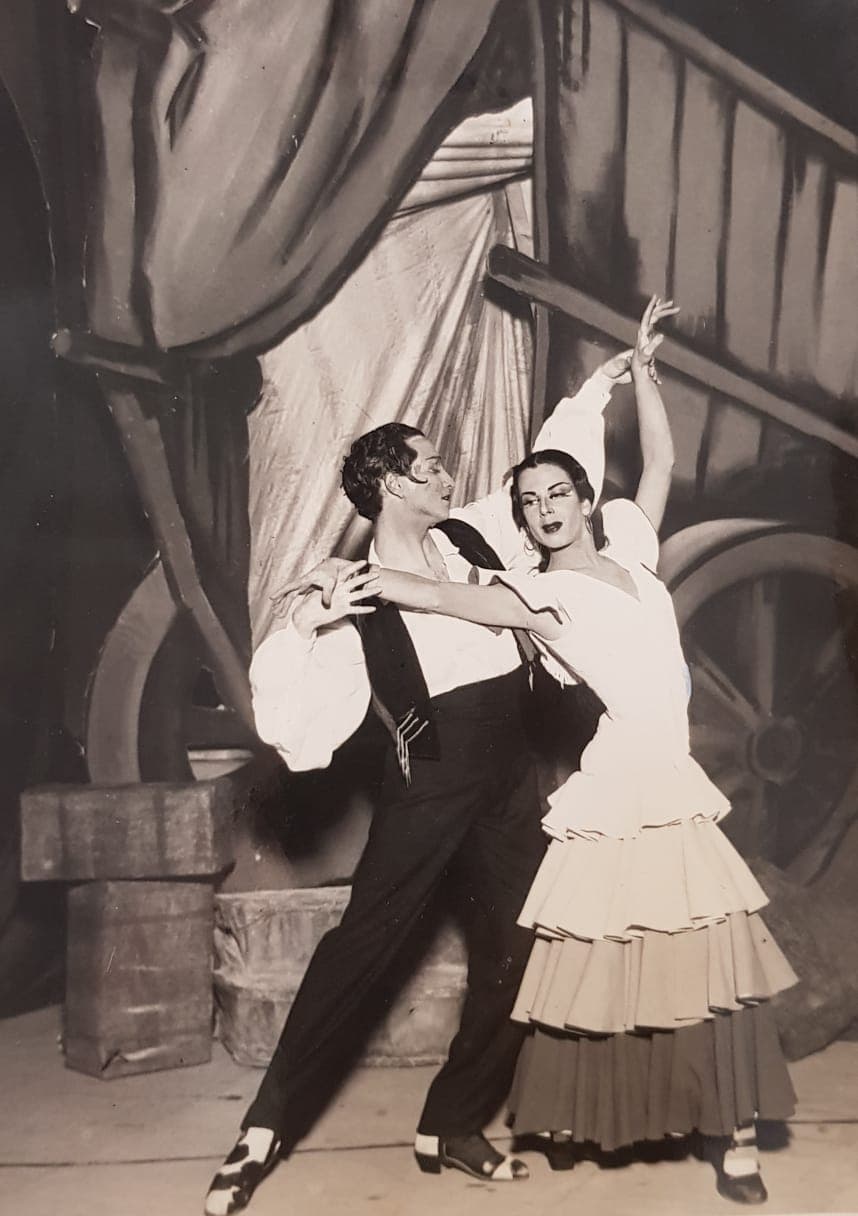
Arquivo pessoal — Revista Lyra, Revista Platea, Correio da Manhã, Hemeroteca Brasileira https://dacapoteatroargentino.wordpress.com/category/da-capo/ · CC BY-SA 4.0
El amor brujo (1915)
El amor brujo is a Spanish stage work by Manuel de Falla, built around the haunting of a young Andalusian widow, Candela, by the ghost of her unfaithful husband, and her eventual freedom to love Carmelo. It exists in three distinct theatrical versions made between 1915 and 1924 — a spoken-and-danced 'gitanería' for actors and dancers, a 1916 revision for mezzo-soprano and small orchestra, and the fully orchestrated one-act 'ballet pantomímico' of 1924 that is the version most commonly staged and recorded today.
What is danced
The article documents the work's musical and dramatic structure — the sung numbers, the orchestration, and the plot points at which dancing occurs — far more thoroughly than it documents any actual choreography. It was originally commissioned as a 'gitanería, or danced gypsy entertainment,' written for and dedicated to the flamenco dancer and cantaora Pastora Imperio, which places its dance vocabulary in an Andalusian/gitano idiom rather than academic ballet steps, but the article gives no choreographer's name for any of the three versions and no description of steps, holds, or floor patterns.
Three numbers are explicitly tied to dramatic action in the synopsis: the 'Danza del terror,' danced nightly by Candela with her dead husband's ghost; the 'Danza ritual del fuego,' performed as an exorcism ritual that initially fails; and the 'Danza del juego de amor,' in which the ghost is finally lured away with Lucía. Beyond naming these moments and their place in the story, the source gives no technical detail — no mention of pointe work, footwork patterns, partnering, or academic vocabulary — so a reader cannot reconstruct the actual danced content from this article alone.
Context
The work sits at the crossroads of early-twentieth-century Spanish nationalist concert music and the vogue for 'gypsy' and Andalusian stage entertainment in Madrid theatres, evolving from an intimate spoken-and-danced piece with a flamenco cantaora into a fully orchestrated ballet suitable for major opera-house and concert stages. Falla's repeated revisions — stripping spoken dialogue, changing the vocal writing from cantaora to mezzo-soprano, and enlarging the orchestra — trace a movement away from flamenco performance practice toward a symphonic concert-ballet idiom aimed at international audiences, reaching Paris and then Philadelphia by the mid-1920s.
Staging history
The 1915 premiere at the Teatro Lara in Madrid was unsuccessful; a pared-down 1916 version followed under conductor Enrique Fernández Arbós, with further revisions proposed for a Teatro Real production. The now-standard one-act 'ballet pantomímico' dates from 1924, was published by Chester in 1925 and given in Paris, and received its American premiere in 1927 at Philadelphia's Metropolitan Opera House. The work has since been the basis of two films — Francisco Rovira Beleta's 1967 version, and Carlos Saura's 1986 film starring and choreographed by Antonio Gades, the third in his flamenco-film trilogy after Bodas de sangre and Carmen.
How to watch it
Listen for the shift between the sung, cantaora-inflected 1915 original and the purely orchestral, mezzo-soprano-accompanied 1924 version most companies now use — the choice of version changes how 'flamenco' the piece can sound. Watch for the three story-driven dances (terror, fire ritual, and the game of love) as the structural spine of the piece, since the article ties each directly to a turn in Candela's ghost story rather than to abstract divertissement.
Structure
- Act I · Danza del terrorCandela, branded crazy by the village, dances nightly with the ghost of her dead husband.
- Act I · Danza ritual del fuegoCandela and Carmelo perform a ritual dance meant to exorcise the ghost, which fails to work.
- Act I · Danza del juego de amorDuring the nightly ritual with the ghost, Candela draws back at the last moment and Lucía is taken by the ghost instead, freeing Candela and Carmelo.
Structure read from an encyclopaedia article, not from a libretto or score we hold. Confirm against a programme before treating the numbering as authoritative.
Credits
- composer: Manuel de Falla
On screen
More from Manuel de Falla
Other staged works in the register connected to this one by author or lineage.
