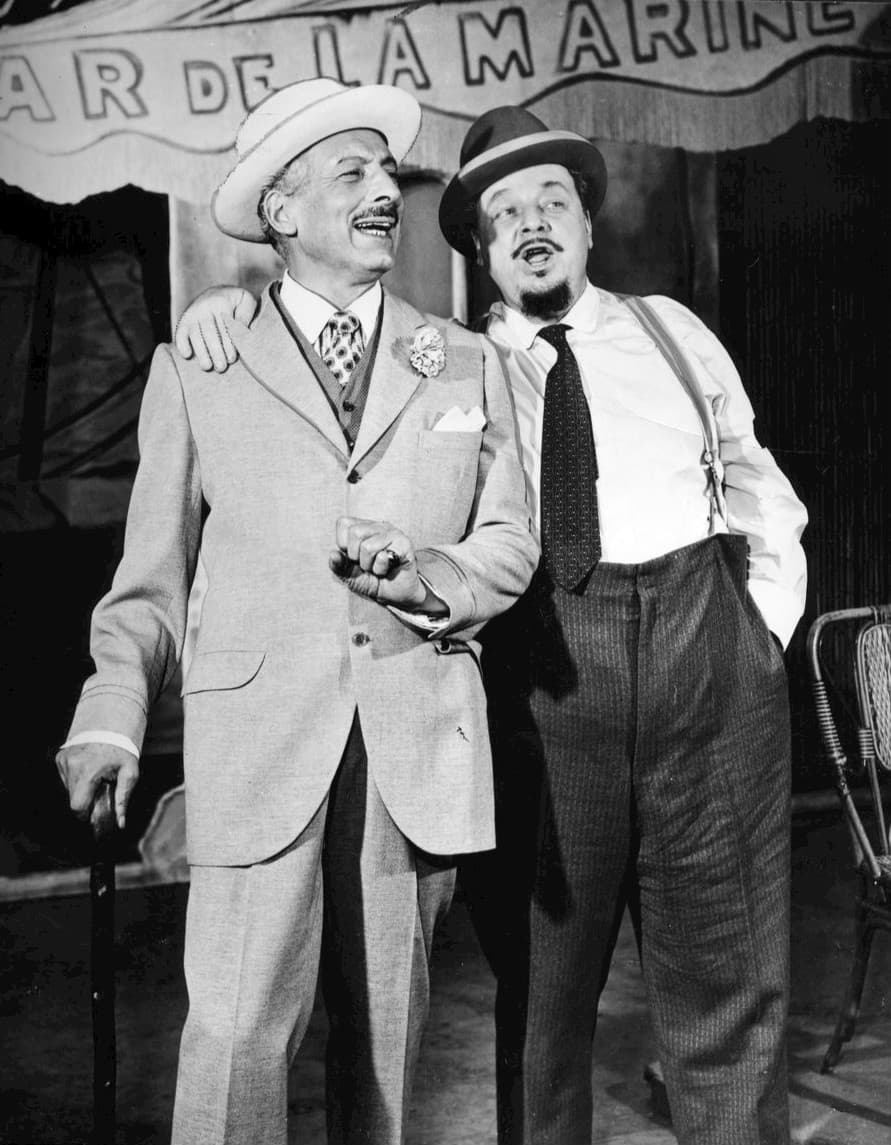
Dick Weaver, the show's publicity director — eBay front back · Public domain
Fanny is a 1954 Broadway book musical with music and lyrics by Harold Rome and a book by S. N. Behrman and Joshua Logan, adapted from Marcel Pagnol's Marseille trilogy (Marius, Fanny, César). It is a romantic melodrama of a sailor's abandoned lover, an arranged marriage to a wealthy widower, and a secret paternity resolved across a generation, staged against the port life of Marseille.
What is danced
The source article does not describe the choreography itself — no step vocabulary, dance numbers, or staging directions for movement survive in the text beyond crediting choreographers by name across productions. What can be established: the original 1954 Broadway production was choreographed by Helen Tamiris (this conflicts with our record's credit to James Starbuck — see record_flags), and the 2010 Encores! staged concert was choreographed separately by Lorin Latarro. The article also notes that the original Broadway cast included a specialty act — belly dancer Nejla Ateş performing with oud musician Mohammed El-Bakkar — which points to a Middle Eastern/'Oriental dance' specialty number embedded in the Marseille tavern setting, but no taxonomy code here covers that vocabulary (see taxonomy_gaps).
Context
Fanny opened on Broadway in November 1954, in the mid-1950s stretch of the golden-age book musical when choreographer-driven staging (following Agnes de Mille's example on Oklahoma! and Carousel) was standard practice for integrating dance into dramatic narrative; this reading of the period is my own inference, not something the article states, since it gives no detail on how movement functioned within the show.
Staging history
The Broadway production opened at the Majestic Theatre on November 4, 1954, transferred to the Belasco Theatre in December 1956, and closed later that month after 888 performances; Walter Slezak won the Tony for Best Actor in a Musical. A West End production opened at Drury Lane in 1956 and was filmed for ITV as promotion. Later revivals include Goodspeed Opera House (1986), Paper Mill Playhouse (1990, with José Ferrer), a Lost Musicals project staging at the V&A Theatre Museum (1990) and Sadler's Wells (2005), a 42nd Street Moon concert (1997, notable as Darren Criss's professional debut), and a City Center Encores! staged concert (2010) that received mixed reviews. Joshua Logan also directed a non-musical 1961 film version with Leslie Caron, Maurice Chevalier, and Charles Boyer, retaining Rome's music only as underscore.
How to watch it
Because the surviving article gives no movement detail, a viewer should watch primarily for how the tavern and port setting is used for incidental specialty acts — the belly-dance/oud number being one documented example — rather than expecting a through-danced score. Pay attention to how successive stagings (Tamiris's original, Latarro's Encores! version) differ, since the choreographer changed across the show's history.