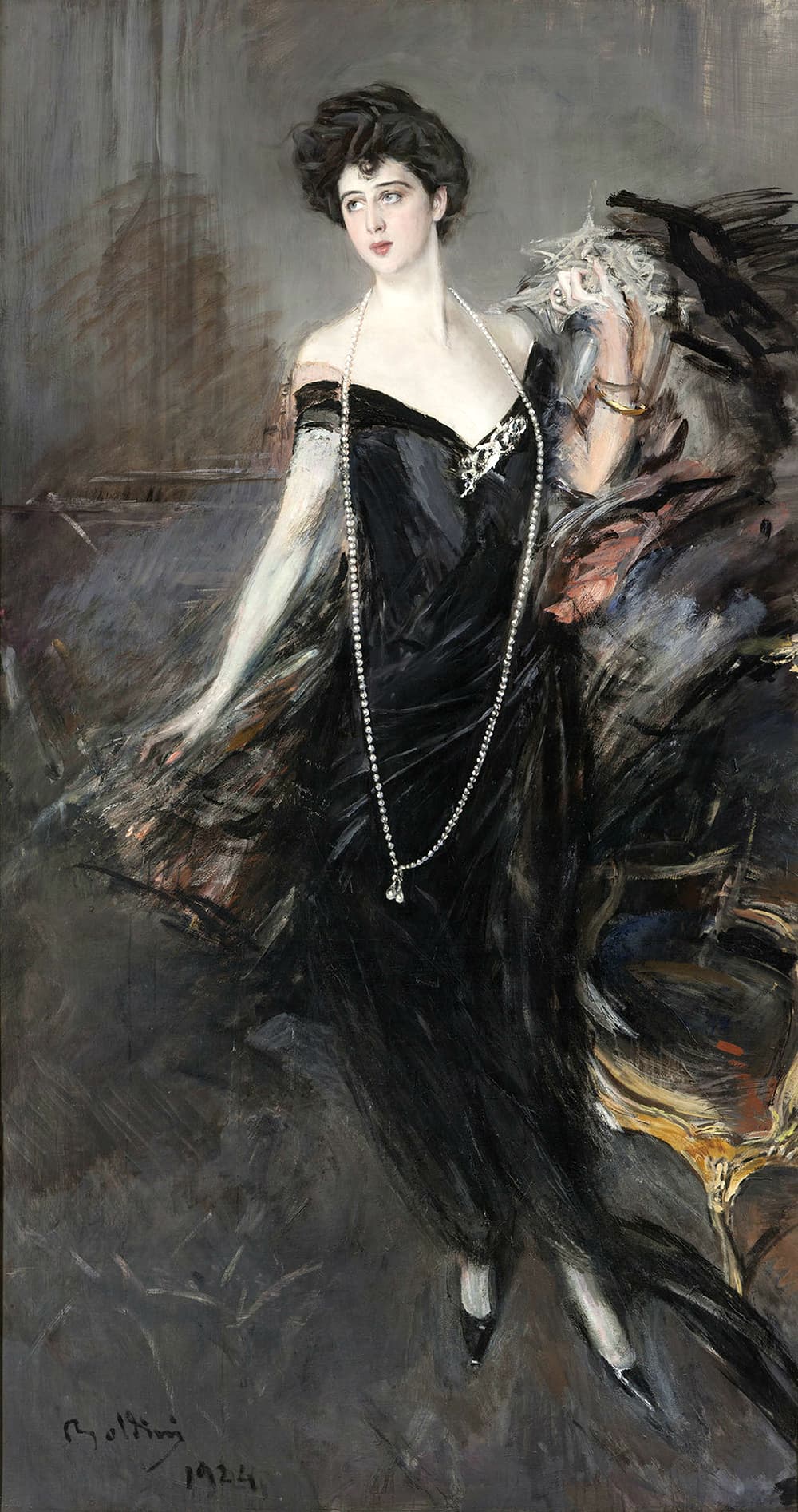
Giovanni Boldini — http://www.homolaicus.com/arte/boldini/boldini.htm · Public domain
Franca Florio, regina di Palermo is a full-length narrative ballet in two acts, made by choreographer Luciano Cannito to a commissioned score by Lorenzo Ferrero, and staged by Teatro Massimo in Palermo in 2007. It dramatises the life of Franca Jacona Notarbartolo di San Giuliano, the Sicilian aristocrat known as "the Queen of Palermo," whose beauty and social standing made her a fixture of Belle Époque high society across Europe.
What is danced
The article does not describe the actual choreography, technique or set pieces danced within the ballet. It confirms the work is structured as a two-act narrative ballet with a large corps de ballet plus numerous lead, solo and minor roles, built around a chronological life-story told through extensive flashback, but it gives no scene-by-scene account of steps, holds or vocabulary — the 'Synopsis and structure' section in the source is present only as a heading, with no content filled in. The cast list names historical figures (Wilhelm II, Empress Augusta Victoria, Edward VII, Queen Alexandra, a Russian prince and princess, the painter Giovanni Boldini) alongside a character called Colombina, which suggests court/society-scene ensemble dancing and at least one commedia dell'arte-adjacent figure, but nothing in the article specifies how any of this was actually danced.
Context
The article situates the work only by production details — a 2007 commission from Teatro Massimo, restaged in 2010 — without placing it within a broader dance-historical movement. It was made for Carla Fracci, by that point one of the most celebrated ballerinas of her generation, in the title role, which the article records but does not otherwise contextualise.
Staging history
The ballet premiered at Teatro Massimo in Palermo on 22 November 2007 with Carla Fracci as Franca Florio, and was restaged at the same house in June 2010. The article gives no further staging history beyond these two dates and does not indicate whether the work has been performed by any other company.
How to watch it
Watch for how the flashback structure is staged — the narrative moves from Franca's late-life retreat on Favignana back through the highlights of her earlier life, so the same dancer or role may need to be legible across different life stages. Attention to the large supporting cast of named historical guests (German and British royals, a Russian prince and princess, the painter Boldini) will show how the production stages Belle Époque high society as a danced backdrop to the central biography.
Credits
- composer: Lorenzo Ferrero