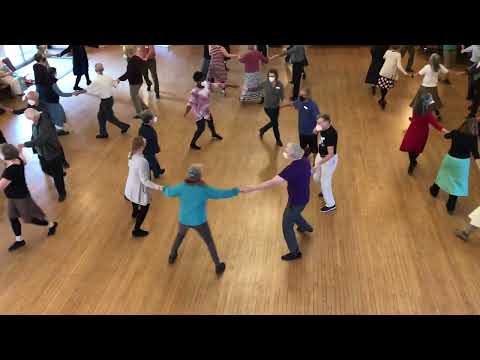
Gambols is a modern-choreographed English country dance for four couples, made by Jenna Simpson. It belongs to the living tradition of newly composed longways dances written in the historic English country dance idiom rather than to the theatrical ballet repertoire, and it is preserved through publication and community teaching rather than through a company's stage history.
What it contains
- English Country Dance · The whole dance — A newly choreographed dance built entirely in the English country dance vocabulary: figures for four couples performed in a longways set to a single period-style tune. Source: "Gambols is an English country dance created by Jenna Simpson for four couples."
- Longways Set · The whole dance — The dance's entire structure is organised as a longways set of four couples, the defining formation for the figures danced. Source: "The dance is composed for four couples longways."
What is danced
The dance is built for four couples in a longways set, the standard formation of English country dance in which couples face each other down the length of a line rather than in a circle or square. The article does not itemise the figures (hands-across, casting, turns, siding, etc.) danced within that formation, so the specific choreographic sequence cannot be reconstructed from this source. What can be said with confidence is the structural frame: four-couple, longways, set to a single named tune, which places it squarely in the ECD compositional convention of pairing a fixed formation with a period or period-style melody.
Context
The tune Simpson used, "The Shepherd and Shepherdess," predates the choreography by more than two centuries, appearing in a 1799 collection from the London publisher Thompson and in an earlier collection from John Johnson of Cheapside — part of the large stock of 18th-century country dance tunes that later composers continue to draw on. Simpson's dance itself belongs to the 21st-century English country dance revival scene, in which callers and choreographers write new longways dances in the historic idiom for present-day dance communities and camps rather than for a stage; the 2017 publication of the dance within a collection is typical of how such work circulates.
Staging history
The article gives a compositional history rather than a performance history: Simpson devised the dance in 2011, revised it in 2014, and published it in the 2017 collection Under the Influence. No company, venue, or premiere performance is named; the dance's public life described here is through print (and, per the external links, video demonstration) rather than through staged revivals.
How to watch it
Watch for the longways-set logic: four couples arranged in a line, with the dance's figures built to interact across and along that line rather than in a round. Because this is a participatory folk form rather than a proscenium ballet, attend to how the dance maps onto the phrase structure of "The Shepherd and Shepherdess" rather than to any narrative or theatrical staging.