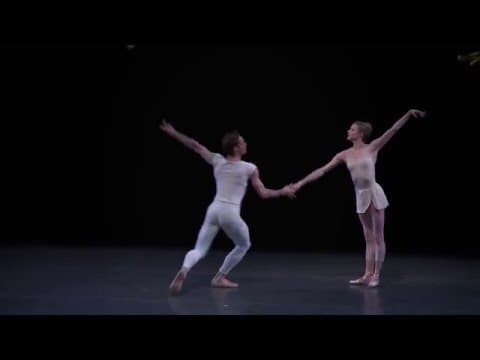
Hallelujah Junction
Hallelujah Junction is a plotless one-act ballet made by Peter Martins, described in the source as the eighth ballet he made to music by John Adams. It was created on the Royal Danish Ballet, premiering in Copenhagen in 2001, before entering the New York City Ballet repertory the following year — the company where Martins was ballet master in chief. It belongs to the line of Martins works built directly on a concert score rather than a narrative libretto.
What is danced
The article itself gives almost no detail on steps or vocabulary. The one concrete staging fact it supplies is that the two pianists performing Adams' score appear in silhouette above the dancers throughout, under Mark Stanley's lighting — meaning the live musical apparatus is made visually part of the stage picture rather than hidden in a pit. Beyond that, the source records no synopsis, no named divertissements, and no description of the choreography's technical vocabulary, so nothing about partnering, pointe work, or ensemble patterning can be sourced to the text as given. From outside knowledge of Martins' output (not stated in the article, so flagged here rather than coded), this is a plotless, musically driven piece for a small ensemble in the fast, interlocking, Balanchine-descended idiom typical of his abstract scores-to-music ballets of this period — but that cannot be verified from what the article actually says, and no taxonomy code is being attached on that basis alone.
Context
By 2001 Peter Martins had spent over a decade as George Balanchine's successor at New York City Ballet, continuing the company's practice of setting abstract, musically-led ballets on contemporary concert scores rather than narrative subjects. Adams' two-piano piece "Hallelujah Junction" (1996) was itself already established in the concert repertory, and Martins' choice to stage it — and to give the pianists visible presence in silhouette — reflects a recurring NYCB-era interest in foregrounding the live musicians as part of the dance's architecture. Making the ballet first on the Royal Danish Ballet, a company with its own distinct classical tradition (Bournonville), before transferring it to NYCB, situates the work within a period of cross-company exchange for Martins.
Staging history
According to the article, the ballet premiered with the Royal Danish Ballet at the Royal Danish Theatre, Copenhagen, on 24 March 2001, and was brought into the New York City Ballet repertory at the New York State Theater, Lincoln Center, on 22 January 2002. The article records no further stagings, revivals, or cast changes beyond these two premieres, and the "Original cast" section of the source is empty.
How to watch it
Watch for the relationship staged between the two silhouetted pianists above the stage and the dancers below: the lighting design makes the live musical labor of the two-piano score a constant visual counterpart to the choreography, not incidental pit music. Beyond that staging conceit, the article gives no synopsis or numbers to orient a first viewing, so approach it as a plotless, score-driven piece rather than looking for narrative incident.
Credits
- composer: John Adams