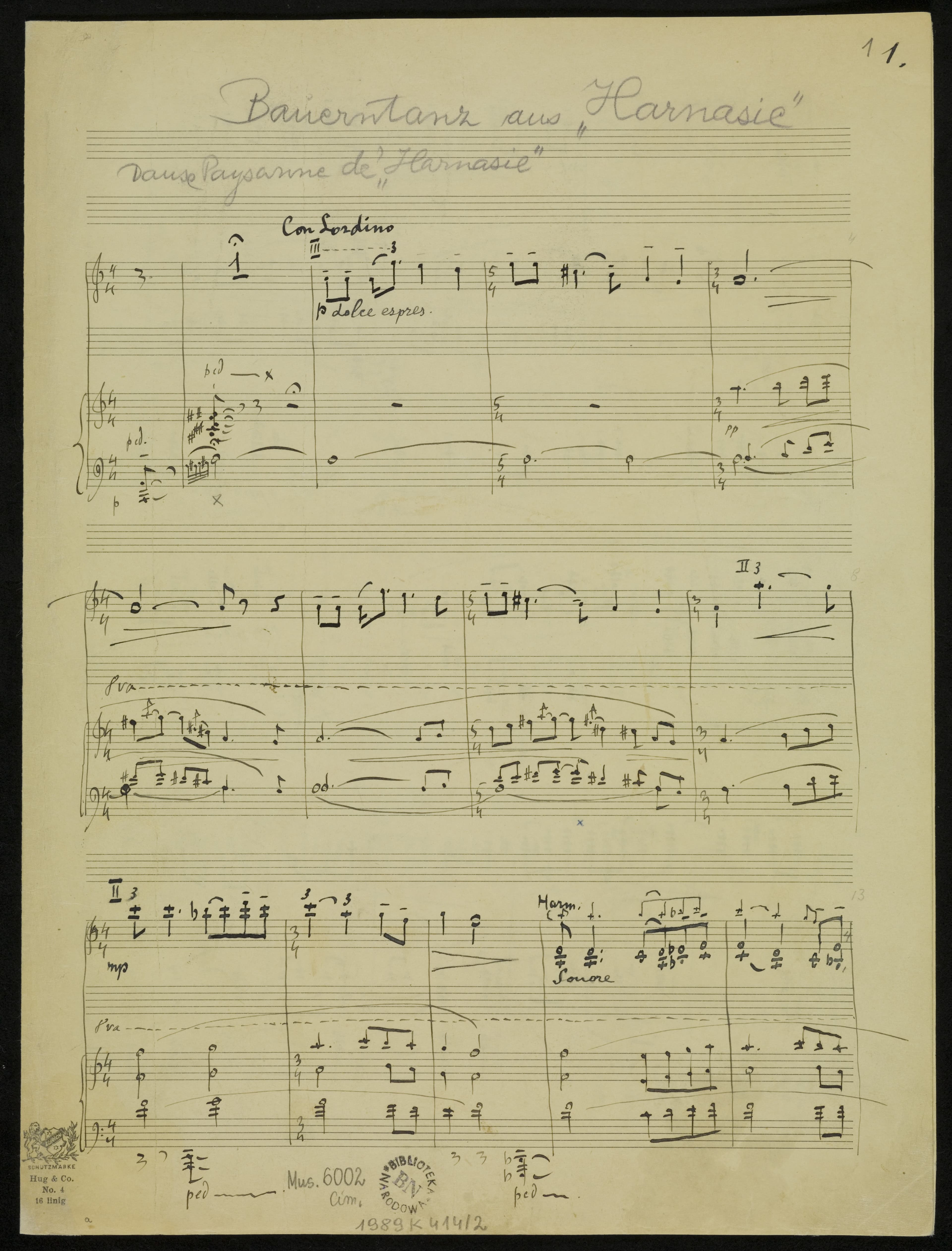
Karol Szymanowski — https://polona.pl/item/bauertanz-aus-harnasie,MTU4MDA0OQ/0/#info:metadata · Public domain
Harnasie (1935)
Harnasie, Op. 55, is a ballet-pantomime by Karol Szymanowski, composed 1923–1931 to a libretto by Jerzy Rytard, his wife, and Jarosław Iwaszkiewicz (also librettist of Szymanowski's King Roger). It dramatises a Tatra-mountain legend of a bride abducted by the robber Harnaś and his band, drawing on the folk music and folklore of the Gorale people that Szymanowski studied after first visiting Zakopane in 1921. The score sets a choir and tenor solo alongside the orchestra and is built extensively from folk-song material.
What is danced
The article gives a plot synopsis but no detailed choreographic description, so the specific step vocabulary used in any of the three staged productions (Nikolská, Lifar, Stakiewicz) cannot be established from this source. What can be said is structural: the work runs a prelude into two acts covering three scenes with only three principal roles (the shepherd, the girl, and Harnaś), meaning the piece is carried by a small cast through mimed narrative action — driving sheep to pasture, an encounter, an abduction from a wedding, captivity in the robber's den — rather than by a large corps de ballet spectacle for most of its length.
The one explicitly named dance event is the closing epilogue, described as concluding 'in an epilogue with a lively dance,' following the robber's-den scene. This is the only point the article identifies as a discrete danced set piece rather than mimed plot action, and given the work's folk-song basis it is reasonable to expect this epilogue drew on Gorale/Tatra folk-dance idiom, but the article does not name a specific dance form and I am not treating that inference as established fact.
Because the article does not describe steps, holds, or technique for any production, no vocabulary-level claims can be safely coded against the taxonomy from this source alone.
Context
Szymanowski composed Harnasie in the 1920s–30s, a period when he was turning from the exoticism of works like King Roger toward Polish folk material as a national and personal source, following his direct fieldwork among the Gorale mountain people of Zakopane from 1921 onward. The ballet's 1935–1938 stagings put it in the hands of choreographers working across different traditions — a Czech premiere, a Paris Opéra production by Serge Lifar, and a Polish premiere in Poznań — reflecting the wider interwar practice of touring composer-driven 'national' ballets through multiple European houses with locally commissioned choreography rather than a single fixed production.
Staging history
The ballet was first performed on 11 May 1935 at the Národní Divadlo in Prague, choreographed by Jelizaveta Nikolská. A second production followed on 27 April 1936 at the Palais Garnier in Paris, choreographed by Serge Lifar; this staging was, per the article, an exceptional success for Szymanowski, coming less than a year before his death. The Polish premiere took place on 9 April 1938 at the Teatr Wielki in Poznań, choreographed by Maksymilian Stakiewicz.
How to watch it
Watch for the balance between mime and dance: with only three principal characters and a plot driven by pastoral work, courtship, and abduction, much of the ballet is likely to read as narrative pantomime rather than continuous dancing, with the choir and tenor solo carrying folk-song material alongside the orchestra. The named epilogue's 'lively dance' is the moment the article itself singles out as a set piece, so it is worth attending to as the work's danced climax rather than its dramatic one.
Structure
- Scene 1The shepherd drives his sheep to pasture and the girl encounters Harnaś.
- Scene 2Harnaś kidnaps the girl from her wedding.
- Scene 3 · EpilogueIn the robber's den, the action concludes with an epilogue featuring a lively dance.
Structure read from an encyclopaedia article, not from a libretto or score we hold. Confirm against a programme before treating the numbering as authoritative.
Credits
- composer: Karol Szymanowski