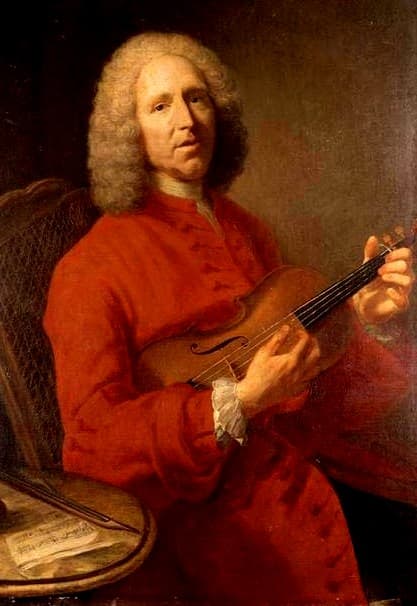
Attributed to Joseph Aved / Formerly attributed to Jean-Baptiste-Siméon Chardin — Unknown sourceUnknown source · Public domain
Io (1800)
Io is an unfinished acte de ballet by Jean-Philippe Rameau, a one-act stage work combining recitative, arias and vocal ensembles with a mythological plot about Jupiter's pursuit of the nymph Io. It survives only as a fragment — the score breaks off mid-scene — and its date, authorship and performance history in Rameau's own lifetime are all disputed by scholars. It sits in the catalogue as a rare case of a Baroque French lyric-tragedy/ballet hybrid that had to wait roughly three centuries for a stage realisation.
What is danced
The article is explicit that dance is almost entirely absent from the surviving score: 'There is no overture or chorus and only a single dance.' No further detail is given about that dance's form, placement in the action, or the steps it called for, so nothing can be said with confidence about its vocabulary — whether it was a courtly dance of the ballet de cour type, a divertissement tied to a specific character (Mercury, Apollo, La Folie), or something else entirely. This is unusual for an acte de ballet, a genre that normally leans on dance interludes, and the scarcity is itself a notable feature for anyone approaching the work from a dance-history angle rather than a purely musicological one.
Context
Rameau's acte de ballet form belongs to the world of French Baroque lyric theatre, where sung drama and formal court/theatrical dance alternated within a single short act, typically built around mythological or allegorical plots. The scholarly dispute over Io's date (either predating 1745, per Sadler, or written by Adrien-Joseph Le Valois d'Orville before being folded into Platée, per Bouissou) places it squarely in the period when Rameau was developing the comic and tragic strands of French opera-ballet that would feed into works like Les fêtes de Polymnie and Platée. The near-total absence of dance in the surviving fragment is itself a historical curiosity within that repertoire, since the genre elsewhere relies heavily on danced divertissements.
Staging history
The article records no performance during Rameau's lifetime. Sylvie Bouissou completed the opera, and it received its first performance by Opera Lafayette with dancers from the Seán Curran Company at the Kennedy Center in Washington, D.C. and El Museo del Barrio in New York in May 2023 — a modern completion and premiere staged roughly three centuries after the work is thought to have been written.
How to watch it
Because the surviving material is dominated by recitative, arias and vocal ensembles rather than dance, a viewer should attend to the vocal drama — the seduction plot involving Jupiter, Apollo and Io, and the disguises of Hylas and Philemon — as the primary theatrical content. Any staged dance element will necessarily be a modern interpolation or reconstruction rather than something the fragmentary score specifies in detail, so treat danced moments in the 2023 production as the completer's and choreographer's own solution to a gap in the source.
Structure
- Act IJupiter, disguised as the shepherd Hylas, and Apollo, disguised as the shepherd Philemon, both court the nymph Io; a storm breaks out and Jupiter reveals his true identity, after which the two declare their love.
- Act ILa Folie announces that Apollo has abandoned Mount Parnassus and that she has stolen his lyre amid the chaos; the score breaks off here.
Structure read from an encyclopaedia article, not from a libretto or score we hold. Confirm against a programme before treating the numbering as authoritative.