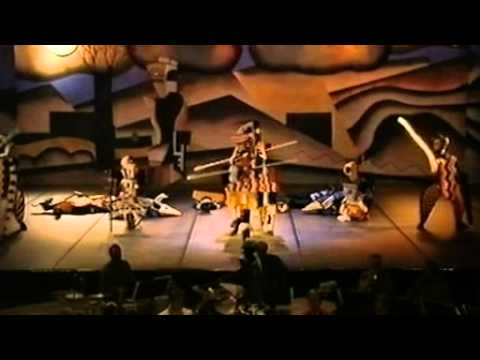
La création du monde (1923)
La Création du monde is a fifteen-minute ballet score by Darius Milhaud, composed 1922–23 to a libretto by Blaise Cendrars retelling the creation of the world through African folk mythology. It was commissioned by the Ballets Suédois, the company built by Rolf de Maré as a rival to Diaghilev's Ballets Russes, and premiered on 25 October 1923 at the Théâtre des Champs-Élysées in Paris.
What is danced
The article is almost entirely about the score, its jazz sources, and the visual design, not about the choreography itself. It states only that the work was 'cast as a ballet in six continuous parts' and that the choreography 'is revived occasionally out of curiosity' — no step vocabulary, technique, or named choreographer is given anywhere in the text. The one concrete physical detail concerns costume, not movement: Fernand Léger's designs 'worked well visually, but were difficult to dance in; the costumes were heavy and too inflexible to allow the dancers to move freely,' which tells us the original staging imposed real restrictions on the dancers' range of motion regardless of what was choreographed.
Because no synopsis, scene breakdown, or description of steps survives in this source, nothing here can responsibly be mapped onto a specific dance-technique code. A reader wanting the actual choreographic vocabulary — reportedly drawing on African-inspired and jazz-age social-dance gesture within a Ballets Suédois idiom — would need to go beyond this article.
Context
The ballet was made at the height of 1920s Paris jazz-age fascination with African and African-American culture — Milhaud himself describes encountering 'authentic' jazz in Harlem and hearing 'negro music' at the Gaya Bar, and situates the work alongside Josephine Baker's popularity and Picasso's mask-influenced paintings. It reflects both the Les Six ideal of drawing on popular art forms and a long French taste for exoticism, and was part of the Ballets Suédois's broader attempt, in the article's words, to 'follow the trend' of African and Afro-American fashion sweeping Paris. The Ballets Suédois itself was a major early-1920s company staging five seasons in Paris and touring continually, positioned as contemporary to Diaghilev's company.
Staging history
The article records only that the original costumes and sets by Fernand Léger survive in museums and galleries, that the music has entered the concert repertory (documented through numerous recordings from Milhaud's own 1932 account through Bernstein, Munch, Rattle, Tilson Thomas and others), and that the choreography 'is revived occasionally out of curiosity' without naming any specific revival, company, or choreographer.
How to watch it
Listen for how the six continuous musical sections build from a jazz-inflected orchestral texture (alto saxophone standing in for the viola, a one-man percussion battery, piano and string quartet) toward the score's celebrated 'swinging climaxes' — this musical architecture is the clearest structural guide available, since no scene-by-scene synopsis survives here. When watching any staged revival, weigh the visual impact of Léger's designs against the reported physical restriction they placed on the dancers, a tension the piece is historically known for.
Credits
- composer: Darius Milhaud