— Europeana · Public domain
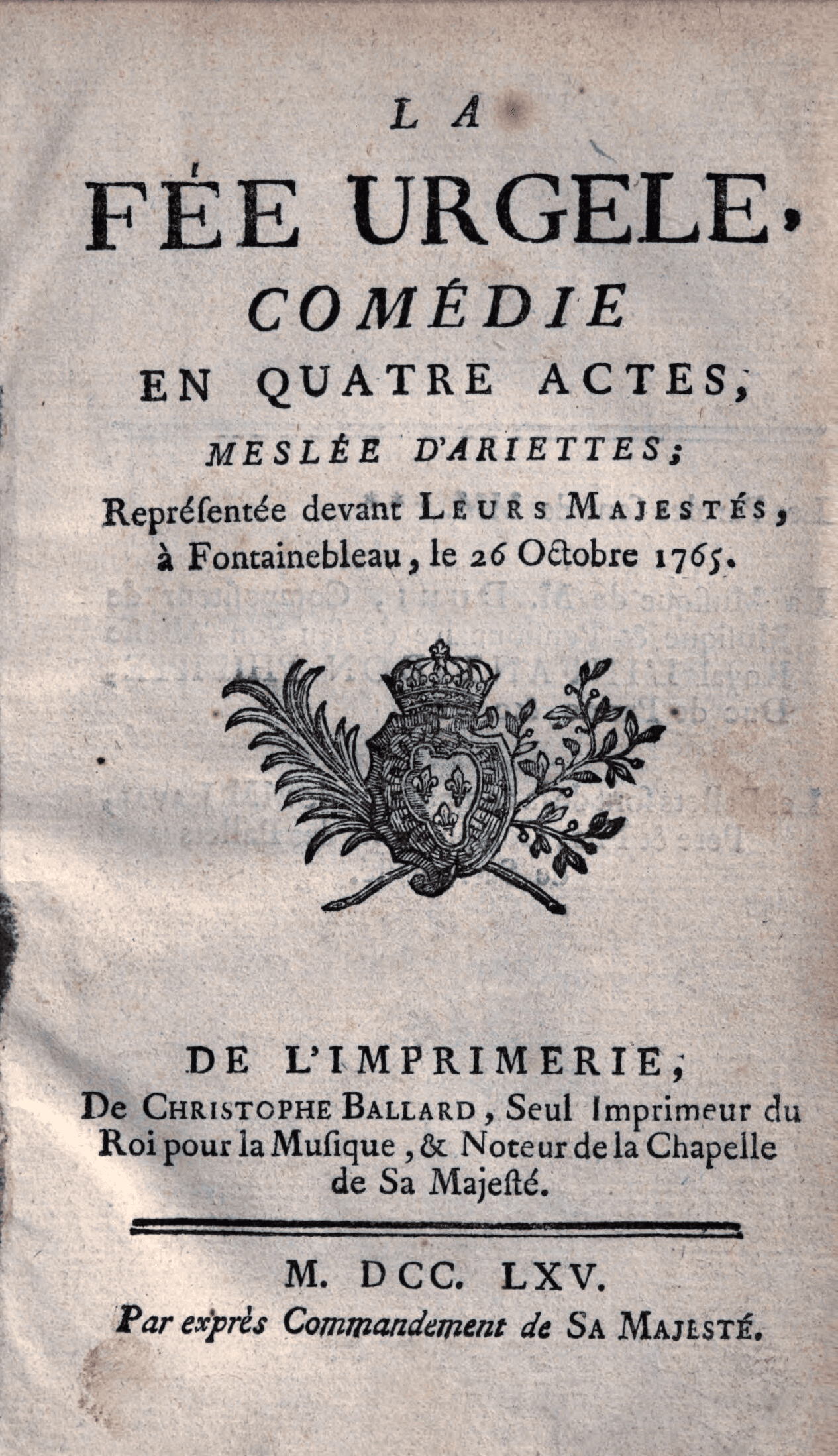
La fée Urgèle, ou Ce qui plaît aux dames is a four-act opéra comique (comédie mêlée d'ariettes) by Egidio Duni, with a libretto by Charles-Simon Favart drawn from Voltaire's Ce qui plaît aux dames and Chaucer's "The Wife of Bath's Tale". It premiered at the Théâtre Royal de la Cour, Palace of Fontainebleau, on 26 October 1765, with an elaborate medieval staging reported to have cost 20,000 livres.
What is danced
The article gives no description of choreography, dance numbers, or movement vocabulary anywhere in the text. It covers the libretto's literary sources, the cast of singers and spoken-role performers who created the piece, the cost and character of the original staging, and later concert-style revivals conducted by Christophe Rousset. Nothing in the source ties dance specifically to any act, scene, or number, and the choreographer credited on our record, Antoine Pitrot, is not named in the article at all.
Context
The article notes that the production's medieval setting was influential beyond itself: it 'popularized medieval settings for other operas such as André Grétry's Aucassin et Nicolette (1779) and Richard Coeur-de-lion (1784).' This places the work within the mid-1760s vogue for chivalric and pastoral subject matter at the French court and, via the Comédie-Italienne transfer, in the wider Parisian comic-opera repertoire, where opéras comiques of this period regularly incorporated ballet divertissements even when librettos and cast lists (as here) do not spell them out.
Staging history
The opera premiered at Fontainebleau on 26 October 1765 and was revived at the Comédie-Italienne on 4 December 1765, after which it was 'given over 100 times in the following years.' It resurfaced in the modern era at the Opéra Comique for eight performances from 12 to 20 April 1991, staged by Les Arts Florissants under Christophe Rousset with Monique Zanetti as Urgèle, paired with Favart's La répétition interrompue; that production then toured Caen, Montpellier, Colmar, Mulhouse, and Strasbourg in February 1994.
How to watch it
Approach it as a comédie mêlée d'ariettes: a spoken-and-sung comic opera structure rather than a danced spectacle, built around the Chaucerian riddle-plot of the knight who must answer what women most desire. The elaborate original medieval décor was itself a talking point of the premiere, per Grimm's account of its cost, so period staging and design convention are more documented here than dance.