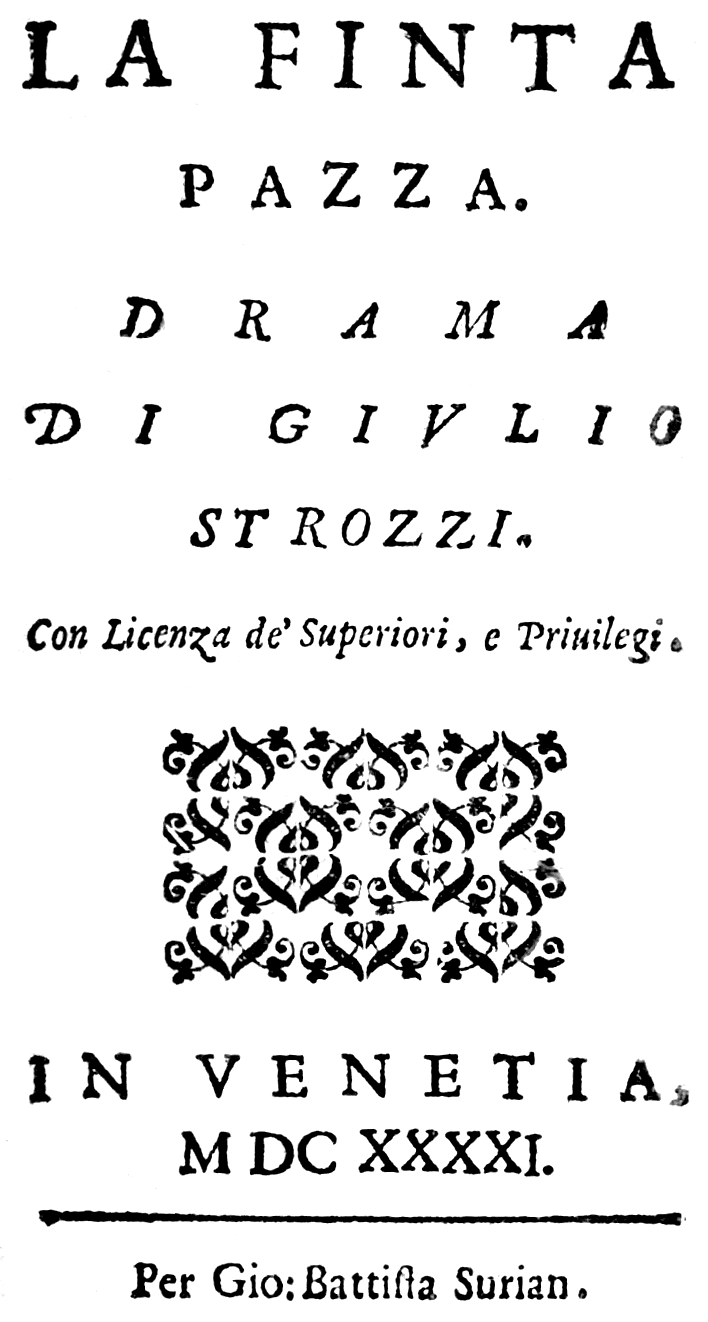
Francesco Sacrati / Giulio Strozzi — https://mdz-nbn-resolving.de/urn:nbn:de:bvb:12-bsb00047961-9 · Public domain
La finta pazza (1641)
La finta pazza is a mid-seventeenth-century Venetian opera by Francesco Sacrati, on a libretto by Giulio Strozzi, that inaugurated the Teatro Novissimo in Venice in 1641 and became one of the most-performed operas of its century. Our record files it under 'ballet' and describes it simply as 'opera by Francesco Sacrati'; the source article confirms it as an opera throughout and gives no indication that dance was integral to the original Venetian production — its presence in a dance catalogue rests almost entirely on a single later staging.
What is danced
The article does not describe the 1641 Venice premiere as containing dance at all; its innovations were vocal (Anna Renzi's mad-scene as Deidamia), scenic (Giacomo Torelli's machinery, documented in the Cannocchiale booklet) and dramaturgical (disguise, feigned madness). The one point at which dance enters the record is the December 1645 Paris production at the Hôtel du Petit-Bourbon, mounted by Cardinal Mazarin and again designed by Torelli, which 'featured additional ballets by Giovan Battista Balbi.' No further detail is given about what these ballets consisted of — no named dances, no description of steps, holds, or technique — so nothing about the actual vocabulary danced can be established from this source.
Context
The work belongs to the first wave of commercial Venetian opera, staged in a theatre (the Teatro Novissimo) built expressly to compete with three existing houses. Its use of feigned madness and cross-dressed disguise as a plot engine was widely imitated in Venetian opera through the mid-1650s. The Paris transplant of 1645, engineered by Mazarin to introduce Italian opera to the French court, is historically significant as an early instance of grafting French court-ballet interludes onto an imported Italian opera, a practice that anticipates the closer opera-ballet fusions Lully would later develop; the article, however, only names the fact of Balbi's ballets without describing their content.
Staging history
After its Venice run of twelve performances in seventeen days (with a second run after Easter, itself a first for the city), the opera was restaged repeatedly: Piacenza (1644), Florence and Paris (1645), Bologna and Genoa (1647), Turin and Reggio Emilia (1648), Naples and Milan (1652), and again in Reggio Emilia in 1679 under the title Gli Amori Sagaci. The Paris production of 1645 is the only staging the article associates with named dance content (Balbi's added ballets); it is unclear from the text whether any of the other revivals also incorporated dance, or used the same music throughout.
How to watch it
As transmitted by this article, the work should be approached as sung theatre built around Anna Renzi's virtuoso feigned-madness scene and Torelli's scenic transformations, not as a dance work. Anyone specifically chasing the danced content should look toward the lost Balbi ballets from the 1645 Paris version rather than the Venetian original.
Credits
- composer: Francesco Sacrati