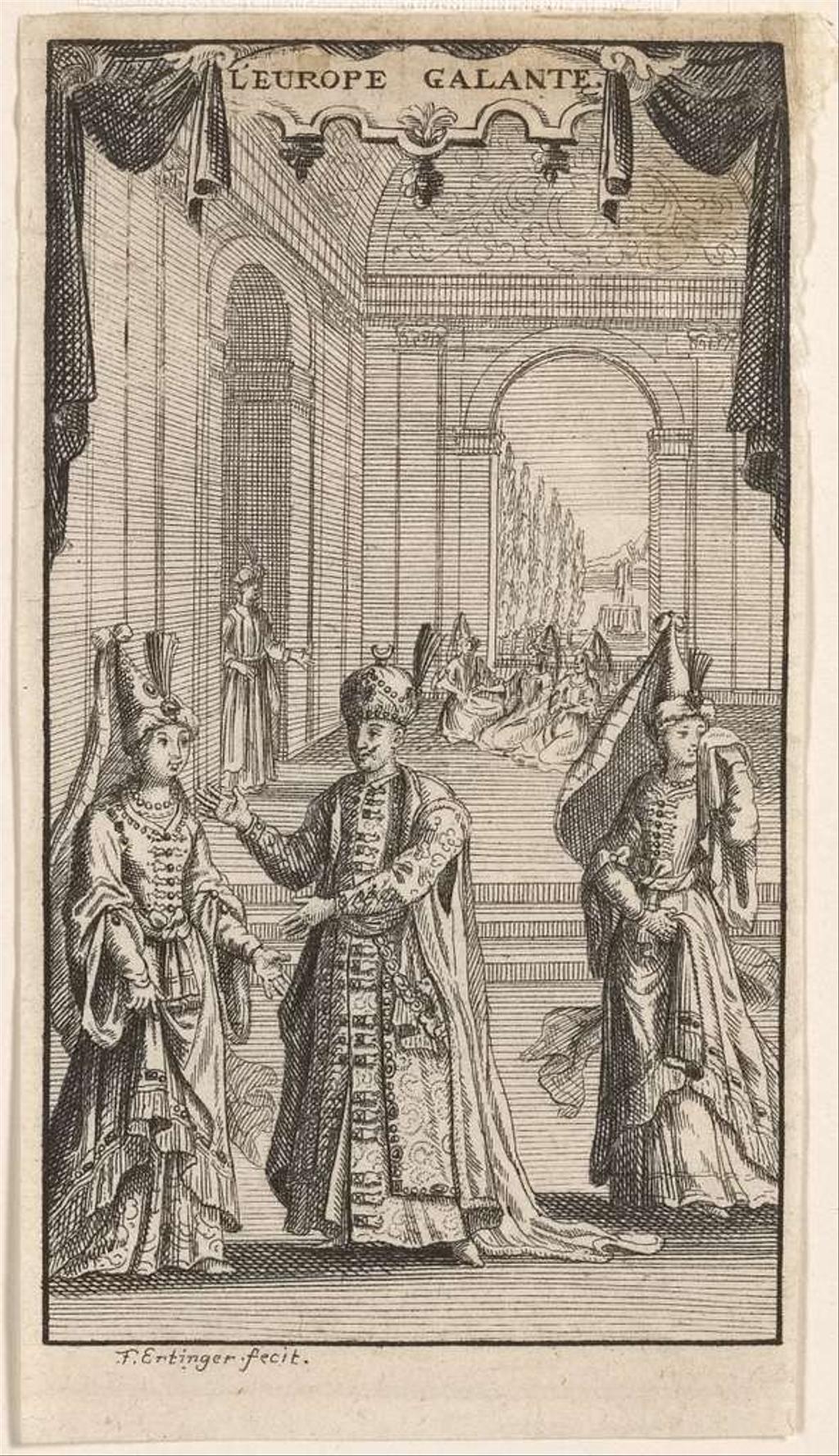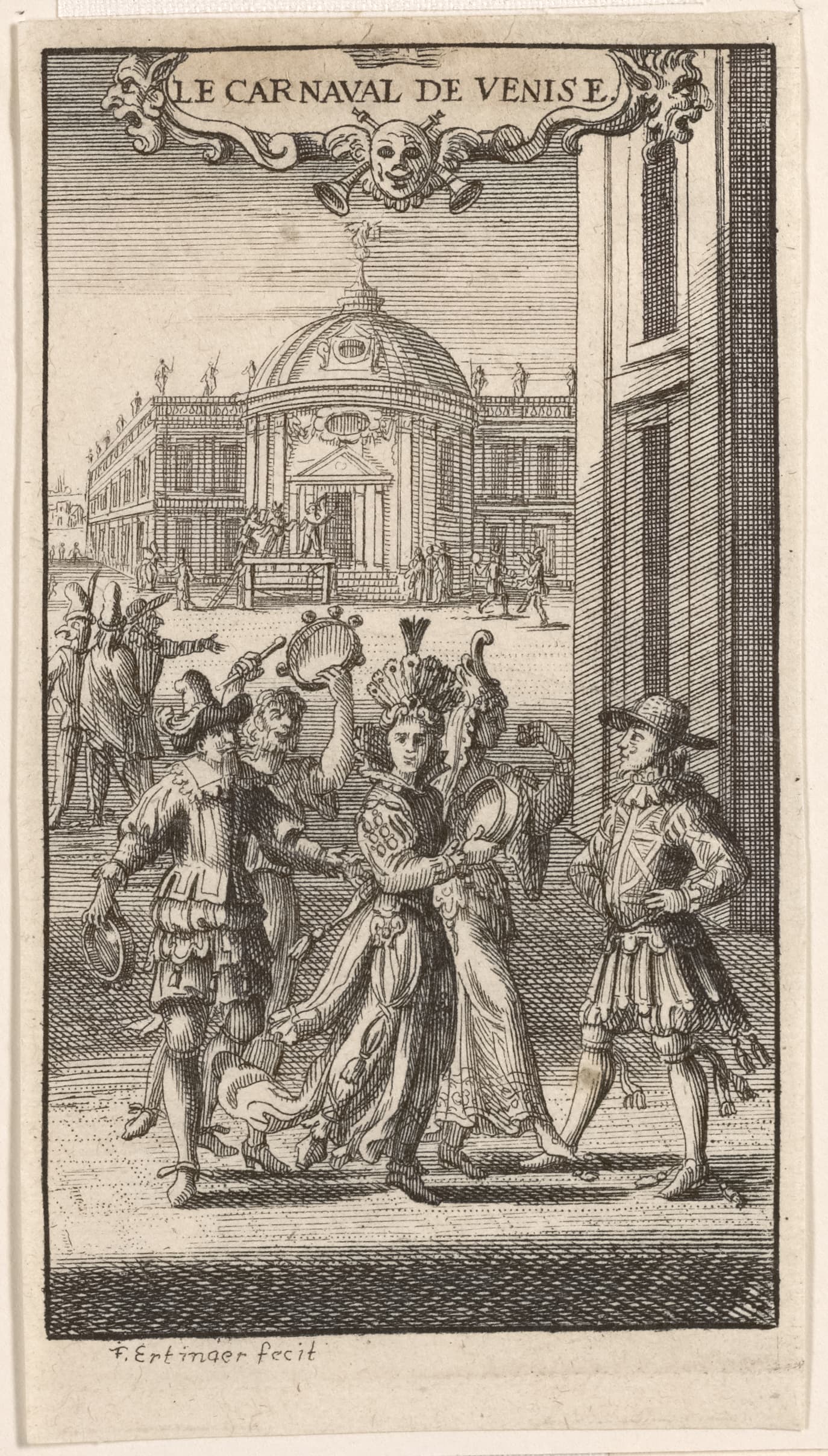
Franz Ertinger · Public domain
Le carnaval de Venise (1800)
Le carnaval de Venise is a comédie-lyrique (a hybrid French/Italian opera) in a prologue and three acts, composed by André Campra to a libretto by Jean-François Regnard, first given by the Académie royale de musique in Paris in 1699. Our record lists it as a ballet with a premiere year of 1800 and no choreographer, but the source article describes an opera nearly a century earlier, staged by an opera company rather than danced by a ballet troupe — this discrepancy should be treated as a research lead, not resolved here.
What is danced
The article never gives step-level detail, but it does describe several built-in danced divertissements typical of French opera at the turn of the eighteenth century. The Prologue stages an allegorical construction of a theatre: Minerva calls on 'the gods of the arts,' and Music, Dance, Painting and Architecture appear 'with their escorts' to build the stage — a court-style allegorical entrée rather than narrative choreography. In Act I a troupe of 'Bohemians, Armenians, and Slavs' sing in Italian and dance to guitars, functioning as an exoticised character divertissement embedded in the love-triangle plot. Act III contains a competitive/celebratory divertissement between two named Venetian factions, the Castelans and Nicolotes, danced to fifes and tambourines, with the winning faction dancing out its joy — this reads as a mock-combat or victory dance rather than abstract court dance. The finale layers a masked-ball divertissement (maskers dancing 'with great seriousness,' then a comic chariot of maskers joining in) over the embedded Orpheus-and-Eurydice scene sung in Italian.
Context
Campra's score is described by a critic quoted in the article as blending Lully, Lalande, Monteverdi and Cavalli while anticipating Handel and Rameau — placing the work at the hinge between the French tragédie lyrique tradition (with its Lullian prologue of gods and its danced entrées) and the more Italianate, comic and vernacular opera-ballet forms that followed. The presence of an allegorical prologue honouring 'a glorious monarch,' commedia dell'arte plotting, and an embedded Italian-language mythological scene (Orpheus in the underworld) all point to a work self-consciously mixing French court-opera convention with imported Italian and folk material, including Provençal tunes used again by Campra in the final act.
Staging history
The work was revived for Louis, Grand Dauphin in February 1711 at his request, shortly before his death, having pleased him at its dedication. In modern times it was presented at the Aix-en-Provence Festival in July 1975, conducted by Michel Plasson and directed by Jorge Lavelli, with a cast including Christiane Eda-Pierre, Martine Dupuy, Bruce Brewer and Roger Soyer; the Boston Early Music Festival mounted a further production in June 2017. A 2011 recording under Hervé Niquet with Le Concert Spirituel, featuring Salomé Haller, Marina De Liso, Andrew Foster-Williams and others, was praised by Gramophone.
How to watch it
Watch for the shift in register between the sung, French-language love-triangle plot of Acts I–II and the Italian-sung mythological interlude of Act III — the dance divertissements sit at the seams between these registers (opening allegory, Act I exotic troupe, Act III factional and masked-ball dances). None of the dance is described as virtuosic or soloistic in the article; treat it as ensemble, occasion-bound divertissement rather than a vehicle for a principal dancer.
Structure
- Act PrologueMinerva summons the gods of the arts; Music, Dance, Painting and Architecture appear with their escorts and build a theatre before unveiling the Venice carnival.
- Act IAmid the Léonore–Isabelle–Léandre love triangle, a troupe of Bohemians, Armenians and Slavs appears with guitars, singing in Italian and dancing.
- Act III · Divertissement of Castelans and NicolotesTwo rival Venetian factions dance to fifes and tambourines; the Castelans defeat the Nicolotes and express their victory in dance.
- Act IIIAfter the embedded Italian-language Orpheus scene, the figure of Carnival leads masked dancers from all nations, first gravely then comically, joined by a chariot of comic maskers.
Structure read from an encyclopaedia article, not from a libretto or score we hold. Confirm against a programme before treating the numbering as authoritative.
Credits
- composer: André Campra
More from André Campra
Other staged works in the register connected to this one by author or lineage.