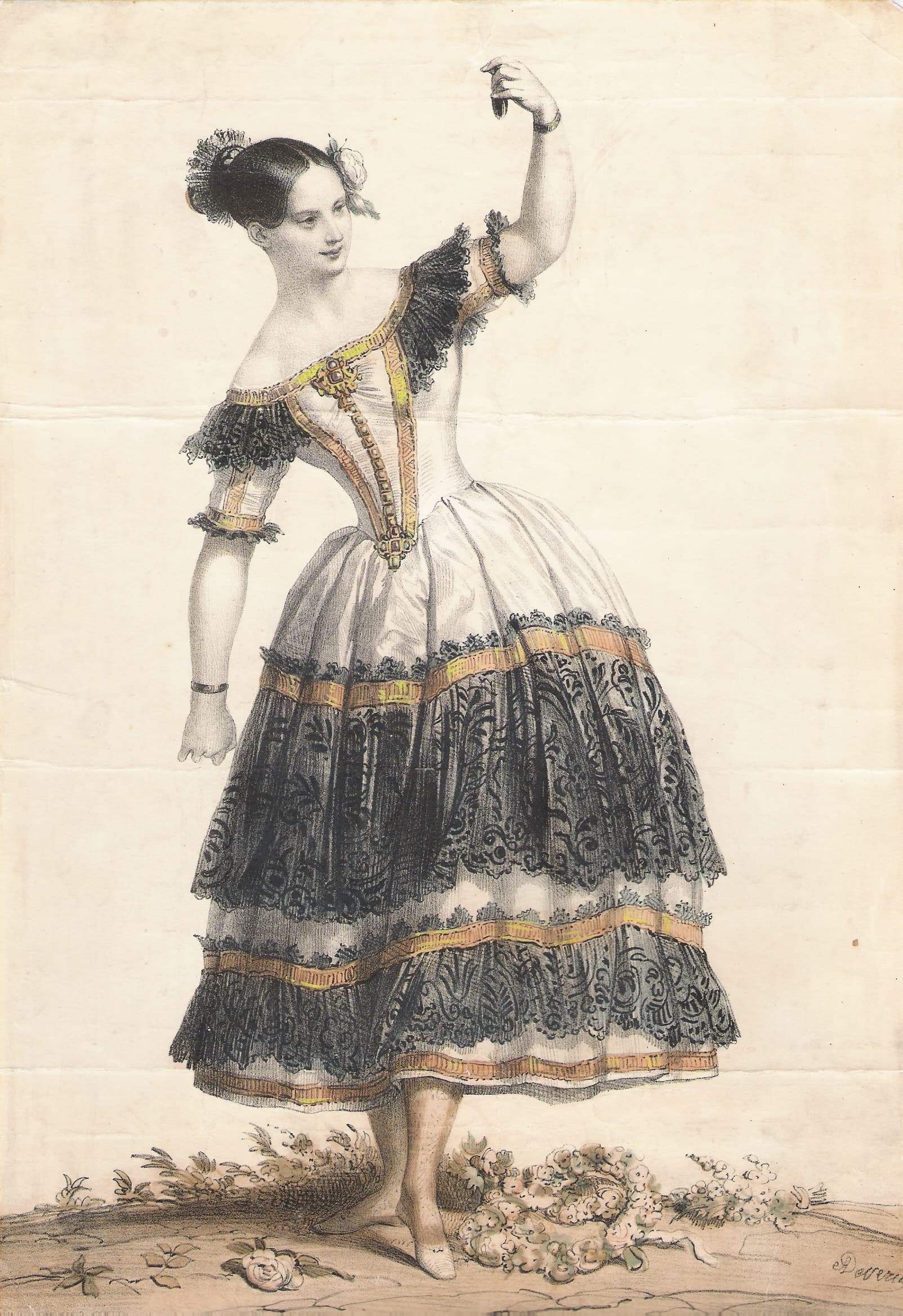
— Own work Huster · Public domain
Le Diable boiteux is a three-act ballet choreographed by Jean Coralli to music by Casimir Gide, first given at the Paris Opera on 1 June 1836, loosely drawn from Lesage's novel of the same name. It is remembered less for its narrative than for a single interpolated number: the cachucha danced by Fanny Elssler, which became one of the defining performance moments of Romantic-era ballet and made Coralli's reputation as an original choreographer rather than a reviser of other men's work.
What is danced
The article's only concrete dance evidence is the cachucha performed by Fanny Elssler, described as a sensational success. This was a named Spanish solo dance, not part of the ballet's main narrative fabric but a set-piece divertissement built around Elssler's own virtuosity and stage persona. Beyond this, the article gives no synopsis, no scene breakdown, and no description of the choreographic vocabulary used in the surrounding acts, so nothing further about the ballet's danced content — its ensemble work, its principal pas de deux for Mazilier and Elssler, or its use of pantomime versus dancing — can be stated on the article's authority.
Context
The premiere sits in the middle of the first flush of Paris Opera Romantic ballet, four years after La Sylphide, and the article notes it was Coralli's first great success as a choreographer of original work rather than someone who mainly re-edited other authors' ballets. Fanny Elssler's cachucha in particular became a touchstone for a contemporary vogue for 'national' or character dance as a foil to the ethereal, pointe-based style associated with Marie Taglioni — a contrast dance historians still use this ballet to illustrate, though that framing is drawn from general dance history rather than stated in the article itself.
Staging history
The article gives no information on revivals, later productions, or how the ballet was transmitted after 1836; it covers only the original 1836 Paris Opera cast.
How to watch it
Attend to the cachucha as a self-contained showpiece rather than as narrative dance: it was prized for its Spanish-inflected footwork, castanets and a physical directness that read as earthier and more overtly sensual than the aerial, pointe-driven Romantic style epitomised by Taglioni. The ballet's wider dramaturgy, per the article, is secondary to this single number's reception.
Credits
- composer: Casimir Gide