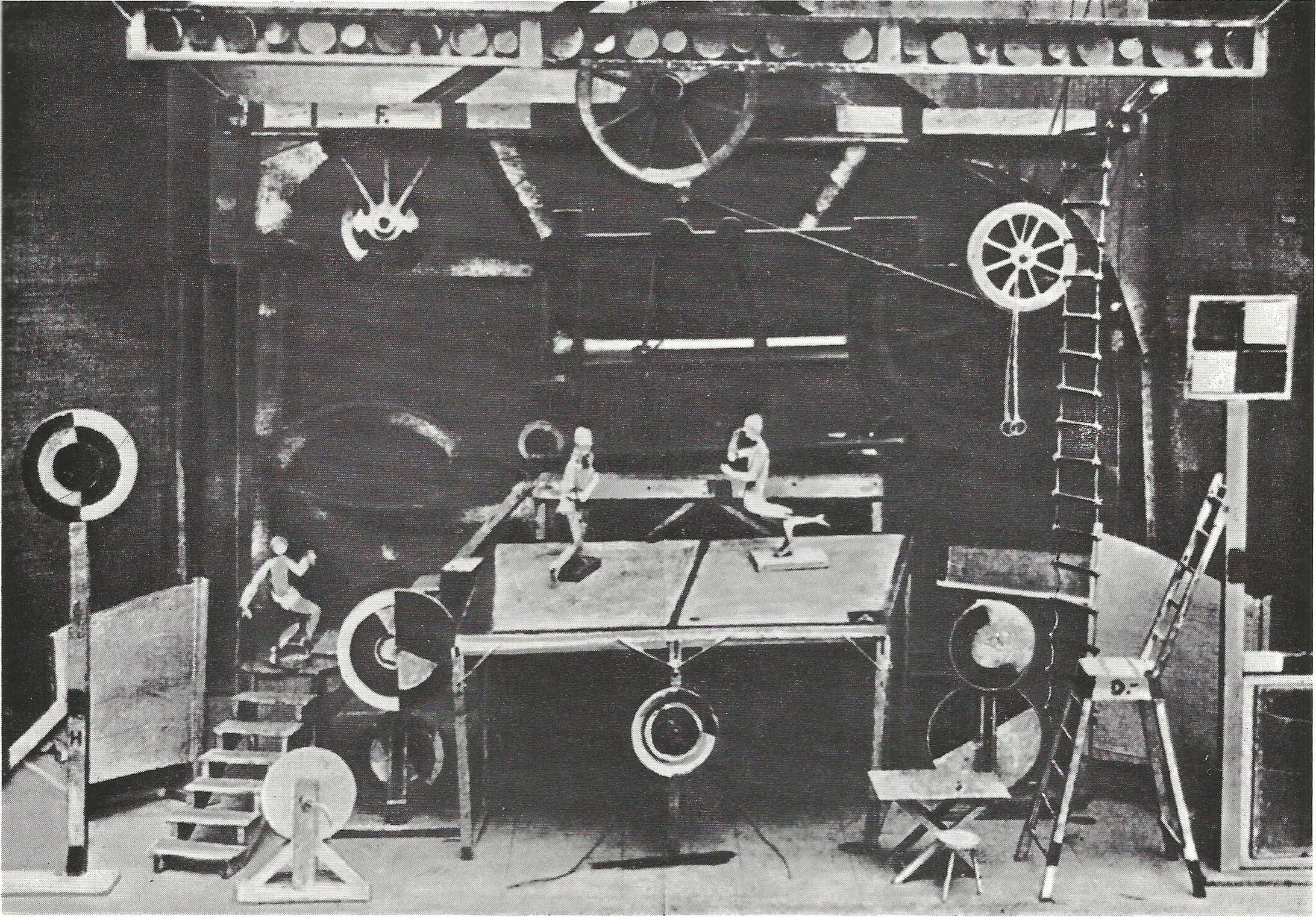
Georgi Bogdanowitsch Yakulow (1884—1928) · Public domain
Le pas d'acier
Le pas d'acier ("The Steel Step"), Op. 41, is a 1926 two-scene, eleven-dance ballet score by Sergei Prokofiev, commissioned by Sergei Diaghilev after he saw the 1925 Paris exhibition of Russian Constructivist art. The scenario, worked out with Constructivist designer Georgi Yakulov, was originally meant to depict Soviet industrial and working-class life — stations, markets, a factory — but was substantially reworked before the stage premiere to fold in the folkloric material Ballets Russes audiences expected.
What is danced
The article does not preserve any record of the choreography actually used at the 1927 premiere — it states outright that 'no record of the choreography of the eventual 1927 production has survived.' What survives is testimony about the scenario and its reception, not a description of steps, holds or technique. Critics report that the staged version, unlike Yakulov's original industrial scenario, incorporated 'scenes of Russian folklore, which were a typical element of Ballets Russes productions,' and the original (unstaged) conception included 'a danced romance between a sailor and a young girl worker' set against factory machinery and sprocketed wheels — but this describes theme and setting, not movement vocabulary, and it is unclear how much of it survived into Massine's production. Because of this gap, no specific dance style can be verified against the text for the choreographed content of the work; the entry can report the ballet's dramaturgy and score but not its steps.
Context
Le pas d'acier belongs to the late Ballets Russes repertoire of the mid-to-late 1920s, when Diaghilev was actively courting Constructivist and machine-age imagery from Soviet Russia (the commission followed his enthusiasm for the 1925 Paris exposition of Russian contemporary art). Prokofiev described the score itself as a break from the folkloristic, fairy-tale Russian idiom associated with Afanasyev and a deliberate move toward music 'which could describe contemporary life,' pushing him toward chromaticism built over sustained diatonic, white-key writing — a musical parallel to the industrial subject. The piece sits alongside contemporaries such as Mosolov's Iron Foundry in using orchestral machine-imitation (the article notes the factory scene's viola ostinato is 'nearly the same' as Mosolov's), situating the ballet within a wider vogue for machine and industrial subject matter in 1920s stage music.
Staging history
The premiere, choreographed by Léonide Massine for the Ballets Russes, took place at the Théâtre Sarah-Bernhardt in Paris on 7 June 1927, with sharply divided critical reaction — André Levinson found it caught between 'enthusiasm for Bolshevism and bitter irony,' and Stravinsky reportedly said the work 'made him ill.' It nonetheless ran for three consecutive Paris seasons and was later given in a new production at the Bolshoi Theatre, as well as in London and, in 1931, in the United States (Philadelphia), where a critic wondered whether it was 'propaganda or music.' After 1931 the ballet went unperformed until a 2005 staging at Princeton University, which the source describes as 'faithful to the original, never-performed concept of a celebration of Soviet workers' lives,' restoring the industrial-celebration intent rather than the ironic version audiences originally saw.
How to watch it
Because no choreographic record from 1927 survives, performance today (as in the 2005 Princeton revival) is necessarily a reconstruction or reinterpretation rather than a restaging of Massine's original; watch for how a given production resolves the tension the critics flagged between earnest industrial celebration and ironic parody of Soviet life. Attend also to how the factory-machinery music (sprocketed-wheel imagery, ostinato figures akin to Mosolov's Iron Foundry) is translated into stage movement, since this was the score's most distinctive dramaturgical device.
Credits
- composer: Sergei Prokofiev