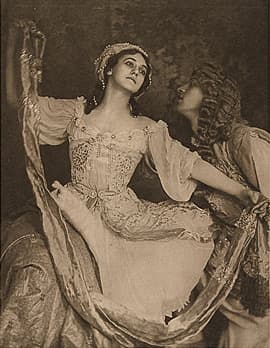
— Adapted from image at The Red List (http://theredlist.com/media/database/settings/performing-art/ballet-russe/1900-1910/pavillon-d-armide/020-pavillon-d-armide-theredlist.jpg) · Public domain
Le Pavillon d'Armide (1907)
Le Pavillon d'Armide is a one-act, three-scene ballet first given at the Mariinsky Theatre in St Petersburg on 25 November 1907, with a libretto by Alexandre Benois drawn from Théophile Gautier's novella Omphale and a score by Nikolai Tcherepnin. It belongs to the last generation of Imperial Ballet productions and, two years later, became the opening production of Sergei Diaghilev's Ballets Russes in Paris, making it a hinge work between the St Petersburg court repertory and the export repertory that reshaped Western European ballet.
What is danced
The article does not describe the choreography scene by scene or name any specific steps, so no set-piece vocabulary can be reconstructed from it. What it does establish is the cast of named roles at the 1907 premiere: Anna Pavlova as Armida, Vaslav Nijinsky as 'her slave', Pavel Gerdt as the Vicomte René de Beaugency, and a dancer named Rozai as the Clown, with Lydia Kyasht, Lubov Tchernicheva and Tamara Karsavina also in the company. That role list points to a structure built around a ballerina lead (Armida), a virtuoso male soloist role built for a dancer of Nijinsky's calibre ('the Slave'), a danseur noble role (the Vicomte), and a comic character part (the Clown) — a shape typical of Imperial-era fantastic ballets with a central pas de deux or pas d'action and a comic interlude, but the article gives no further detail on steps, mime, or ensemble patterning.
Context
The ballet was made in 1907 by Michel Fokine, working from a Benois libretto and Tcherepnin score, at a moment when the Mariinsky was still producing large decorative, French-themed fantastic ballets in the line descended from Petipa. Its transfer to Paris in 1909 mattered disproportionately to dance history: the article states it was the first ballet Diaghilev presented in Paris, and that its success there owed partly to its French subject, alongside the Russian-folklore-themed works that filled out the same season and drew the Parisian public toward what would become the Ballets Russes brand.
Staging history
Two productions are documented. The premiere was given by the Mariinsky company on 25 November 1907 in St Petersburg, staged and designed by Alexandre Benois, with Pavlova, Nijinsky, Gerdt and Rozai in the principal roles. On 19 May 1909 the Ballets Russes presented it at the Théâtre du Châtelet in Paris, with Vera Karalli as Armida, Mikhail Mordkin as the Vicomte de Beaugency, and Nijinsky again as the Slave — the production that opened Diaghilev's Paris seasons.
How to watch it
Because the article gives no scene-by-scene account, a viewer should look for what the role list implies rather than expect it confirmed here: a ballerina-centred fantastic-ballet structure (Armida), a showcase male solo or pas de deux for 'the Slave', a danseur noble role for the Vicomte, and a comic Clown part providing character contrast. Note also that Alexandre Benois designed as well as wrote the libretto, so decor and costume are as much part of the original conception as the steps.
Credits
- composer: Nikolai Tcherepnin