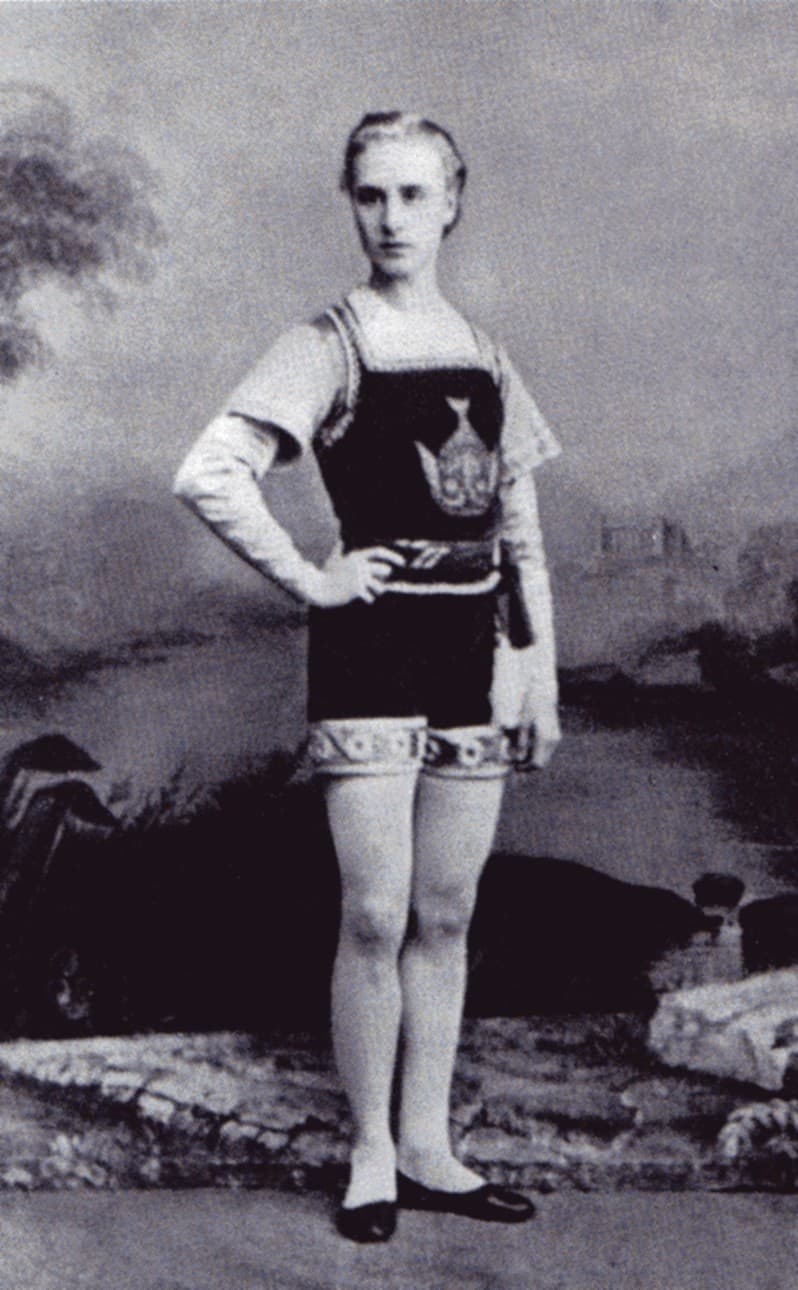
Unknown〔The original uploader was Mrlopez2681 at English Wikipedia.〕 — Transferred from en.wikipedia to Commons. · Public domain
Le Poisson doré
Le Poisson doré (The Golden Fish) is a four-act "fantastic ballet" with prologue and epilogue, made by Arthur Saint-Léon to a score by Ludwig Minkus and first given complete by the Imperial Ballet in St Petersburg in 1867, following a partial premiere of Act I at the Hermitage Theatre in 1866. It was Saint-Léon's second attempt to build a Russian-themed ballet after the success of The Little Humpbacked Horse, and it adapted Pushkin's 1835 poem The Tale of the Fisherman and the Fish, relocating the story to a Ukrainian village on the Dnieper and giving the fisherman and his wife the names Taras and Galia.
What is danced
The source article is a production and reception history, not a scenario or musical-number list, so it does not describe what was actually danced scene by scene: there is no account of variations, pas de deux, mime passages, or character-dance divertissements. What can be said with confidence is limited to casting and structure — a ballet in four acts and six scenes, with a title role (Galia) created by Praskovya Lebedeva and later danced by Guglielmina Salvioni, Alexandra Kemmerer, Ekaterina Vazem and Vera Liadova, opposite Timofei Stukolkin as Taras, with Pavel Gerdt and Lev Ivanov in supporting roles and Clavdya Kantzyreva dancing the Golden Fish itself.
Context
The ballet belongs to the Imperial Ballet's Saint-Léon era of the 1860s, when the chief ballet-master was building a run of ostensibly "Russian" story ballets for the St Petersburg stage on the strength of The Little Humpbacked Horse. The satirist Mikhail Saltykov-Shchedrin used it as an example of ballet's political and artistic conservatism, calling it emblematic of the form's failure to change while "the whole structure of life" around it was shifting — a rare piece of direct contemporary criticism of an Imperial ballet's ideological content rather than its dancing.
Staging history
The complete ballet was staged at the Imperial Bolshoi Kamenny Theatre in St Petersburg on 8–20 October 1867 with Salvioni and Stukolkin in the leads, but it left the repertoire only a few months after Salvioni's successors failed to draw audiences. In 1903 Alexander Gorsky mounted a substantially reworked version at the Bolshoi Theatre in Moscow, rewriting the libretto, removing the characters' names, expanding the ballet from three to four acts, and supplementing Minkus's score with music by Serov, Tchaikovsky, Delibes and Brahms; that production, with Nikolay Domashov, Sofia Fedorova and Enrichetta Grimaldi, also had only a short life and was not revived further.
How to watch it
Because no full choreographic record or reconstruction is described in the sources here, there is nothing to watch in performance today; the work is of interest historically as a title and a casting record rather than as a living staging. A researcher approaching it should treat it as a repertory and reception case rather than a technique case.
Credits
- composer: Ludwig Minkus