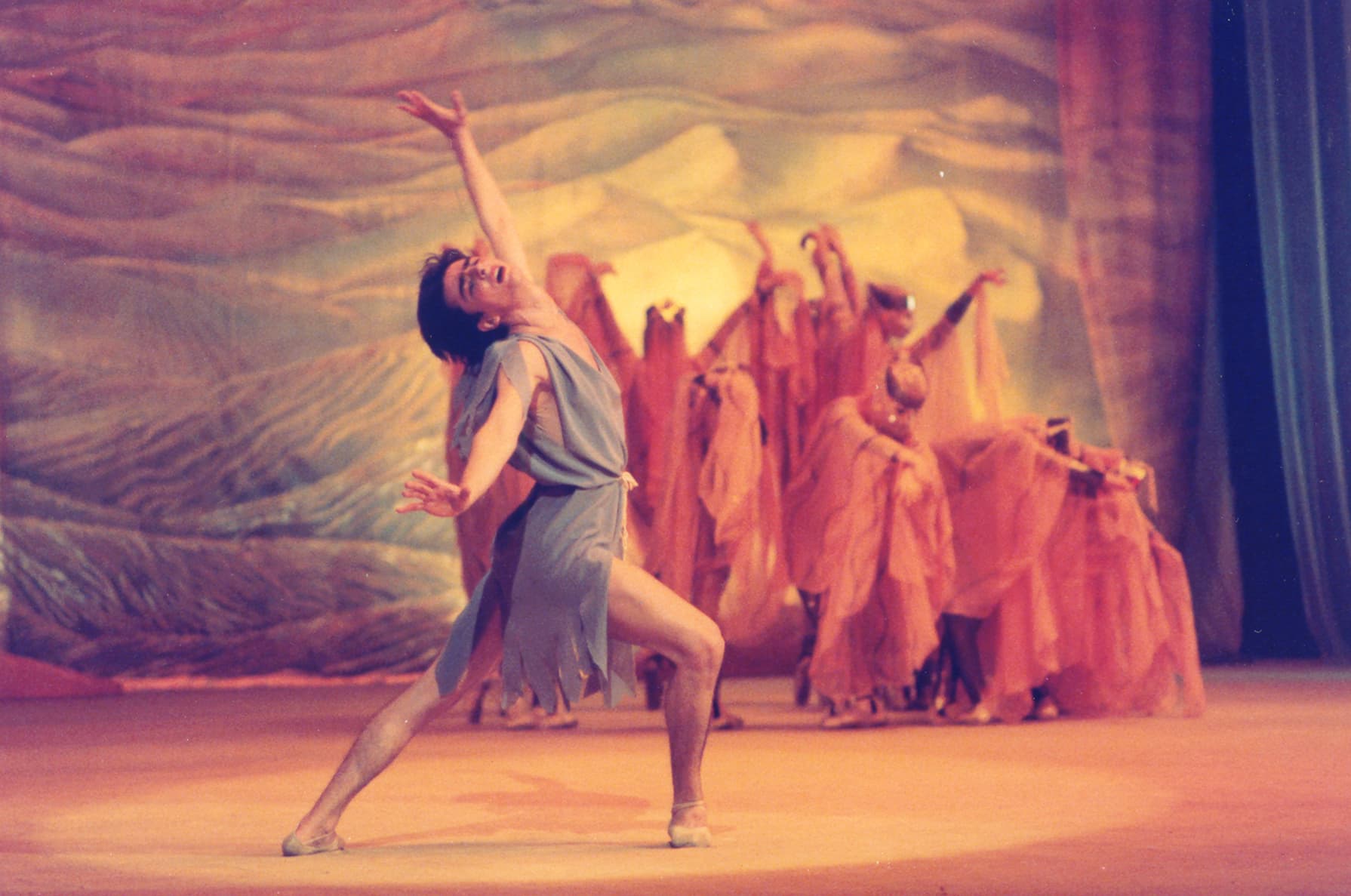
Ilgar Jafarov — Own work · Copyrighted free use
Leyli and Majnun is a one-act ballet by the Azerbaijani composer Gara Garayev, its libretto drawn from Nizami Ganjavi's 12th-century narrative poem Layla and Majnun (the third book of his Khamsa). The story is the Persian/Near Eastern counterpart to Romeo and Juliet: two lovers kept apart by their families, one forced into another marriage, the other retreating into the wilderness to die of grief, the pair reunited only after death.
What is danced
The article does not describe the choreography, step vocabulary, or technical demands of either the 1969 original by Nelya Nazirova or the 2001 restaging by Georgy Aleksidze. It records only the fact of the premiere, its conductor and principal cast, and the later production's tour to the Bolshoi. Nothing in the source text specifies whether the work is danced on pointe, what character or national idiom is used for its Azerbaijani setting, or how the corps and principals are deployed across its single act. Any statement about the actual movement vocabulary would therefore be invention rather than reporting, so no dance-style codes can be attached from this article.
Context
The ballet had its premiere in 1969 at the Azerbaijan State Academic Opera and Ballet Theater in Baku, the republic's principal stage for Soviet-era national ballet and opera, under conductor R. D. Abdullayev. The article notes that Nazirova's production was later adapted into the 1975 ballet film In the World of Legends, made by the creative association Ekran, extending the work's reach beyond the stage.
Staging history
The original 1969 production was choreographed by Nelya Nazirova, with V. N. Pletnev as Majnun and T. N. Mamedova as Leyli, and became the basis for the 1975 film In the World of Legends. In 2001 Georgy Aleksidze mounted a new production, first shown on 17 February that year with soloists R. Iskenderov and G. Mirzayev, and presented again on 4 December 2001 on the Bolshoi Theater stage during a Moscow tour.
How to watch it
The article gives no performance detail to anchor specific viewing cues; a viewer would need to look separately at the Nazirova and Aleksidze productions to compare how each stages the wilderness exile and the final reunion-in-death, since the source only confirms that both existed and where they were shown.
Credits
- composer: Gara Garayev