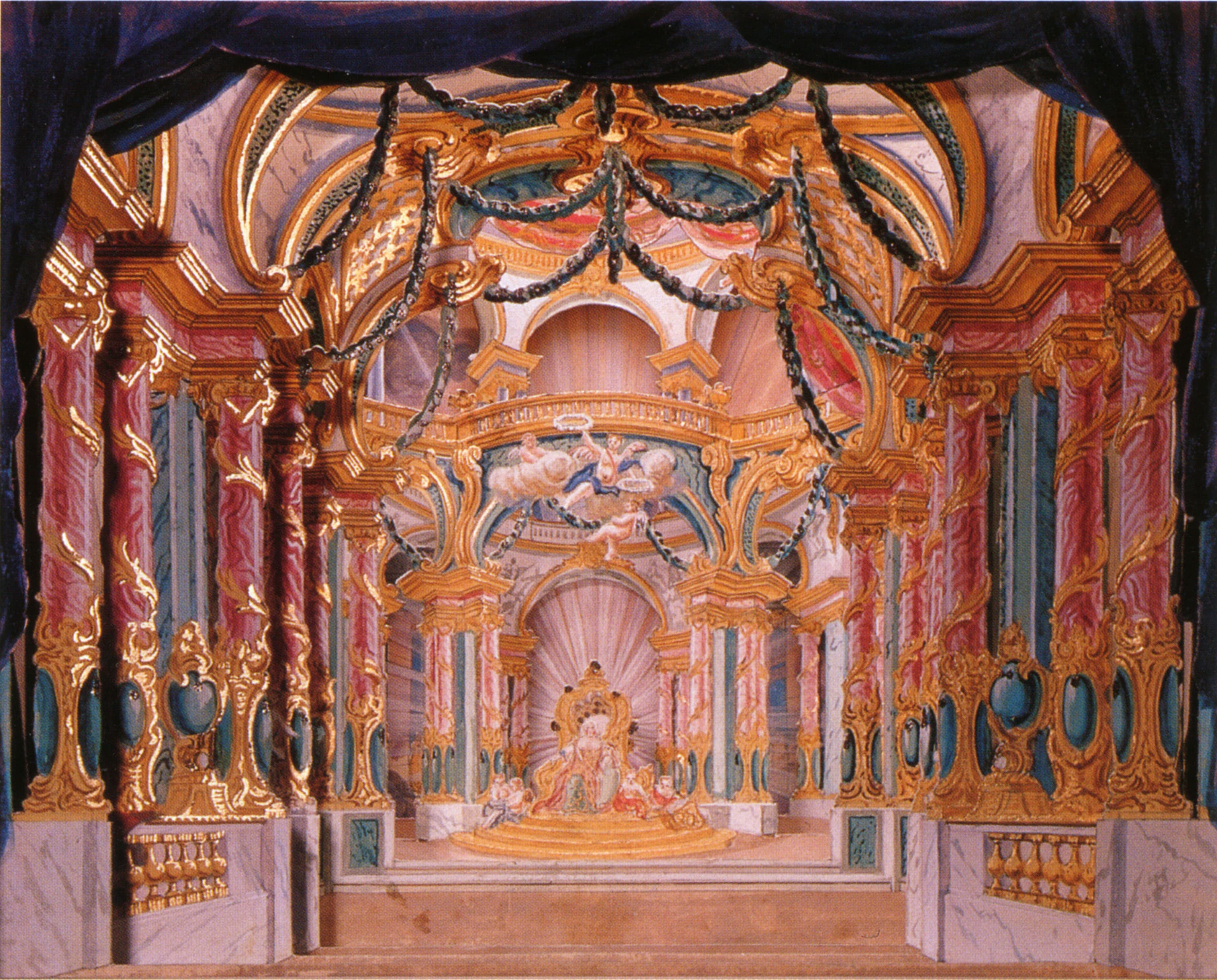
Studio of Piero Bonifazio Algieri (died 1764) VIAF — User scan of Johnson, Victoria (2008). Backstage at the Revolution: How the Royal Paris Opera Survived the End of the Old Regime, plate 7. Chicago: The University of Chicago Press. ISBN 9780226401959. · Public domain
Les fêtes de Paphos (1758)
Les fêtes de Paphos is an opéra-ballet in three acts (entrées) by Jean-Joseph Cassanéa de Mondonville, first given at the Académie royale de musique in Paris on 9 May 1758, where it was a popular success. The printed score labelled it a ballet héroïque, the mid-eighteenth-century French genre that framed mythological love stories through a sequence of largely self-contained acts, each with its own librettist and its own divertissement of song and dance built around a classical myth.
What is danced
The article gives a full synopsis of the sung plot in each act — the myths of Venus and Adonis, Bacchus and Erigone, and Cupid and Psyche — but it does not describe any specific danced number, divertissement, or step vocabulary. Ballet héroïque as a genre conventionally carried entrées de ballet and divertissements danced by the corps alongside the singers, but nothing in this article names such a number, credits a choreographer, or describes what was actually danced in performance, so no movement detail can be responsibly drawn from it.
Context
The work belongs to the French opéra-ballet tradition of the 1740s–50s, the period of Rameau's Les Indes galantes and related ballets héroïques, in which mythological entrées combining song, spectacle and dance were staged at the Paris Opéra. Mondonville drew two of the three acts from earlier works written for Madame de Pompadour's private Théâtre des Petits Cabinets (Erigone, 1747, and Vénus et Adonis, 1752), repurposing court entertainment for the public stage — a common route by which private, aristocratic theatrical material reached the Académie royale de musique.
Staging history
The article records only the 1758 Paris premiere and its success, and a modern studio recording (Les Talens Lyriques under Christophe Rousset, Decca/L'Oiseau-Lyre, 1997); it gives no account of revivals, later stagings, or choreographic reconstructions.
How to watch it
Approach it as an opera first: each act is a near-independent mythological entrée with its own librettist, so watch for how music and myth carry the narrative across the three loosely linked stories of Venus, Bacchus and Cupid. The genre label ballet héroïque signals that danced divertissements would traditionally punctuate the action, but this source gives no detail on where or how those danced passages were staged.
Structure
- Act I · Vénus et AdonisMars, jealous of Adonis, plots against him; Adonis is killed while hunting and turned by Venus into an anemone, before Jupiter resurrects him and reunites him with Venus.
- Act II · Bacchus et ÉrigoneThe nymph Erigone loves Bacchus, who cares only for his own glory, until Jupiter's celebration leads Bacchus to succumb to her charms.
- Act III · L'Amour et PsychéPsyche and Cupid are shipwrecked by the Fury Tisiphone; Psyche drowns, Cupid rescues her from the underworld, and Venus, moved by his fidelity, restores Psyche's beauty and blesses their love.
Structure read from an encyclopaedia article, not from a libretto or score we hold. Confirm against a programme before treating the numbering as authoritative.
Credits
- composer: Jean-Joseph de Mondonville