Campra, André (1660-1744). Compositeur — Bibliothèque nationale de France · Public domain
Les fêtes vénitiennes (1710)
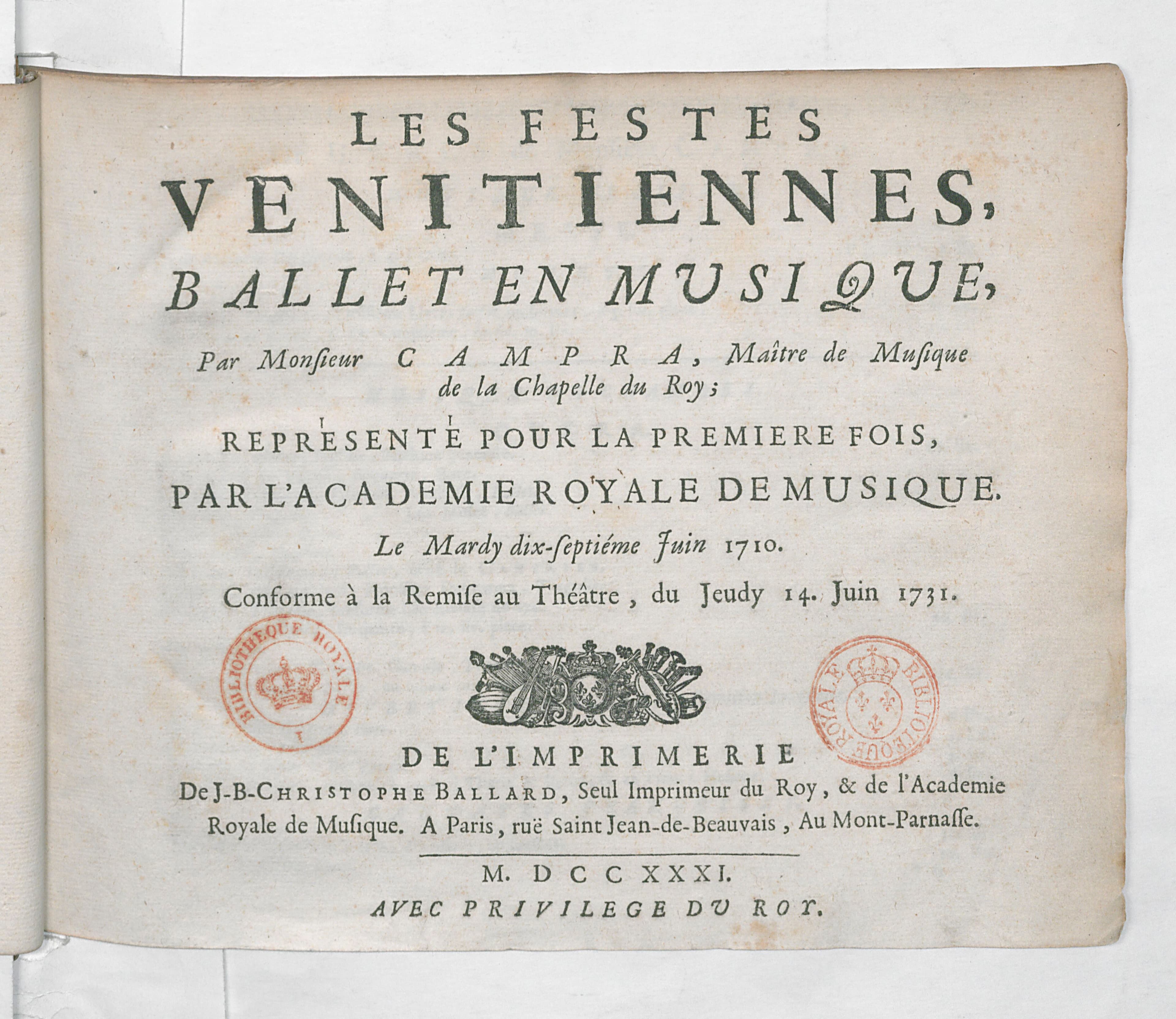
Les fêtes vénitiennes is a French opéra-ballet by André Campra, with a libretto by Antoine Danchet, first performed on 17 June 1710 by the Académie royale de musique at the Salle du Palais-Royal in Paris. Structurally it consists of a prologue and a loosely linked set of self-contained entrées, each with its own plot and characters, tied together only by the notional Venetian setting.
What is danced
The article does not describe what was actually danced in any entrée: it gives no synopsis, no named dances, and no account of steps, holds or technique. What it does establish is the work's genre and structure — a prologue plus a variable number of entrées (the total shifted repeatedly, from two prologues and eight entrées trialled in 1710 down to a settled prologue-plus-four/five-entrée format by December 1710) — and that it was billed in its own time simply as a 'ballet'. Surviving period manuscripts named in the sources (Les Barquerolles Entrée, Feste Marine Entrée, Le Bal) indicate discrete danced or dance-adjacent episodes existed, but the article gives no further detail about their content.
Because opéra-ballet of this period conventionally interleaved sung scenes with instrumental dance airs (courantes, sarabandes, menuets, gavottes and the like) performed by the Opéra's dancers, it is likely such vocabulary was present here too — but this is outside knowledge, not something the article supports with a quotable claim, and no coding can responsibly be attached to it.
Context
Campra and Danchet's piece arrived as Parisian audiences were tiring of the fixed lyric-tragedy mould established by Lully and Quinault, and it became one of the defining early instances of what scholars later named the opéra-ballet: a genre built from loosely connected entrées rather than a single continuous tragic plot, favouring comic and 'realistic' contemporary settings over myth. Its immediate and repeated success — Campra and Danchet reworked it through trial and error across 1710 alone, swapping entrées in and out — helped establish opéra-ballet as a viable, commercially durable alternative to tragédie en musique at the Paris Opéra.
Staging history
The work was revised extensively within months of its premiere: between June and December 1710 the creators tried two prologues and eight entrées in total, reaching a 51st performance on 14 October in a restructured version with a shortened prologue and four entrées, which grew to five by December. It remained in the Opéra's active repertory for half a century, with documented revivals in 1712, 1713, 1721, 1731–1732, 1740, 1750–1751 and 1759, entrées being reshuffled at various points, ultimately accumulating around three hundred performances and giving work to nearly every major artist to appear at the Paris Opéra in that period.
How to watch it
There is no danced synopsis on record here, so approach the work through its structure rather than a fixed sequence of steps: expect a prologue followed by several self-contained entrées, each with independent characters and intrigue, held together only by the Venice setting. Because the entrées were swapped in and out across revivals, any given performance in the eighteenth century might differ substantially in content from another bearing the same title.
Credits
- composer: André Campra