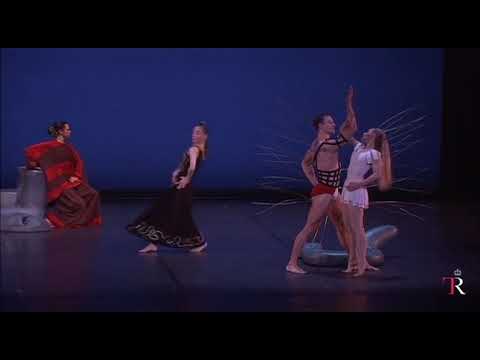
This entry covers Samuel Barber's Op. 23 score, written in 1946 for a Martha Graham commission from Columbia University's Ditson Fund. The ballet it was written for was premiered on 10 May 1946 under the title Serpent Heart, then revised in 1947 and retitled Cave of the Heart — the name 'Medea' survives in our record because Barber kept it for the free-standing orchestral suite he extracted from the score early in 1947, and again for the later concert excerpt Medea's Dance of Vengeance (1955). A reader searching this catalogue under 'Medea' is therefore reaching, at one remove, for a Graham stage work that has carried two other titles for most of its performance history.
What is danced
The article gives almost no step-level detail. What it does establish is dramaturgical rather than technical: Medea and Jason are staged on two simultaneous time-planes, appearing first as 'godlike, super-human figures of the Greek tragedy' who periodically 'step out of their legendary roles' and become 'the modern man and woman, caught in the nets of jealousy and destructive love,' before Medea resumes 'her mythical quality' at the close. The article states plainly that 'in both the dancing and music, archaic and contemporary idioms are used' — a direct textual instruction that the choreography, whatever its vocabulary, deliberately alternates registers rather than sustaining one idiom throughout.
Context
The ballet belongs to the mid-1940s partnership between Martha Graham's company and a circle of American composers and designers commissioned through university and foundation funds — here the Ditson Fund at Columbia. The original cast (Graham herself, Erick Hawkins, Yuriko, May O'Donnell) and the Isamu Noguchi set place the work squarely inside Graham's own company at the height of her mythological-psychological cycle, of which this is one of the best-known examples, alongside her later Clytemnestra.
Staging history
The article traces two lines of afterlife rather than a stage revival history. On the theatrical side, Graham revised the ballet in 1947 and renamed it Cave of the Heart, the title under which it is still generally performed and known in dance repertory. On the concert side, Barber extracted a seven-movement orchestral suite in early 1947, premiered by the Philadelphia Orchestra under Eugene Ormandy on 5 December 1947, and later drew a further concert piece, Medea's Dance of Vengeance, Op. 23a, from the same material in 1955. The article gives no information on later stagings, companies, or revivals of the danced version itself.
How to watch it
Watch for the shifting register the article itself flags: passages where the two central figures hold themselves as remote, legendary forces versus passages where they collapse into recognisably domestic jealousy and betrayal, with the music's archaic and contemporary idioms cueing the change. The attendant figure functions as an onlooking chorus — watch how she frames, rather than joins, the central conflict.
Credits
- composer: Samuel Barber