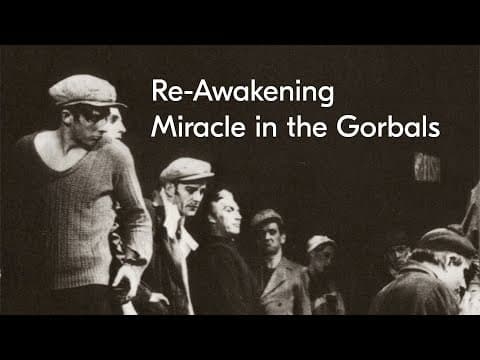
Miracle in the Gorbals
Miracle in the Gorbals is a one-act dramatic ballet made for the Sadler's Wells Ballet in 1944, with a scenario by Michael Benthall, choreography by Robert Helpmann and a score by Arthur Bliss, designed by Edward Burra. It transplants a Christ-like miracle-and-betrayal story into the wartime slums of Glasgow's Gorbals district, with characters drawn from urban poverty: a suicide, a prostitute, a minister, a beggar, street urchins and a mysterious Stranger who raises the dead and is then killed by a mob.
What is danced
The article's synopsis is written almost entirely in terms of dramatic action and mime rather than named steps: characters 'dance' at specific narrative moments (a pair of lovers 'come on and dance', the revived girl 'slowly warms to rebirth and starts dancing') but no vocabulary, holds or technique are described. The structure of the piece can be partly read off Bliss's own seven-movement concert suite drawn from the fifteen ballet numbers -- The Street, The Girl Suicide, The Young Lovers, The Stranger, Dance of Deliverance, Intermezzo, and Finale: The Killing of the Stranger -- which indicates that the ballet moves through discrete set-pieces: a crowd/street scene, a solo or duet for the suicide, a pas de deux for the lovers, a solo for the Stranger, a revival/rebirth dance ('Dance of Deliverance'), and a violent mob finale.
The climax is danced-as-violence rather than as classical steps in the article's telling: the Stranger is surrounded, 'jostled', slashed with knives and kicked to the ground, ending in silence broken by a ship's siren. This is consistent with the British 'dramatic ballet' idiom of the period, which used stylised mime, crowd composition and pantomime-adjacent gesture as much as academic steps to carry a literal plot -- but the article does not give enough concrete technical detail (footwork, partnering, use of pointe, character-shoe work, etc.) to support any taxonomy assignment with confidence.
Context
The ballet was made in wartime Britain for the Sadler's Wells Ballet (forerunner of the Royal Ballet), the company then developing a repertory of home-grown narrative ballets alongside its classical inheritance. A slum setting with a suicide, a prostitute and mob violence was unusual subject matter for ballet audiences of the day, and the work sits alongside other Helpmann narrative pieces of the period as part of a push toward socially engaged, literary and dramatic ballet-making distinct from the fairy-tale classicism of the nineteenth-century repertory.
Staging history
The Sadler's Wells Ballet performed Miracle in the Gorbals every season from 1944 to 1950 and revived it again in 1958, including a Paris performance, but pointedly did not perform it in Glasgow itself during a 1945 Scottish tour. It then dropped out of the repertory until 2014, when Birmingham Royal Ballet revived it under the direction of Gillian Lynne, who had danced in the original 1944 corps; the revival is credited to the efforts of David Drew, a Royal Ballet dancer of over fifty years' standing.
How to watch it
Watch the crowd scenes for how the ensemble (urchins, drunks, the minister, the beggar) is used to build and shift mob sentiment, since the plot turns on collective reaction rather than solo virtuosity. Note the contrast between the lyrical passages -- the lovers' duet, the prostitute's visionary movement after the Stranger leaves her room -- and the pantomimic build toward the final killing, staged in near-silence and broken only by a ship's siren.
Credits
- composer: Arthur Bliss