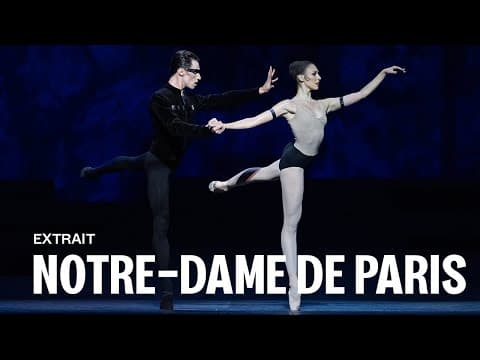
Notre-Dame de Paris is a full-length narrative ballet by Roland Petit, based on Victor Hugo's 1831 novel The Hunchback of Notre-Dame, with a score by Maurice Jarre. It premiered with the Paris Opera Ballet in 1967 and marked Petit's return to the company he had left two decades earlier, this time as the maker of an original full-evening work rather than as a dancer.
What is danced
The article does not describe the choreography itself — no scene-by-scene account of steps, lifts, or vocabulary survives in the source. What it does establish is the production's shape: a story ballet built around four principal roles (Esmeralda, Quasimodo, Frollo, Phoebus) danced against designs by René Allio and costumes by Yves Saint Laurent, with Petit himself originating the role of Quasimodo. That casting detail is worth noting for anyone studying the work in performance — the choreographer built the central physical role on his own body, which typically means a demanding, character-driven movement profile rather than a purely virtuosic one, though the article gives no specifics of what that vocabulary was.
Context
The premiere came at a moment when Petit, having spent twenty years running his own companies and working in film and revue after leaving the Paris Opera Ballet, returned to the institution to make his first work for it. The article frames this as a significant re-entry for Petit into French state ballet, but offers no further detail on how the piece related to the choreographic currents of 1967 France.
Staging history
The ballet has stayed in repertory since 1967. The article records performances at the Opéra national de Paris at the Opera Bastille at the end of the 2013–2014 season, and a separate 2013 production at the Teatro alla Scala in Milan, indicating the work has travelled beyond its originating company.
How to watch it
Pay attention to how the central role of Quasimodo is built physically, since Petit created it on himself; this is usually a sign the role is written around a specific dramatic body rather than generic ballet lines. Beyond that, the source gives no guidance on step vocabulary or set pieces to watch for, so approach any staging expecting a full-length narrative treatment of the Hugo story rather than a plotless or abstract work.
Credits
- composer: Maurice Jarre