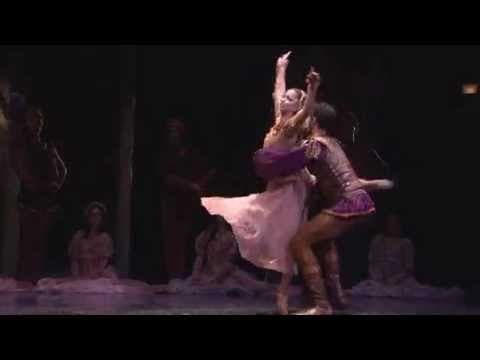
Othello (1997)
This is a full-evening dramatic ballet retelling Shakespeare's Othello, made for American Ballet Theatre and San Francisco Ballet with an original orchestral score by Elliot Goldenthal (better known for his film scores). The article credits the choreography to Lar Lubovitch and dates the original production to 1997; our record holds neither fact, so both are flagged below as research leads rather than written in as settled.
What is danced
The article does not describe the actual steps, holds or technique used on stage — it is built almost entirely around the commercially released score and its track listing, which functions as the ballet's own act-and-number spine. That listing tells us the work is structured as a sequence of named dance numbers rather than continuous mime-narrative: a Sarabande and a Formal Court Dance frame Act I alongside character vignettes for Cassio and for Iago and Emilia, Act II is anchored by an extended, fourteen-minute Tarantella following a Storm and Ships' Arrival, and Act III moves through a set called Lies and Variations (which includes an Othello solo), Desdemona's Prayer, and a closing Adagietto and Coda Agitato. This naming pattern — using historical dance forms (sarabande, tarantella) and formal court/character dance titles as scene headings — is strong circumstantial evidence that the choreography leans on stylised period and character dance for its public/ceremonial scenes and on solo and duet 'variation' forms for the psychological material (Othello's solo, the Adagietto), but the article gives no description of the vocabulary itself, so none of this can be coded to a specific taxonomy style with confidence.
Context
The article situates the piece as a joint commission between American Ballet Theatre and San Francisco Ballet with an original score by a composer who came to ballet from film music — the piece is framed by the article's own commentary as unusually complex for Goldenthal because he had to supply not just music but 'ambience' and set the dancers' pace and rhythm, i.e. write a score that functions structurally as much as atmospherically. Beyond this, the article gives no wider account of the ballet landscape the piece entered.
How to watch it
Because the score's own track titles double as the ballet's scene headings, a viewer can use them as a map: watch for a shift from ensemble/character numbers (Carnival Dance, Formal Court Dance, the Tarantella) toward solo and duet 'variation' writing in Act III (Othello's Solo Dance, the Adagietto), which the naming suggests is where the ballet turns from public spectacle to interior psychological drama. The article gives no further guidance on staging conventions, so beyond this structural cue there is nothing here to confirm what house style or technique is being used.
Structure
- Act IAct I is structured, per the score's track listing, as a Sarabande, Entrada, Carnival Dance, a Cassio number, a Formal Court Dance, a duet for Othello and Desdemona, a Zigzag Dance, and a duet for Iago and Emilia.
- Act IIAct II consists of a Storm and Ships' Arrival followed by an extended Tarantella.
- Act IIIAct III comprises Lies and Variations (including Iago and Othello and Othello's Solo Dance), Desdemona's Prayer, and a closing Adagietto and Coda Agitato.
Structure read from an encyclopaedia article, not from a libretto or score we hold. Confirm against a programme before treating the numbering as authoritative.
Credits
- composer: Elliot Goldenthal