Albert Roussel, Louis Laloy — Padmâvatî - program booklet, Theater Dortmund 1997 · Public domain
Padmâvatî (1923)
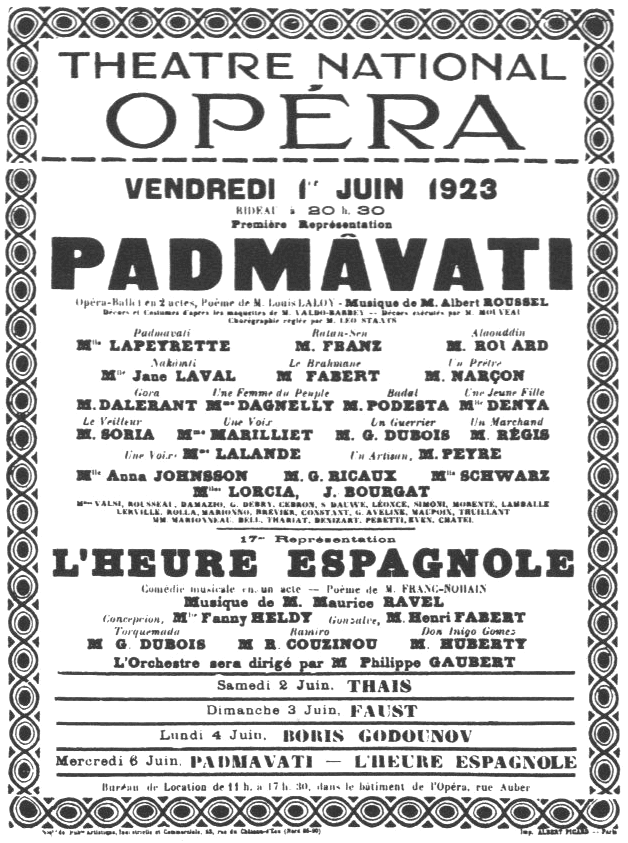
Padmâvatî is a two-act opera by Albert Roussel, with a libretto by Louis Laloy after Théodore-Marie Pavie's La légende de Padmanî, reine de Tchitor, itself a retelling of the sixteenth-century Indian poem Padmavat. It premiered at the Paris Opéra on 1 June 1923, telling of the siege of Chittor, the Khilji sultan Alaouddin's demand for the queen Padmâvatî, and her self-immolation rather than surrender.
What is danced
The article states plainly that Roussel 'styled the work an opéra-ballet and there are many dance numbers and opportunities for spectacle,' which is the only thing it tells us about dance in this piece. It does not name a choreographer, describe any step vocabulary, identify which moments in Act One or Act Two carry the dance numbers, or say whether the dancing is diegetic (temple ritual, court entertainment) or purely spectacular filler around the sung drama. Roussel's score incorporates 'many features of Indian music,' drawn from his visit to the ruined city of Chittor, which strongly implies the danced sections leaned on evocations of Indian courtly or devotional movement rather than a standard nineteenth-century divertissement vocabulary — but this is an inference from the music cue in the article, not a documented account of choreography, and should be treated as such.
Context
The article does not describe the dance world Roussel was writing into, beyond noting his own visit to Rajputana as the source of the music's local colour. The term 'opéra-ballet' itself points back to an older French court tradition of alternating or fused sung and danced scenes, which Roussel revives here at the Paris Opéra in 1923, but the article gives no detail on how the 1923 production actually staged or choreographed that hybrid.
How to watch it
Listen for where Roussel's Indian-inflected orchestral writing takes over from the sung scenes — those are the likeliest points where the 'dance numbers and opportunities for spectacle' the article mentions would fall, particularly around the siege and temple scenes of Act Two. Because no production or choreographic record survives here, treat any staged dance content as a directorial choice rather than an inherited tradition.
Structure
- Act IAlaouddin besieges Chittor, is shown the city by Ratan-Sen, and demands to see and then possess Padmâvatî, refusing peace otherwise.
- Act IIThe Khilji army attacks; the wounded Ratan-Sen is stoned to death and Padmâvatî joins him on his funeral pyre rather than submit to Alaouddin.
Structure read from an encyclopedia article, not from a libretto or score we hold. Confirm against a program before treating the numbering as authoritative.
Credits
- composer: Albert Roussel