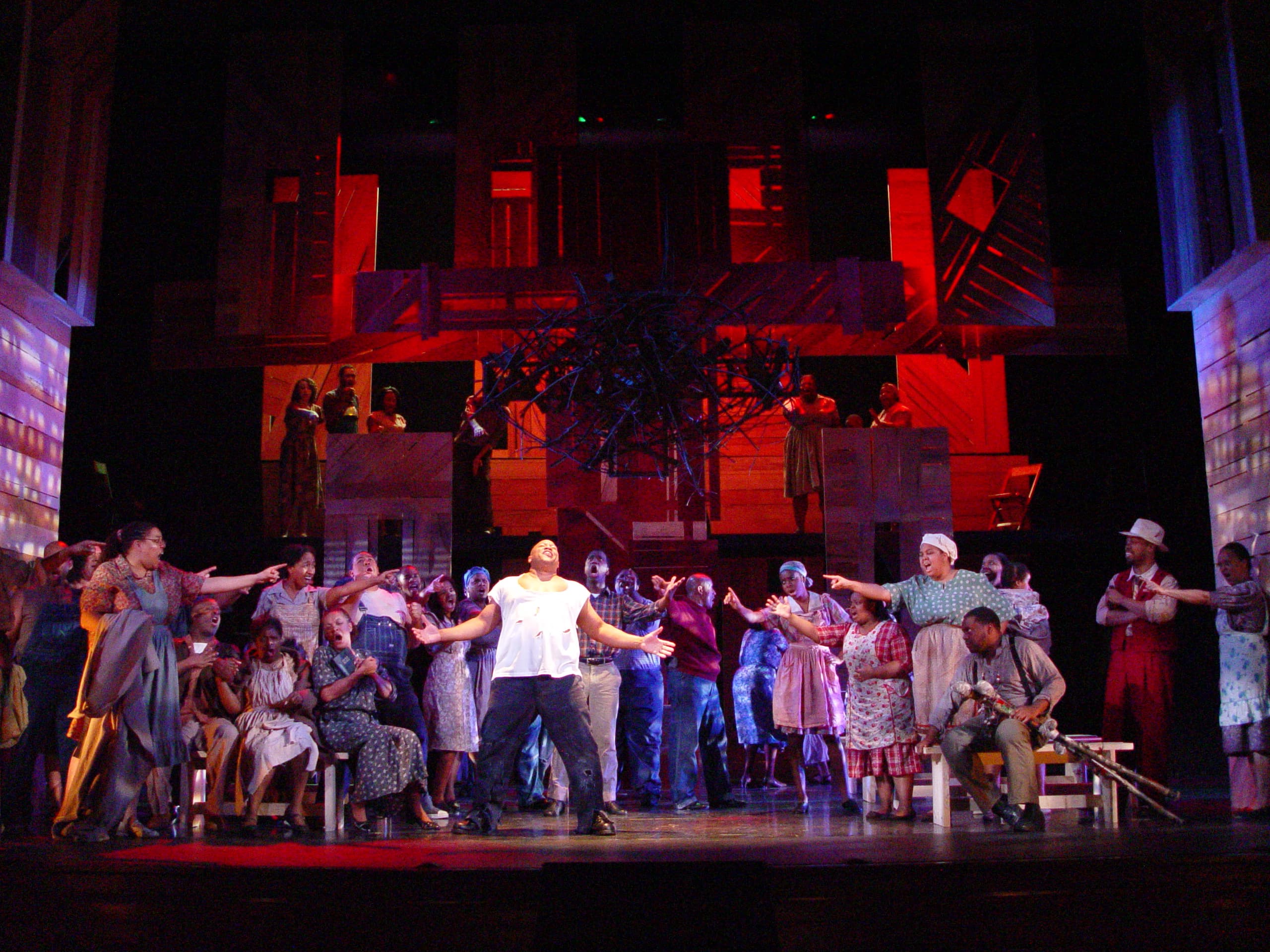
Porgy and Bess is George Gershwin's 1935 opera, with libretto by DuBose Heyward and lyrics by Ira Gershwin, adapted from Heyward's novel and the Heyward/Heyward play Porgy. Set among the Black tenement community of Catfish Row in Charleston, it follows the disabled beggar Porgy's rescue of Bess from her violent lover Crown and the drug dealer Sportin' Life, told through a score that fuses spirituals, blues, work songs and street cries with operatic recitative and aria.
What is danced
The source article is a musical and production history of the opera and does not describe choreography, dance vocabulary, or named dance numbers in any staging. Its synopsis is built around songs ("Summertime", "I Got Plenty o' Nuttin'", "It Ain't Necessarily So") and stretches of recitative, not movement. The one phrase that brushes against dance — Sportin' Life "waltzes around selling 'happy dust'" during Act 2 — is a narrative turn of phrase describing his swagger, not a documented set piece with steps or hold, and is not strong enough evidence to assign a ballroom-waltz code to it.
Our record credits Hermes Pan as choreographer at the 1935 premiere, but the article makes no mention of him anywhere; the 1935 Boston and Broadway production it describes was staged and directed by Rouben Mamoulian, with Alexander Smallens as music director and Eva Jessye as choral director. No choreographer is named for any of the productions the article covers, including the 1976 Houston Grand Opera staging, the Met productions, or the Nunn and Paulus musical-theatre adaptations. Anyone approaching this entry for dance research should treat it as an opera/musical-theatre hybrid whose danced content, if any, is not documented in this source.
Context
Porgy and Bess arrived in 1935 at a moment when Broadway, opera and jazz idioms were being deliberately blurred: Gershwin called it a "folk opera" and insisted, unusually for the period, on a classically trained all-Black cast rather than white singers or blackface, a decision the article frames as "a daring artistic choice at the time." The physical life of the piece as described — the craps game and brawl of "Roll them Bones," the communal picnic number "Oh, I can't sit down," the hurricane-shelter scene — suggests ensemble stage business and crowd choreography typical of 1930s musical theatre and opera staging, but the article gives no technical detail about how any of it was moved.
Staging history
The opera premiered in Boston on September 30, 1935, transferring to the Alvin Theatre on Broadway on October 10, 1935, directed by Rouben Mamoulian; a shortened, more song-driven version was mounted by Cheryl Crawford in 1942, and a fuller touring version by Blevins Davis and Robert Breen in 1952 toured internationally including Leningrad and La Scala. The Houston Grand Opera's 1976 production restored Gershwin's complete original score for the first time and won a Tony Award, reshaping the work's critical reception; it was followed by Metropolitan Opera productions from 1985, a scenically expanded Trevor Nunn staging at Glyndebourne in 1986, and two later musical-theatre adaptations retitled The Gershwins' Porgy and Bess — Nunn's 2006 London version and Diane Paulus's 2011–2012 Broadway version (book by Suzan-Lori Parks), the latter winning the 2012 Tony for Best Revival of a Musical. None of these accounts name a choreographer.
How to watch it
Watch the ensemble crowd scenes — the Catfish Row craps game, the Kittiwah Island picnic, and the hurricane shelter — for how a production stages communal movement around Gershwin's choral numbers, since the article documents these as sung set pieces rather than choreographed ones. Different eras of production (1935 sung-through original, 1942 and later versions with spoken dialogue replacing recitative) will differ sharply in how much continuous musical staging versus spoken scene work a viewer sees.
Structure
- Act I · Scene 1Catfish Row on a summer evening: Clara sings 'Summertime,' a craps game turns violent when Crown kills Robbins, and Porgy takes in the abandoned Bess.
- Act I · Scene 2Serena's room, the night after: mourners raise burial money for Robbins ('Overflow'), a detective threatens the community, and Bess is welcomed into the fold.
- Act II · Scene 1A month later at Catfish Row: Porgy sings 'I Got Plenty o' Nuttin'', Bess and Porgy declare their love, and the community leaves for a church picnic.
- Act II · Scene 2Kittiwah Island picnic: Sportin' Life sings 'It Ain't Necessarily So'; Crown corners Bess and forces her to stay with him.
- Act II · Scene 3A week later: Bess recovers from fever and pledges herself to Porgy in 'I Loves You, Porgy' as a hurricane approaches.
- Act II · Scene 4Serena's room during the hurricane: the community prays while Crown, having swum from Kittiwah, taunts them and goes out into the storm after Clara.
- Act III · Scene 1The community mourns the storm's dead; Porgy kills Crown in a confrontation over Bess.
- Act III · Scene 2Porgy is detained as a witness in Crown's murder; Sportin' Life lures Bess with happy dust and a picture of life in New York.
- Act III · Scene 3Porgy returns from jail to find Bess has left for New York with Sportin' Life, and sets out after her in 'Oh, Lawd, I'm on my way'.
Structure read from an encyclopaedia article, not from a libretto or score we hold. Confirm against a programme before treating the numbering as authoritative.