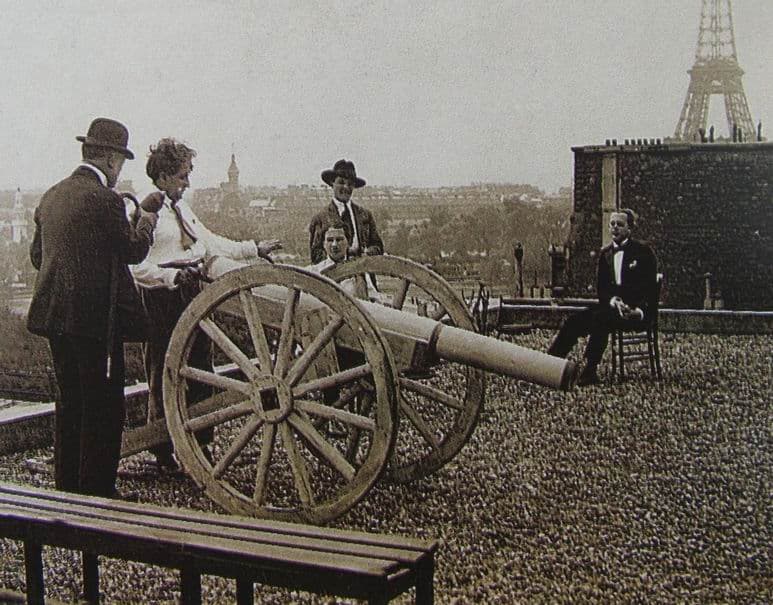
UnknownUnknown Photograf на съёмках фильма "RELACHE" — Book: Anne Rey. Satie. Solfeges Seuil, Paris 1995. Originally uploaded in ruwiki by ru:Участник:Финитор as ru:Файл:Satie_&_Picabia,_Clair_&_Biorlin_(prologue_de_Relache).jpg. · Public domain
Relâche
Relâche is a 1924 stage work billed as a "ballet obscène," created by the painter and Dadaist Francis Picabia with a score by Erik Satie, and staged by the Ballets Suédois. It belongs to dance history less as a piece of danced vocabulary than as a documented Dada intervention into the ballet stage: the title itself is the French word posted outside theatres to announce a cancellation, and the joke was made real when the scheduled premiere had to be called off.
What is danced
The source article does not describe what was actually danced — there is no synopsis, cast of characters, scene breakdown, or account of steps, holds, or technique. What it documents instead is the production's conceptual apparatus: a Dada-authored 'ballet obscène' with a Satie score, a cancelled premiere turned into part of the work's meaning, and a cinematic entr'acte (René Clair's Entr'acte) inserted into the intermission and featuring Picabia, Satie and other artists as performers on film rather than on stage. Because the article gives no movement detail, no set-piece descriptions, and no numbers or scenes to anchor a style claim, this entry cannot responsibly assign danced vocabulary to any part of the work.
Context
The mid-1920s Ballets Suédois, under Jean Börlin, was one of the vehicles through which the Parisian avant-garde — Dada and early Surrealist circles among them — pushed at the edges of what a 'ballet' could be, collaborating with painters, poets and composers rather than treating ballet as a self-contained classical tradition. Relâche sits in that lineage: a painter (Picabia) as author, a composer (Satie) already known for anti-illusionist scores, and a film interpolation (Clair's Entr'acte) that blurred the line between stage spectacle and cinema. The joke embedded in the title — and its accidental fulfilment when the first performance was cancelled — is itself a Dada gesture aimed at theatrical convention, independent of whatever choreography was actually performed.
Staging history
The premiere scheduled for 27 November 1924 was cancelled because principal dancer, choreographer and artistic director Jean Börlin fell ill; the work went on to be given thirteen times between 4 and 31 December of that year. It then disappeared from the stage until a revival in 1970, and did not reach the United States until 1980, when the Joffrey Ballet in New York staged it under the direction of Moses Pendleton.
How to watch it
Because the article supplies no choreographic detail, a viewer or reader should attend to the framing gestures rather than to step vocabulary: the title's double meaning as both work and cancellation notice, the fact that Börlin was simultaneously its principal dancer, choreographer and artistic director, and the insertion of René Clair's film Entr'acte as a discrete cinematic interruption of the live performance. Any account of what was actually danced onstage would need a source beyond this article.
Credits
- composer: Erik Satie