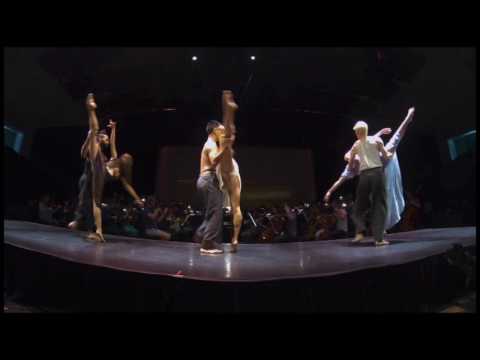
Rift (2016)
Rift is a three-act ballet score composed by Anna Clyne in 2016 for a large orchestra, made in collaboration with choreographer Kitty McNamee. It was commissioned by the Cabrillo Festival of Contemporary Music and premiered there under conductor Marin Alsop; the piece runs roughly 25 minutes across three linked movements titled 'dust', 'water' and 'space', played without pause.
What is danced
The source article is a music-critical account of the score and its reception, not a record of the choreography. It does not describe steps, holds, technique, partnering, or stage action of any kind — no synopsis, no cast list of roles, no description of how McNamee's movement responded to the three named sections. One reviewer (David Nice) notes that he 'hadn't expected the trajectory... to be hard to make out' and mentions 'non-irritant stage and hall lighting', which confirms a staged production existed but tells us nothing about what was danced. Because the article gives no movement evidence, no dance vocabulary can be responsibly attributed to this entry from this source alone.
Context
Anna Clyne was, at the time, an established orchestral composer working increasingly with theatrical and choreographic commissions; the Cabrillo Festival of Contemporary Music, under Marin Alsop, was a venue oriented toward new orchestral repertoire rather than a ballet company's home stage, which situates Rift as a contemporary-music-festival commission that happened to take balletic form rather than a work originating inside a ballet company's repertoire cycle. The article frames the piece's conception around Clyne's own programme note about 'the chaos and destruction... prevalent in the world today,' suggesting a topical, abstract rather than narrative premise typical of contemporary concert-hall ballet collaborations of the mid-2010s.
How to watch it
Because the surviving account is musical rather than choreographic, attend first to the score's three-part arc — 'dust', 'water', 'space' — played without pause, and to whether the staging (lighting is described as 'non-irritant') makes that trajectory legible in the body, a point one critic explicitly found unclear even in the pit. There is no confirmed technique or idiom to watch for based on this source; any expectations about pointe work, contemporary release, or narrative mime would be speculation not supported by the article.
Structure
- Act I · dustFirst of three linked movements played without pause; no synopsis of stage action is given in the article.
- Act II · waterSecond of three linked movements played without pause; no synopsis of stage action is given in the article.
- Act III · spaceThird of three linked movements played without pause; no synopsis of stage action is given in the article.
Structure read from an encyclopaedia article, not from a libretto or score we hold. Confirm against a programme before treating the numbering as authoritative.
Credits
- composer: Anna Clyne