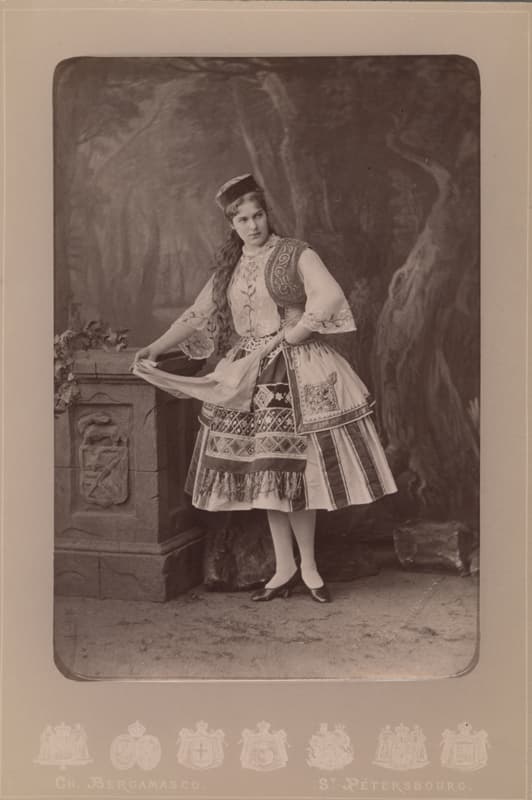
Unknown author — Государственный академический Мариинский театр · Public domain
Roxana, the Beauty of Montenegro
Roxana, the Beauty of Montenegro is a four-act 'fantastic ballet' made for the Imperial Ballet in St Petersburg, with choreography credited to Marius Petipa, a score by Ludwig Minkus, and a libretto written jointly by Petipa and the journalist-historian Sergei Khudekov. It premiered in 1878, its Montenegrin subject chosen to coincide with Montenegro's recent liberation from Ottoman rule by the Russian army — one of several Petipa-Minkus works of the period built around current events and exotic or patriotic settings for the imperial stage.
What it contains
- Grand March — Grand Marche · Act III, the 'Grand Marche' — A named ceremonial/processional march number in Act III; the article documents it only as a piece of music of exceptional fame, not its steps or staging, so its classification as a danced grand march is an inference from the form's typical use in Petipa-era imperial ballets. Source: "Minkus' "Grand Marche" from the third act of this ballet"
What is danced
The article supplies almost no detail on choreography, steps, or technique. The single concrete piece of repertory information it gives is that Act III contained a 'Grand Marche' by Minkus, described by the ballet historian Konstantin Skalkovsky as Tsar Alexander II's favourite piece of music and famous enough that Russian troops reportedly marched to it during the storming of Plevna. This places at least one substantial ceremonial or processional number in the third act, consistent with the grand-scale ensemble marches that closed or punctuated acts in Petipa's imperial productions, but the article does not describe its floor pattern, dancers, or vocabulary.
Context
The ballet belongs to the productive Petipa-Minkus partnership at the Imperial Bolshoi Kamenny Theatre in the 1870s, when the Imperial Ballet regularly staged large-scale narrative works tied to contemporary political events — here the Russo-Turkish War and Montenegro's liberation from the Ottoman Empire. Minkus's score for this ballet, and specifically its Act III march, is recorded as having circulated beyond the theatre into military use, an unusually direct instance of a ballet score entering wider public and patriotic life.
How to watch it
Little survives in this record to guide a viewing beyond attention to Act III, where the 'Grand Marche' sat; watch for how such Petipa-era set marches typically organize large ensembles in processional or ceremonial patterns rather than virtuosic solo work. Because no synopsis or full number list is preserved here, treat any staged revival's choreography as a reconstruction rather than a transmitted text.
Structure
- Act III · Grand MarcheA march by Minkus in the third act, singled out by ballet historian Konstantin Skalkovsky as a favourite of Tsar Alexander II and reportedly used by Russian troops during the storming of Plevna.
Structure read from an encyclopedia article, not from a libretto or score we hold. Confirm against a program before treating the numbering as authoritative.
Credits
- composer: Ludwig Minkus