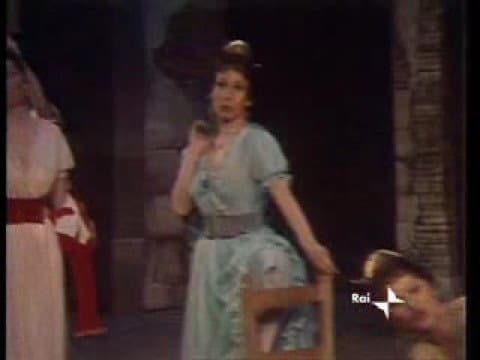
Rugantino is a Roman-dialect musical comedy written by Pietro Garinei and Sandro Giovannini, with a score by Armando Trovaioli, that opened at the Teatro Sistina in Rome on 15 December 1962. It belongs to the postwar Italian genre of "commedia musicale" — song-and-sketch theatre built around a commedia dell'arte stock figure, here transplanted into papal Rome of the 1830s, with a cast led by Nino Manfredi and Aldo Fabrizi.
What is danced
The article does not describe the choreography of the production at any point: the synopsis is plot-only and the song list gives titles without staging notes. Several titles name traditional Italian forms that imply movement content — "Saltarello" is a historical Italian couple/festival dance, and "Stornelli e finale" and "Carnevale" point to a Roman folk-song and carnival idiom — but nothing in the source text tells us how these were staged, what steps or holds were used, or which cast members danced them. Because our own record credits two choreographers (Dania Krupska and Gino Landi) whom this article never names, we cannot connect their work to any specific number here using this source alone. A genuine dance-content entry for this work would need a different source — a programme, a review describing the staging, or choreographic notes — before any vocabulary can be coded with confidence.
Context
Commedia musicale, the genre Garinei and Giovannini effectively founded and to which Rugantino belongs, was Italy's answer to Broadway and West End musical comedy: song, spoken sketch and popular vernacular theatre built around a star comic performer rather than integrated dance-driven storytelling. Its 1964 Broadway transfer, with an English translation projected as surtitles above the stage rather than sung, is an early instance of a non-English-language musical attempting a Broadway run largely on the strength of its music and stars rather than its choreography — which may explain why choreographic detail is thin in accounts of the show.
Staging history
The original 1962 Teatro Sistina cast included Nino Manfredi as Rugantino, Aldo Fabrizi as the executioner Mastro Titta, Lea Massari (later replaced by Ornella Vanoni) as Rosetta, and Bice Valori as Eusebia; a second Italian edition recast the leads with Enrico Montesano and Alida Chelli. The show also played Toronto and New York, opening at the Mark Hellinger Theatre in February 1964 in a translation by Alfred Drake with lyrics by Edward Eager, using surtitles projected above the stage; the New York Times reported the American run's losses at $300,000.
How to watch it
Attend to the show as sung-and-spoken Roman vernacular comedy first: the numbers named for traditional forms (Saltarello, Stornelli) signal where folk-dance or carnival-style ensemble movement would plausibly sit within the score, even though the source gives no staging description. In the New York run, watch for the surtitle convention itself — the English text was projected above the stage rather than sung, an unusual bilingual staging choice for a Broadway house of the period.