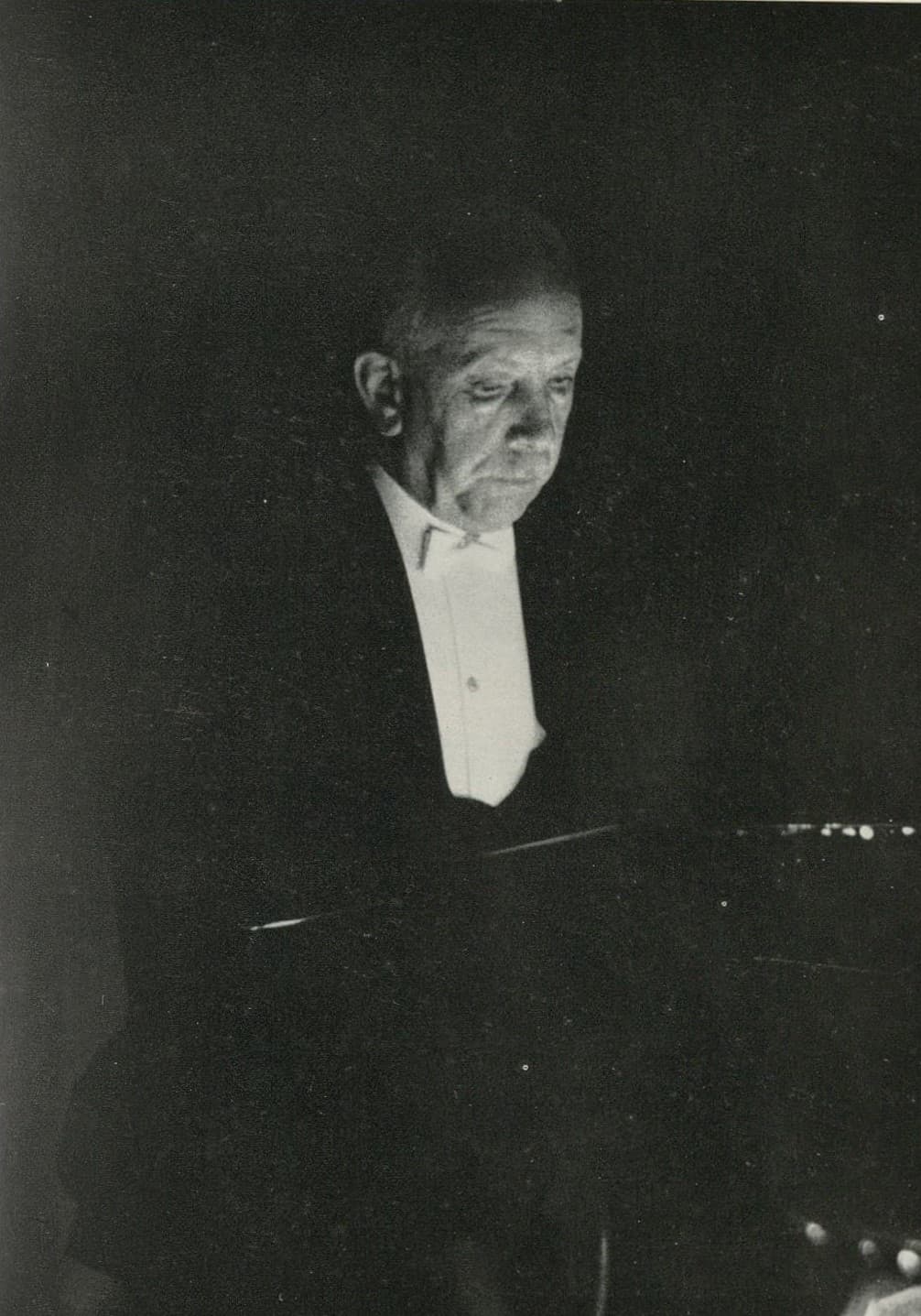
Erich Salomon — Erich Salomon: Berühmte Zeitgenossen in unbewachten Augenblicken. Stuttgart : Engelhorn, 1931 · Public domain
Schlagobers (1924)
Schlagobers ("Whipped Cream"), Op. 70, is a two-act ballet with libretto and score by Richard Strauss, composed in 1921–22 and premiered at the Vienna State Opera on 9 May 1924 as part of the official celebrations of Strauss's sixtieth birthday. It was made while Strauss was co-director of the Vienna State Opera, as one of a series of productions with choreographer Heinrich Kröller intended to revive a ballet company that had struggled after the fall of the Austro-Hungarian monarchy.
What is danced
The article gives a scenario rather than a step-by-step account of the choreography: children at a confirmation party in a Viennese cake shop watch the confections come to life, with "marzipan marches and chocolate dances"; a boy who has overindulged hallucinates a court presided over by Princess Pralinée, a trio of anthropomorphised liqueurs standing in for France, Poland and Russia, and a riot of cakes eventually calmed by beer. This is a pantomime-ballet structure built on character numbers and divertissements rather than a single sustained technique, comparable in shape to The Nutcracker, but the article does not describe the actual steps, holds or technique used in any of these numbers.
Context
Strauss took on this project as co-director of the Vienna State Opera (1919–1924), a period in which he was trying to rebuild the fortunes of the resident ballet company after the collapse of the Austro-Hungarian monarchy. He brought in Heinrich Kröller from the Berlin State Opera and, alongside Schlagobers, the pair restaged Josephslegende and arranged ballets from music by Schumann, Couperin, Beethoven and Gluck (Karneval, Ballettsoirée, Die Ruinen von Athen, Don Juan). Schlagobers was the most ambitious of these efforts, timed to Strauss's sixtieth-birthday celebrations, and its scenario's resemblance to a Konditorei-set Nutcracker is noted in the article, with the wry observation that the Tchaikovsky ballet itself had not yet reached Western stages.
Staging history
Kröller's original choreography survives only partially, through drawings and dance notation, alongside sketches for the 287 costumes and sets; the production's extravagant cost (some four billion Kronen against two hundred million for a contemporary Rienzi staging) earned it the nickname Milliardenballett, or "billionaire's ballet," and contributed to its poor initial reception amid hyperinflation and food shortages. The next staging recorded in the article is American Ballet Theatre's, mounted in 2017 at the Metropolitan Opera in New York with new choreography by Alexei Ratmansky and designs by Mark Ryden, subsequently shown at the Kennedy Center and the Hong Kong Arts Festival.
How to watch it
Watch for the shift from the confectionery genre-scene of Act I (marzipan, chocolate, the confirmation party) into the fever-dream court of Princess Pralinée and the three liqueur suitors, since the work pivots from decorative character dance to a more satirical, almost political allegory once the boy falls ill. Because Kröller's own choreography is only fragmentarily documented, any modern viewing (such as the Ratmansky staging) reflects a new choreographic reading of Strauss's scenario rather than a restaged original.
Credits
- composer: Richard Strauss